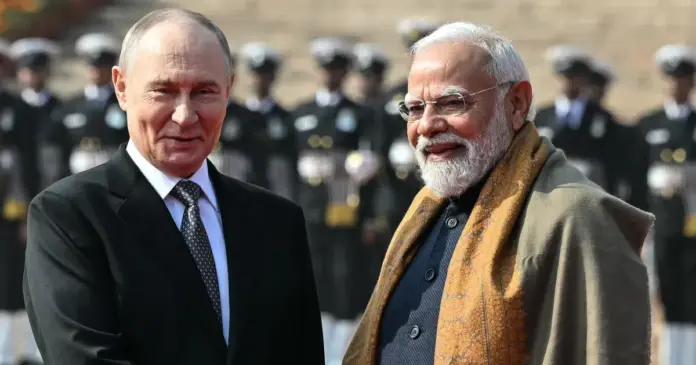
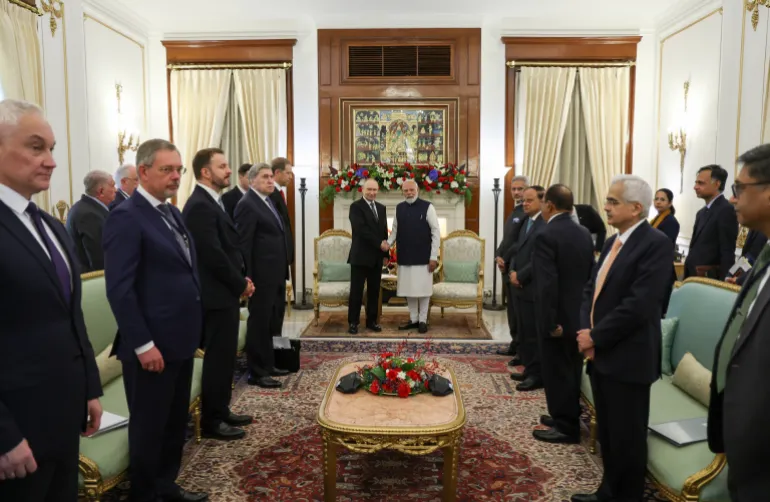
A sweeping military logistics agreement between Russia and India came into force on January 12, granting both nations unprecedented access to each other’s military installations and marking a significant shift in the strategic architecture of the Indo-Pacific.
The Reciprocal Exchange of Logistics Support (RELOS) agreement, originally signed in Moscow in February of the previous year following eight years of negotiations, was ratified by Russian President Vladimir Putin under federal law on December 15. The pact will remain active for five years, with provisions for extension by mutual consent.
Under its terms, each country may station up to 3,000 troops, five warships, and ten military aircraft on the other’s territory. Both sides gain access to military bases, naval ports, and airfields during peacetime and wartime alike, with the agreement also covering refuelling, repairs, supplies, air traffic control, navigation support, and aircraft security.
The deal carries historic weight for India. The world’s most populous country has, for the first time, permitted a foreign military to temporarily station soldiers on its soil — a threshold New Delhi had never previously crossed in any bilateral defence arrangement.
For Moscow, the strategic prize is equally significant. Russia currently holds no military bases or infrastructure in the Indian Ocean, and the RELOS agreement provides a pathway into one of the world’s most contested maritime regions. In return, India gains access to ports along the northern sea route stretching from Vladivostok to Murmansk, opening an Arctic corridor that could prove valuable for trade and naval operations.
The agreement deepens a defence relationship that stretches back decades. Russia has served as a major arms supplier to India since the 1960s, and the majority of India’s current military arsenal remains Russian-made. That dependency has only grown more politically charged since Russia’s invasion of Ukraine in February 2022, after which India became one of the largest buyers of discounted Russian crude oil — a decision that drew a punitive 25 percent additional trade tariff from the administration of US President Donald Trump.
Yet New Delhi shows little sign of abandoning its carefully calibrated balancing act. India describes its foreign policy approach as a ‘multi-alignment’ strategy — maintaining substantive partnerships across competing great powers rather than anchoring itself exclusively to any single bloc. That posture is reflected in the country’s parallel defence architecture with Washington.
India signed the Logistics Exchange Memorandum of Agreement (LEMOA) with the United States in 2016, enabling mutual access to military logistics and refuelling facilities. A separate US-India pact facilitates the sharing of encrypted and high-technology communication systems between the two militaries. Crucially, however, neither American agreement grants the United States the right to station troops, aircraft, or warships on Indian soil — a provision that RELOS uniquely extends to Russia.
The timing of the agreement’s entry into force adds a layer of geopolitical complexity. Trump returned to the White House in January of last year, bringing with him a transactional approach to alliances and a willingness to penalise partners who maintain economic ties with Moscow. Washington’s reaction to the RELOS agreement’s activation is likely to test the durability of US-India relations, particularly as competition with China intensifies across the Indo-Pacific and both Washington and Moscow seek to consolidate influence in the region.
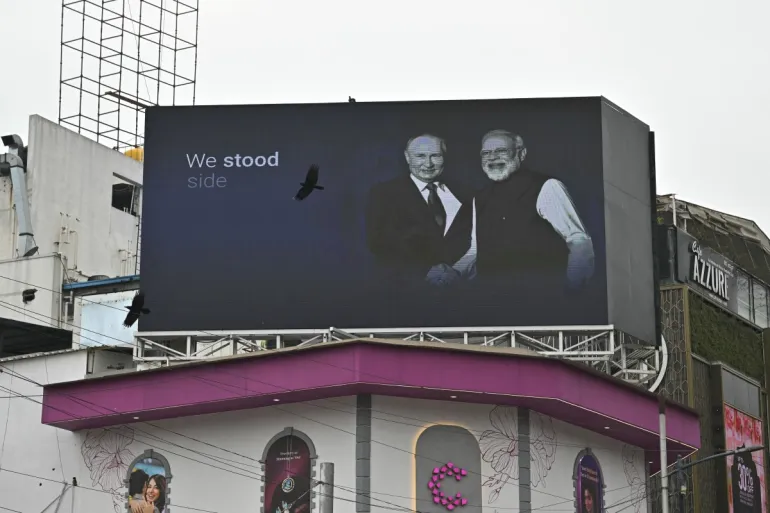
Analysts note that Russia’s access to Indian Ocean ports and airfields, even on a limited and conditional basis, represents a meaningful expansion of Moscow’s global military reach at a moment when Western sanctions have sought to isolate it. For India, the arrangement offers logistical depth and continued access to Russian defence platforms, while reinforcing New Delhi’s insistence that it will not be drawn into any single-power orbit.
The agreement’s five-year framework, with its built-in renewal mechanism, suggests both governments view RELOS as a foundation for longer-term strategic coordination rather than a one-off arrangement — a signal that the Russia-India axis, long underestimated in Western strategic calculations, is entering a more formalised and consequential phase.