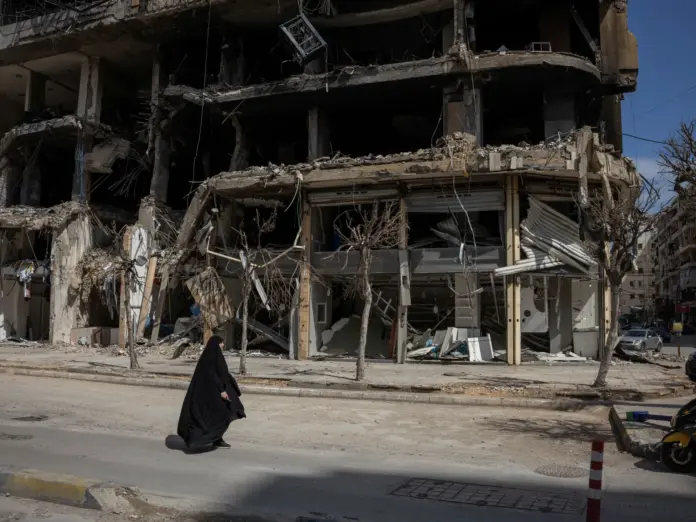
Israeli and Lebanese diplomats sat across from one another in Washington on Thursday evening for the first direct negotiations between the two countries in decades, a landmark encounter overshadowed by continuing Israeli strikes that have killed thousands and razed entire communities since the latest escalation began in early March.
US Secretary of State Marco Rubio participated in the talks alongside US Ambassador to Lebanon Michael Issa and US Ambassador to Israel Mike Huckabee. The delegations were led by each country’s ambassador to the United States. It marked a significant expansion from an initial meeting held on April 14 in Washington, which Huckabee had not attended.
Lebanese Prime Minister Nawaf Salam set out his government’s core demands ahead of the session: a complete Israeli military withdrawal from Lebanese territory and the return of all Lebanese captives currently held by Israel. Beirut also requested an extension of the existing ceasefire as a precondition for advancing the negotiations — a demand that carries particular weight given that Israel has repeatedly violated the terms of that agreement.
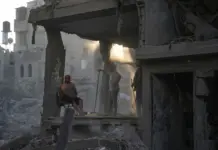
The diplomatic opening comes against a backdrop of relentless violence. Since March 2, when Israel intensified its military campaign following a Hezbollah retaliatory strike — itself described by the group as a response both to sustained Israeli attacks and to the Israeli-US killing of Iranian Supreme Leader Ayatollah Ali Khamenei two days prior — the death toll in Lebanon has climbed to at least 2,294 people. Among the dead are journalists and medical workers. More than 1.2 million Lebanese have been displaced.
The killing has not paused for diplomacy. On Wednesday, an Israeli strike claimed five lives, including front-line reporter Amal Khalil. A day later, Lebanon’s Health Ministry confirmed that a further three people were killed in another Israeli attack — hours before the Washington talks convened.
Israel has carved out what it designates a ‘yellow line’ buffer zone stretching roughly 10 kilometres inside Lebanese territory from the border. Within that zone, homes and entire villages have been demolished, a physical transformation of the landscape that Lebanon’s negotiators will need to address in any final settlement.
The path to Thursday’s talks was neither smooth nor universally welcomed. Hundreds of protesters flooded central Beirut the day before the April negotiations to voice opposition to any engagement with Israel. Hezbollah, which retains an armed presence despite the Lebanese government declaring its military activities illegal shortly after the March 2 attacks, has rejected the talks entirely. The group commands loyalty primarily within Lebanon’s Shia Muslim community but holds little broader popular support across the country.
The Lebanese state’s posture toward Hezbollah has hardened considerably in recent months. Following a 2024 ceasefire that ended the previous Israeli escalation, Beirut pledged to disarm the group and assigned the Lebanese Armed Forces responsibility for carrying out that mandate — a commitment that remains deeply contested and largely unfulfilled.
The historical weight of Thursday’s meeting is difficult to overstate. Lebanon’s civil war, which tore the country apart for 15 years, ended in 1990 with all armed factions surrendering their weapons — except Hezbollah. Israel withdrew from southern Lebanon a decade later in 2000, but the two countries have remained formally in a state of hostility, with no direct diplomatic contact, ever since.
Whether the Washington channel can translate into a durable agreement remains deeply uncertain. Israel’s continued military operations, the displacement of more than a million civilians, and the destruction of communities within the buffer zone all represent enormous obstacles. Hezbollah’s outright rejection of the process adds a further layer of complexity for a Lebanese government that must navigate between international pressure and domestic political realities.
For now, the talks represent the most significant diplomatic contact between the two countries in a generation — convened even as the guns have not fallen silent.