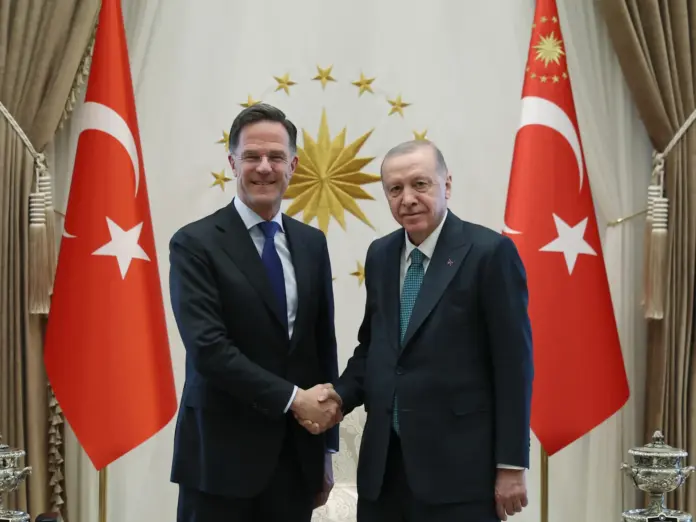
Turkish President Recep Tayyip Erdogan stepped up his role as a potential peace broker on Wednesday, hosting NATO Secretary-General Mark Rutte in Ankara and pressing for the revival of direct negotiations between Russia and Ukraine — including a summit between the two countries’ leaders.
The meeting in the Turkish capital came as the war between Russia and Ukraine entered its fifth year, with no ceasefire in sight and diplomatic channels largely frozen. Erdogan, who has cultivated working relationships with both Kyiv and Moscow since Russia’s full-scale invasion in February 2022, told Rutte that Ankara was actively working to bring the two sides back to the table and to elevate those talks to the presidential level.
In a readout released by the Turkish presidency, Erdogan also stressed that maintaining transatlantic ties was ‘indispensable’ and called on European NATO allies to assume greater responsibility for transatlantic security — a pointed message at a moment when the alliance is grappling with shifting burden-sharing expectations.
Separately, Erdogan held a phone call Wednesday with German Chancellor Frank-Walter Steinmeier, during which he outlined Ankara’s efforts to achieve a lasting peace through negotiations. He also raised a broader regional concern, warning Steinmeier that the ongoing US-Iran conflict was ‘starting to weaken Europe’ — framing Turkey’s mediation efforts as part of a wider stabilisation agenda that extends beyond Ukraine.
‘Turkey is trying to end the Ukraine-Russia war through negotiations and reach lasting peace, just as it is trying with regards to Iran,’ Erdogan said, according to the presidential readout.
Ukraine has moved quickly to capitalise on Ankara’s diplomatic positioning. Foreign Minister Andrii Sybiha confirmed on Tuesday that Kyiv had formally asked Turkey to host a leaders’-level meeting between President Volodymyr Zelenskyy and Russian President Vladimir Putin. Sybiha said Ukraine had also approached several other capitals about potentially hosting such a meeting, adding that Kyiv would consider any venue except Belarus or Russia itself.
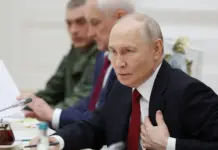
The Kremlin, however, has set a high bar for any direct encounter. Spokesman Dmitry Peskov said Putin would be willing to meet his Ukrainian counterpart only for the purpose of finalising agreements already reached on the conflict — not for preliminary or exploratory discussions. Peskov added that Putin was ready for such a meeting in Moscow ‘at any moment,’ provided it would be productive and outcome-focused.
The divergence in preconditions underscores the fundamental challenge facing any mediation effort. Ukraine has consistently sought a comprehensive ceasefire and security guarantees before committing to a final settlement, while Moscow has signalled it expects any summit to ratify terms largely on its own conditions.
Turkey’s unique position as a NATO member that has simultaneously maintained functional ties with Russia gives Erdogan a rare degree of access to both sides. Ankara brokered the landmark Black Sea Grain Initiative in 2022 and hosted earlier rounds of peace talks in Istanbul in the war’s opening weeks, before those negotiations collapsed. Turkish officials have since kept diplomatic lines open, positioning the country as an indispensable intermediary.
Erdogan’s dual outreach on Wednesday — to the NATO chief and to a senior European leader — signals a deliberate effort to align Turkey’s mediation push with broader Western interests, even as Ankara has declined to join sanctions against Moscow. The emphasis on European allies taking greater responsibility for their own security also reflects a wider debate within NATO about the continent’s defence posture amid uncertainty over long-term American commitments.
Whether the renewed push translates into substantive talks remains uncertain. Zelenskyy has long sought to accelerate a resolution to a war that has devastated Ukrainian cities, displaced millions, and claimed tens of thousands of lives on both sides. Yet bridging the gap between Kyiv’s demand for sovereignty and territorial integrity and Moscow’s stated war aims has so far proved insurmountable through diplomacy alone.
For now, Turkey’s willingness to serve as host and honest broker keeps a narrow diplomatic channel open — one that both sides appear reluctant to close entirely, even as fighting continues on the front lines.