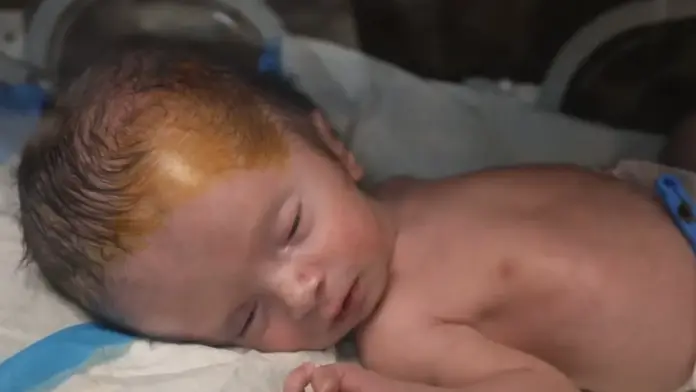
Inside the neonatal unit at Nasser Hospital in southern Gaza, the consequences of nearly two years of war are written on the smallest, most vulnerable faces. Infants born with heart defects, brain abnormalities, and severe physical deformities fill the ward — a generation shaped by hunger, contaminated water, and the unrelenting trauma of conflict.
Two-month-old Osama was born with a hole in his heart and enlarged ventricles in his brain. His mother, Najia Zurub, conceived him during the war and spent her pregnancy sheltering in tents, with no reliable access to safe drinking water. Nearby, two-week-old Ahmed shows early signs of hydrocephalus, a dangerous accumulation of fluid in the brain. Two-month-old Suheir arrived in the world with multiple deformities affecting her mouth and ears. Infant Fatama was rushed to intensive care. A baby named Iyal did not survive — one of 457 neonatal deaths recorded in Gaza last year alone, a figure representing a 50 percent increase compared to pre-war levels.
Asaad al-Nawajha, a paediatrician and neonatology specialist at Nasser Hospital, explains that internal organ anomalies typically develop when a fetus is exposed to adverse environmental conditions during the first trimester. The environment facing pregnant women in Gaza has been catastrophic by any measure.
The scale of the crisis is documented in stark statistical terms. Stillbirths have increased by 140 percent. Cases of congenital anomalies in 2025 are double what they were in 2022, before the war began. At the height of Israeli bombardment, live births across Gaza plummeted by more than 30 percent. Although a ceasefire took effect late last year and birth numbers have shown a slight recovery, they remain well below pre-war levels.
Zaher al-Wahidi, director of the Health Information Unit at the Gaza Ministry of Health, identifies five interlocking factors driving the health catastrophe: widespread hunger, a severe decline in healthcare services, extreme overcrowding, exposure to contaminated drinking water, and the ongoing physical and psychological toll of Israeli air attacks. Together, these conditions have created a toxic environment for fetal development and newborn survival.
Malnutrition among pregnant women is particularly devastating. Without adequate nutrition during pregnancy, fetal organ development is compromised at the cellular level. Contaminated water supplies introduce pathogens and chemical pollutants that can disrupt fetal growth. Overcrowded displacement camps, where families like Najia Zurub’s have been forced to live in tents, offer no protection from disease, extreme temperatures, or the psychological stress that itself carries measurable physiological consequences for developing fetuses.
The broader toll on children in Gaza is staggering. Israel’s war on Gaza has killed at least 20,000 children — a figure that does not account for the thousands more who, like Iyal, have died in neonatal units, or those who will carry the physical consequences of their wartime births throughout their lives.
Healthcare workers at Nasser Hospital continue to operate under extraordinary pressure, treating complex neonatal cases with severely limited equipment, medicines, and staff. The hospital, like much of Gaza’s medical infrastructure, has been stretched far beyond its capacity since the conflict began in late 2023.
For families like Najia Zurub’s, the war’s impact is not measured only in the rubble of destroyed homes or the grief of lost relatives. It is measured in the fragile heartbeat of a two-month-old boy, born into a world of deprivation before he ever drew his first breath — and in the quiet, devastating question of what his future holds.