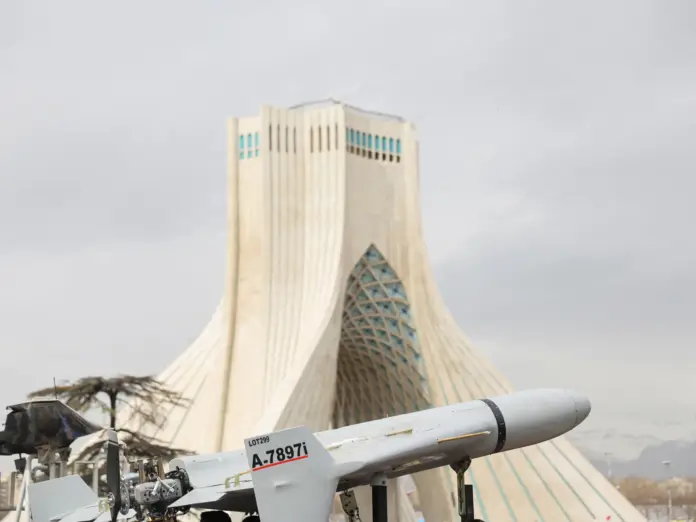
The United States Treasury Department announced sweeping sanctions Tuesday against 14 individuals and entities accused of facilitating Iran’s acquisition of weapons components, a move that deepened tensions just hours before scheduled diplomatic talks and as a fragile ceasefire between Washington and Tehran showed signs of unravelling.
The sanctions, which freeze targets’ US-held assets and prohibit American citizens from conducting business with them, swept up companies and individuals operating across Iran, Turkey, and the United Arab Emirates. Among those targeted was Chabok FZCO, a Dubai-based firm accused of procuring sensors and US-origin aircraft components on behalf of Iranian carrier Mahan Air. Iranian money exchanger Kamal Sabah Balkhkanlu was also named in the designations.
Treasury Secretary Scott Bessent framed the action as part of the Trump administration’s broader ‘maximum pressure campaign,’ stating that the Iranian regime must be held accountable for what he described as the extortion of global energy markets.
The announcement came as US and Iranian officials were due to meet Wednesday in Pakistan for negotiations — talks Tehran had not confirmed it would attend. Iranian Foreign Minister Abbas Araghchi declared Tuesday that the ongoing US naval blockade of Iranian ports constitutes an act of war and a direct violation of the ceasefire agreement, signalling deep mistrust ahead of any potential dialogue.
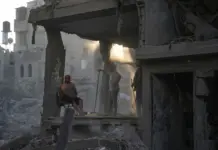
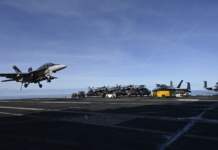
The conflict’s origins trace to February 28, when the United States and Israel launched coordinated airstrikes against Iran. Tehran responded by closing the Strait of Hormuz and unleashing waves of drone and missile attacks across the region. A two-week ceasefire halted the fighting on April 8, but the truce remained fragile from the outset. Iran kept the Strait of Hormuz closed after Israel declined to extend the ceasefire to Lebanon, and the US military responded by imposing a naval blockade targeting all vessels originating from or bound for Iranian ports. At least one Iranian ship was seized, and 28 others were ordered to turn back.
The situation shifted last week when Iran announced the reopening of the Strait of Hormuz following a separate truce established in Lebanon. Despite that development, President Donald Trump maintained that the US naval blockade would remain in place — a position Iran characterised as a fundamental breach of the ceasefire’s terms.
On Tuesday, Trump posted on Truth Social that he was extending the ceasefire beyond its original Wednesday expiry, reversing his earlier stated position that he did not want to prolong the pause in hostilities. The extension, he wrote, would remain in effect until Iran’s leadership could present a unified proposal. Trump also suggested Iran’s government is ‘seriously fractured,’ a characterisation that underscored Washington’s scepticism about Tehran’s negotiating coherence.
Iranian officials pushed back sharply. Tehran dismissed the ceasefire extension as a ploy to buy time for a potential surprise military strike — a framing that reflected the profound breakdown of trust between the two sides even as diplomats prepared to meet.
The diplomatic impasse carries significant consequences for global energy markets. The Strait of Hormuz, through which roughly a fifth of the world’s oil supply passes, has been a central flashpoint throughout the conflict. Its closure earlier in the crisis sent shockwaves through commodity markets, and any renewed disruption risks triggering another spike in energy prices worldwide.
The new sanctions add another layer of complexity to already tortured negotiations. By targeting the financial and logistical networks that Washington says sustain Iran’s military procurement, the Treasury action signals that the US intends to maintain economic pressure regardless of the diplomatic track’s outcome. For Tehran, the combination of an active naval blockade, fresh asset freezes, and an unresolved dispute over Lebanon’s ceasefire status makes meaningful engagement increasingly difficult to justify domestically.
Whether Iranian officials ultimately travel to Islamabad for Wednesday’s talks — and whether those talks produce anything substantive — may determine whether the ceasefire holds or whether the region slides back toward open conflict.