MELBOURNE — Australia and Japan have signed contracts for the first three vessels in an ambitious $7 billion warship programme, cementing one of the most significant defence partnerships in the Indo-Pacific region and signalling a dramatic expansion of Australian naval power.
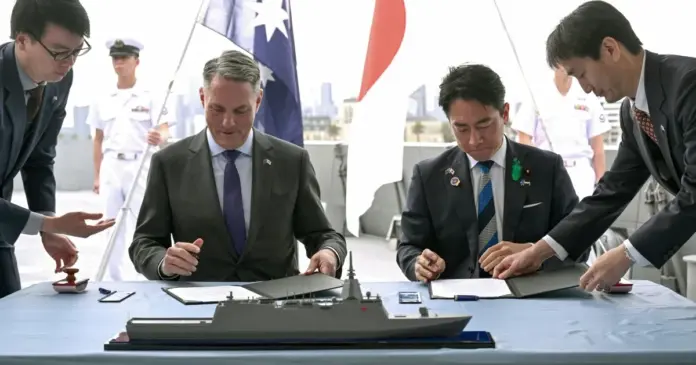
Australian Defence Minister Richard Marles and his Japanese counterpart, Koizumi Shinjiro, formalised the arrangement at a signing ceremony in Melbourne on Saturday, launching what both governments have branded the ‘Mogami Memorandum’ — a framework pledging deeper military ties through closer industrial cooperation in defence.
The deal covers 11 Mogami-class stealth frigates destined for the Royal Australian Navy. Under the division of labour, Japanese defence giant Mitsubishi Heavy Industries will construct three of the vessels at its facilities in southern Nagasaki Prefecture, while Australian shipbuilder Austal will build the remaining eight in Western Australia. The first Japanese-built frigate is scheduled for delivery in 2029 and is expected to enter active service the following year.
Mitsubishi Heavy Industries secured the contract after a competitive bidding process that saw it defeat Germany’s Thyssenkrupp, underscoring the strategic preference Canberra placed on partnering with a fellow Quad member over a European alternative.
The general-purpose frigates are equipped with stealth capabilities and are specifically intended to help secure Australia’s maritime trade routes and its strategically vital northern approaches — waters that have grown increasingly contested as regional tensions rise.
Marles described the surface fleet as more important now than at any point in decades, framing the programme as central to a broader national defence overhaul designed to restore Australian naval strength to levels not seen since World War II. Koizumi, for his part, pointed to what he characterised as an increasingly severe regional security environment as the driving rationale for closer defence coordination between Tokyo and Canberra.
The warship programme sits within a sweeping commitment by the Australian government to spend $305 billion on military capability over the next decade. Defence expenditure is projected to climb from roughly 2 percent of gross domestic product today to 3 percent by 2033 — a trajectory that would place Australia among the highest defence spenders in the developed world relative to the size of its economy.
Both nations are members of the Quad security bloc, the United States-led grouping that also includes India and which has increasingly positioned itself as a counterweight to China’s expanding military and economic footprint across the Indo-Pacific. Australia and Japan have steadily intensified bilateral military cooperation in recent years, driven by shared anxieties over Beijing’s assertiveness in the South China Sea, its pressure on Taiwan, and its broader strategic ambitions in the region.
The Mogami Memorandum formalises what has been a rapidly evolving relationship. Beyond the immediate shipbuilding contracts, the agreement is designed to integrate the two countries’ defence industries over the long term, creating supply chain interdependencies and shared technological development that would be difficult to unwind — a deliberate structural commitment to the alliance.
For Australia, the programme represents a generational transformation of its naval capabilities. The Mogami-class frigates are among the most advanced surface combatants currently in production anywhere in the world, combining low radar cross-sections with sophisticated sensor and weapons suites. Deploying a fleet of 11 such vessels would substantially increase Australia’s ability to project power, protect sea lanes, and operate alongside allied navies in high-intensity scenarios.
For Japan, the deal carries its own strategic significance. Tokyo has been progressively loosening post-war restrictions on arms exports, and the Australian contract represents one of the most substantial defence export agreements Japan has concluded. It reinforces Japan’s emergence as a meaningful defence industrial partner rather than simply a consumer of American military technology.
The ceremony in Melbourne drew attention to the geographic symbolism of the announcement — a city in Australia’s south, far from the contested northern waters the frigates are ultimately meant to patrol, yet chosen as the site to signal the depth of a partnership that both governments clearly intend to endure.