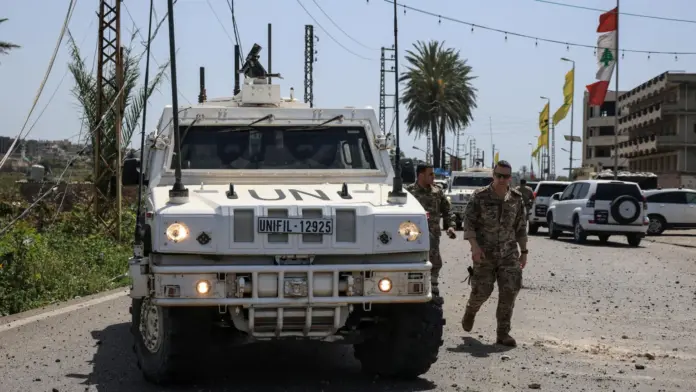
A French peacekeeper was shot and killed in southern Lebanon on Tuesday when a United Nations Interim Force in Lebanon (Unifil) patrol came under fire while clearing explosive ordnance along a road in the village of Ghanduriyah. Three other peacekeepers sustained injuries in the attack, two of them seriously.
France’s Armed Forces Minister Catherine Vautrin confirmed the peacekeeper died from a direct shot fired from a small arms weapon — a detail that underscored the deliberate nature of the assault. President Emmanuel Macron swiftly attributed responsibility to Hezbollah, the Iran-backed militant group that wields significant influence across southern Lebanon.
Hezbollah flatly rejected the accusation, describing it as "rushed" and "baseless." Unifil, for its part, characterised the attackers as non-state actors, stopping short of naming any specific group.
Lebanon’s political leadership moved quickly to distance the state from the violence. President Joseph Aoun condemned the attack, while Prime Minister Nawaf Salam ordered a formal investigation into the circumstances surrounding the killing.
The incident comes at a particularly volatile moment along the Blue Line — the de facto border separating Lebanon from Israel. Renewed hostilities between Hezbollah and Israel erupted on 2 March, before a 10-day ceasefire brokered by the United States came into effect on 16 April. The fragile calm has done little to stabilise conditions on the ground for international peacekeepers operating in the area.
Tuesday’s killing is not an isolated tragedy. In late March, three Indonesian peacekeepers lost their lives in separate incidents. One was killed when an explosion destroyed a Unifil vehicle; another died a day earlier after being struck by a projectile. The cluster of attacks has intensified alarm within the United Nations over the safety of its personnel deployed across the south.
Unifil issued a stark warning in the wake of the latest fatality, stating that deliberate attacks on peacekeepers constitute grave violations of international humanitarian law and could amount to war crimes. The force has now recorded more than 330 peacekeeper deaths since its establishment — a toll that reflects decades of instability in one of the world’s most contested border regions.
The mission was first created in 1978 by the UN Security Council following Israel’s initial invasion of southern Lebanon. Its mandate was substantially expanded after the 2006 war between Israel and Hezbollah, with Security Council Resolution 1701 assigning Unifil broader responsibilities for monitoring the ceasefire along the Blue Line and supporting the Lebanese Armed Forces in maintaining security in the south.
Despite that expanded mandate, peacekeepers have repeatedly found themselves caught between armed factions unwilling to respect the boundaries of international law. The killing of a French soldier during what was a routine ordnance-clearing operation illustrates the persistent danger facing the roughly 10,000 troops from dozens of nations currently serving under the Unifil flag.
France is one of Unifil’s most prominent contributing nations and has historically played a central diplomatic role in Lebanon. Macron’s direct accusation against Hezbollah is likely to sharpen tensions between Paris and the group, and may prompt renewed calls within the Security Council for accountability measures. Whether those calls translate into concrete action remains uncertain, given the deeply entrenched geopolitical divisions that have long complicated international responses to violence in southern Lebanon.
For now, the focus remains on the investigation ordered by Prime Minister Salam and on the condition of the three wounded peacekeepers, two of whom are fighting serious injuries. Unifil has called on Lebanese authorities to ensure those responsible are identified and brought to justice.