The Jordan Valley is emptying. Community by community, Palestinian shepherding families are abandoning land their families have worked for generations — driven out by armed settlers, livestock theft, and explicit warnings from Israeli military commanders that the territory will be cleared of Palestinians.
The scale of displacement in 2026 has already shattered previous records. 1,727 Palestinians from 36 communities across the West Bank were forced from their homes in the first three months of the year alone, according to the United Nations Office for the Coordination of Humanitarian Affairs. That figure exceeds the highest annual total recorded in any of the preceding three years — and the year is barely a quarter complete.
Haitham al-Zayed, 24, is among those counted in that statistic. He grew up in Shallal al-Auja, a community nestled beside a stream fed by the al-Auja spring in the southern occupied West Bank. His family raised sheep there for years. Then, three months before Passover, settlers forced them out.
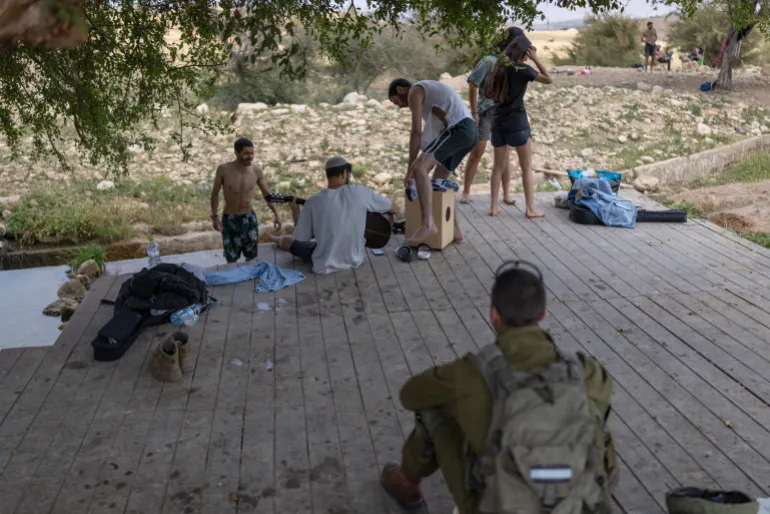
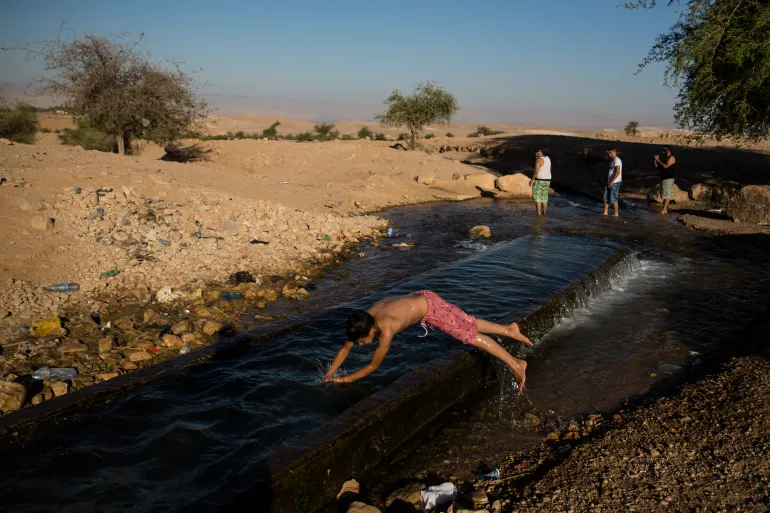
The dispossession was methodical. After October 2023, settlers cut off Palestinian access to al-Auja spring and its irrigation canals entirely. Armed settlers aboard all-terrain vehicles — funded by the Israeli government — chased livestock and children through the area. Approximately 400 sheep were stolen from al-Zayed’s family alone. By January 2026, the families of Shallal al-Auja and the neighbouring community of Ras Ein al-Auja concluded they had no choice but to leave.
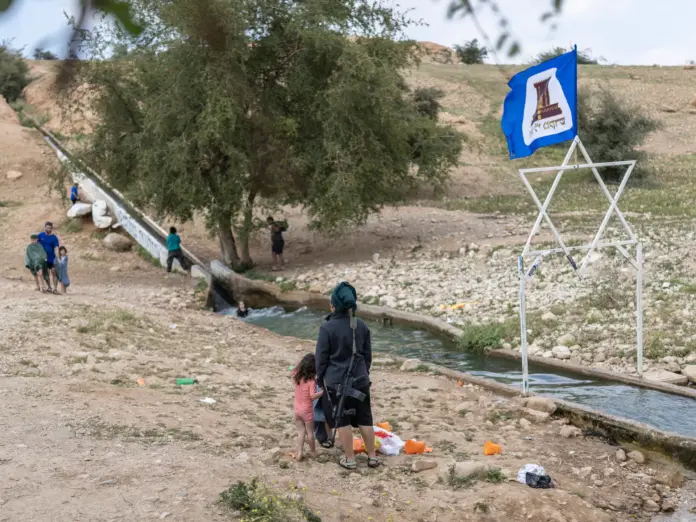
The al-Zayed family was relocated to Jabal al-Birka, roughly five kilometres away. Their new settlement now houses approximately 120 families drawn from several displaced communities. During Passover at the start of April, thousands of settlers converged on the very spring from which Palestinians had been expelled — settler children wading in the natural pools while organised groups conducted "get to know the Holy Land" hikes through Areas B and A of the West Bank.
Further north in the Jordan Valley, the ancient hot-spring settlement of Hammam al-Maleh — a touristic area featuring Mamluk-era remains whose school once served more than 100 students — has been driven to near-wholesale evacuation within the past month. On March 8, Gilad Shriki, commander of the Israeli forces’ Jordan Valley Brigade, issued a direct warning to Hammam al-Maleh and several surrounding communities to leave. Palestinian activists reported that Shriki declared that "Area C will soon be cleared of Palestinians."
One resident, identified as Muhammad, moved his wife and four young children — including a nine-year-old daughter with a disability who is unable to speak — from Hammam al-Maleh to Tayasir, a community in Area B. When he left for three days during the Eid holiday, settlers stripped the community of generators, electrical cables, and solar panels in his absence.
The violence is not only economic. On April 8, settlers shot and killed Alaa Sobeih inside his greenhouse in Tayasir, underscoring the lethal dimension of what humanitarian organisations describe as a coordinated campaign of dispossession.
Allegra Pacheco, chief of party of the West Bank Protection Consortium — a strategic partnership of international organisations and nearly a dozen European Union donor countries — has been monitoring the acceleration of displacement. The consortium’s data tracks a pattern that advocates say reflects deliberate policy rather than isolated incidents of settler misconduct.
OCHA’s cumulative figures paint an even starker picture: more than 5,600 people have been displaced across the West Bank since 2023, a toll that has mounted steadily as settler infrastructure expands and military enforcement of Palestinian movement tightens.
The communities being emptied are not abstract statistics. They are shepherding villages whose residents have grazed livestock along the Jordan Valley for generations, whose children attended schools that now stand abandoned, and whose access to water sources — like the al-Auja spring — has been severed and handed, effectively, to those who displaced them. The Passover celebrations at al-Auja this year offered a stark illustration of that transfer: the spring that Palestinian families could no longer reach became a recreational destination for the settlers who had driven them away.
With displacement in the first quarter of 2026 already exceeding any full-year figure from recent history, humanitarian observers warn the trajectory points toward an unprecedented crisis in the occupied territory before the year is out.