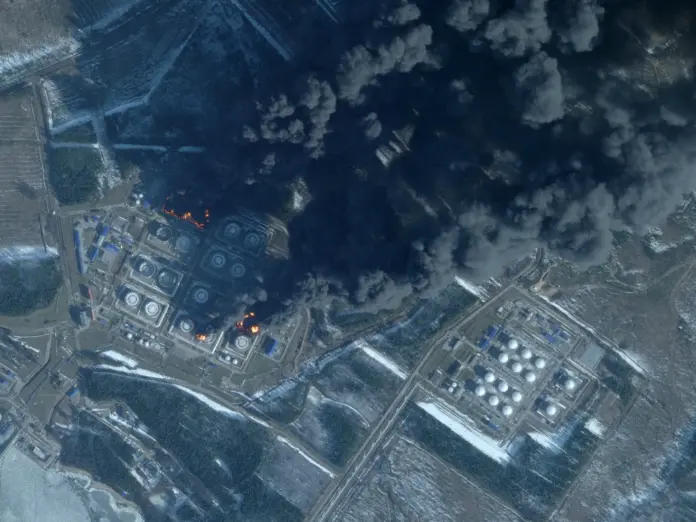
Ukraine has delivered its most damaging blow yet to Russia’s energy economy, striking two major Baltic Sea oil export terminals in coordinated drone attacks that severed roughly 40 percent of Russian oil export revenue — the equivalent of 2 million barrels per day — in what energy analysts are calling the most severe oil supply disruption in modern Russian history.
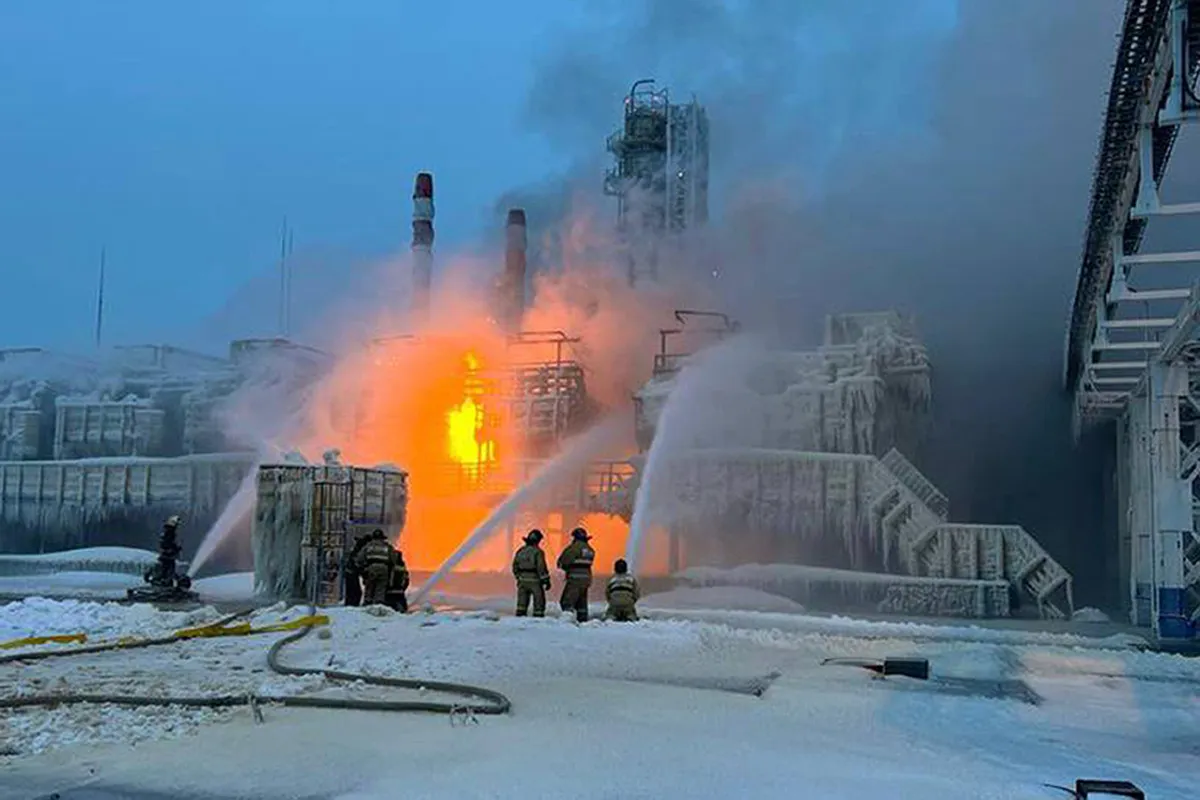
Drones struck an oil tank farm and loading pier at the Transneft-Port Primorsk terminal west of St Petersburg, with satellite imagery indicating at least five of the facility’s 18 storage tanks sustained damage. Primorsk exported 16.8 million tonnes of oil products in the previous year. On Tuesday night, Ukrainian drones followed up with an attack on the Ust-Luga oil offloading platform in the Baltic Sea, igniting a fire reported by regional governor Alexander Drozdenko early Wednesday. No casualties were recorded at Ust-Luga. The terminal, which ships both crude oil and liquefied natural gas, handled approximately 450,000 barrels of crude daily last month and exported 32.9 million tonnes of oil products in the prior year — nearly double Primorsk’s volume.
The strikes sent Brent crude prices surging from $70.71 a barrel on February 27 to $108.01 by March 26, a gain of more than 50 percent in under a month. Ukraine also struck the Saratov Oil Refinery on Sunday and the Bashneft-Ufaneftekhim refinery in the Republic of Bashkortostan on Monday, compounding pressure on Russia’s energy infrastructure. Ukrainian strikes between 50 and 250 kilometres inside Russian territory have quadrupled over the past year, reaching 45 per month.

The energy campaign unfolded against a backdrop of ferocious aerial and ground combat. Russia launched a record 948 drones and 34 missiles within a single 24-hour period, a figure the Institute for the Study of War described as unprecedented. Ukrainian air defences intercepted 91 percent of the 1,968 drones Russia launched during the week and shot down 25 of 34 missiles. The attacks killed at least five people and wounded more than 40 across Ukraine, with Russian strikes continuing into Tuesday.
Among the week’s most significant defensive achievements, Ukrainian military intelligence intercepted and destroyed two Zircon hypersonic antiship missiles along with their truck-mounted launcher. On March 20, Ukrainian drones also struck a repair plant in Russia’s Novgorod region, damaging a Beriev A-50 airborne early warning and control aircraft valued at approximately $500 million. Russia lost two A-50s to Ukrainian action in early 2024, leaving just six in its inventory according to then-military intelligence chief Kyrylo Budanov, with a further aircraft damaged during Operation Spiderweb. The latest strike leaves Russia’s strategic surveillance fleet critically depleted.
Ukraine’s drone production capacity has grown dramatically. President Volodymyr Zelenskyy confirmed in January 2026 that Ukraine had reached a production target of 1,000 interceptor drones per day, praising Defence Minister Denys Shmyal for the achievement. Zelenskyy stated Ukraine is now capable of manufacturing at least 2,000 effective combat-proven interceptors daily. The contrast with Russia is stark: last July, Russia produced roughly 90 Shahed drones per day; by January, Commander-in-Chief Oleksandr Syrskii reported that figure had risen to just over 400 — still far below Ukraine’s interception capacity. Zelenskyy had warned in July 2025 that Russian intelligence indicated Moscow intended to scale strike packages to 1,000 drones a day.
On the ground, Syrskii reported 619 assault operations over four days between March 17 and 20, with 163 originating from the direction of Pokrovsk in the eastern Donetsk region — a city of 60,000 people before the war that has become one of the most contested points along the front. Russian forces simultaneously pressed toward Lyman and Kupiansk in the northeastern Kharkiv region. Syrskii said Russian forces lost more than 6,090 soldiers killed and wounded during those four days alone, with total weekly losses reaching approximately 8,710 killed and seriously wounded.
The intensity of operations across the 1,250-kilometre front line is widely interpreted as the opening phase of Russia’s anticipated spring offensive. Ukraine is actively seeking additional Patriot air defence missile batteries from international partners to sustain its interception rates as Russian strike volumes continue to climb. With energy revenues under pressure and battlefield losses mounting, the coming weeks will test the resilience of both sides as the conflict enters what may prove to be a decisive operational phase.