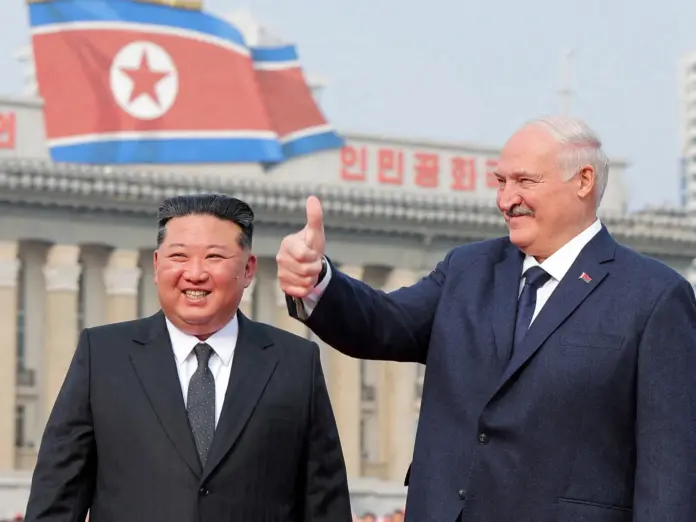
PYONGYANG — North Korean leader Kim Jong Un and Belarusian President Alexander Lukashenko signed a friendship and cooperation treaty on Thursday, formalising a deepening partnership between two isolated states that have both thrown their weight behind Russia’s war in Ukraine.
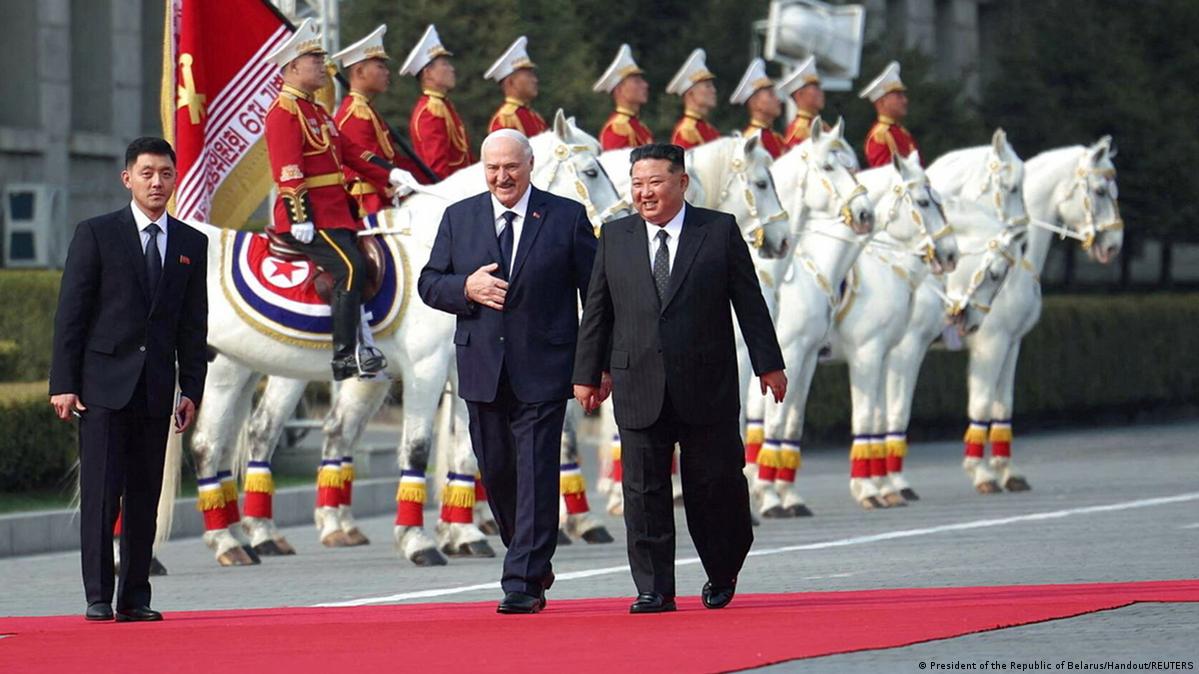
The signing took place during Lukashenko’s first-ever visit to Pyongyang, a two-day trip that opened with a lavish welcome ceremony on Kim Il Sung Square on March 25. Rows of soldiers stood at attention alongside white-horsed cavalry, flag-waving children lined the route, and a 21-cannon salute thundered across the North Korean capital as the two leaders met.
Lukashenko told Kim that relations between their two countries were entering a ‘fundamentally new stage.’ Kim, in turn, declared that both nations stand united against what he described as undue pressure from the West — a pointed reference to the sweeping sanctions that have isolated both governments from the international financial system.
The Belarusian foreign minister, Maxim Ryzhenkov, confirmed ahead of the visit that the treaty would be signed and indicated it could open new avenues for bilateral trade, particularly in food and pharmaceuticals — sectors where both countries face significant shortages driven in part by economic isolation.
Lukashenko also visited the Kumsusan Palace of the Sun, where the embalmed bodies of Kim’s father and grandfather lie in state, laying a bouquet on behalf of Russian President Vladimir Putin. The two leaders later observed a moment of silence together at the Liberation Tower, where Lukashenko laid a wreath.
The ceremony and the treaty reflect a broader realignment among three states that have grown increasingly intertwined since Russia launched its full-scale invasion of Ukraine in February 2022 — an offensive that used Belarusian territory as a staging ground. Putin visited Pyongyang in 2024, and the latest summit in the North Korean capital underscores how that trilateral relationship has solidified into something more structured.
North Korea’s contribution to Russia’s war effort has been substantial. South Korean and Western intelligence agencies estimate that Pyongyang has dispatched thousands of soldiers to Russia, deployed primarily to the Kursk region to help expel Ukrainian forces that had crossed the border in 2024. Beyond troops, North Korea has supplied artillery shells, missiles, and rocket systems. In exchange, Pyongyang has received financial aid, military technology, food, and energy — support that has also helped reduce its traditional dependence on China.
Belarus’s role has been no less significant. Lukashenko, who has held power for three decades since 1994, allowed Russian forces to mass on Belarusian soil before the 2022 invasion and has since agreed to host Russian tactical nuclear missiles on his country’s territory. Belarus shares borders with three NATO member states, making that arrangement a source of acute concern for the alliance.
Both governments operate under heavy Western sanctions. North Korea faces restrictions tied to its nuclear weapons programme, ballistic missile activity, and its military support for Russia. Belarus has been sanctioned over its facilitation of the Ukraine invasion and its brutal crackdown on mass protests that followed a widely disputed 2020 presidential election — an election the opposition and most Western governments dismissed as rigged. Hundreds of people detained in the aftermath of those protests remain imprisoned.
Yet Lukashenko’s visit to Pyongyang comes at a moment of cautious diplomatic movement on another front. Earlier this month, Belarus released 250 prisoners, including a Nobel Peace Prize laureate, largely under pressure from Washington. Last week, Lukashenko met with John Coale, an envoy of United States President Donald Trump, in a sign that relations between Minsk and Washington have begun, however tentatively, to thaw. Belarus still holds hundreds of political prisoners, many detained after the 2020 vote.
The dual track — reaching toward Washington while simultaneously deepening ties with Pyongyang — illustrates the complex balancing act Lukashenko is attempting. Politically and economically dependent on Putin, he has little room to manoeuvre independently. The friendship treaty with North Korea, a country with which Belarus conducts only a small volume of trade, carries more symbolic than economic weight. Its primary message is one of solidarity among states that have each, in their own way, positioned themselves in direct opposition to the Western-led international order.
International human rights organisations have long documented severe abuses inside North Korea, including torture, public executions, forced labour, and extreme restrictions on freedom of movement and expression. Belarus, too, faces sustained criticism over the treatment of political detainees and the suppression of civil society since 2020.