The United States has formally demanded the complete disarmament of Hamas and all allied Palestinian armed factions in Gaza, presenting the ultimatum in writing during high-level diplomatic meetings in Cairo in mid-March — a move that has deepened an already fraught standoff over the territory’s future.
The proposal was delivered by Trump’s Board of Peace, a diplomatic body whose Gaza envoy, Nickolay Mladenov, appeared before the United Nations Security Council on Tuesday to press Palestinian factions to accept the framework. The plan conditions the reconstruction of Gaza — a territory of two million residents, more than half of which is now under Israeli military occupation — on armed groups surrendering their weapons entirely.
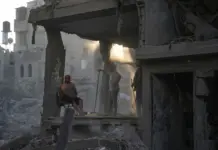
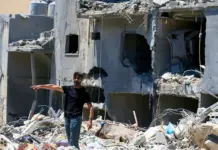
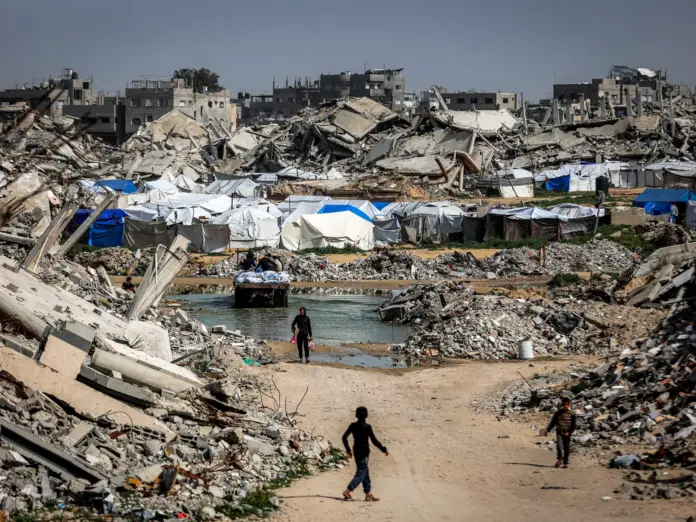
The scale of destruction in Gaza is staggering. More than 72,000 people have been killed since the conflict began, the majority of them women and children. Thousands more remain missing, believed buried under rubble. Approximately 1.4 million Palestinians are displaced across the strip, with no clear timeline for their return to homes that, in many cases, no longer exist.
Despite those conditions, Hamas and its allies have refused to engage with the disarmament demand, insisting that the first phase of the October ceasefire agreement — itself brokered by Washington — must be fully implemented before any discussion of weapons can take place. The group also harbours deep suspicions about the security guarantees embedded in the US plan, fearing that disarming would leave it exposed to rival armed factions operating inside Gaza, some of which are reportedly backed by Israel.
Wesam Afifa, a Gaza-based political analyst who closely followed the Cairo meetings, noted that the gap between what Washington is demanding and what Hamas is willing to consider remains wide. The movement views the sequencing of the US proposal — reconstruction funds contingent on disarmament — as a mechanism to strip it of leverage before any political settlement is reached.
The American framework centres on the second phase of the October ceasefire agreement and was developed alongside a decommissioning structure backed by guarantors including the US, Egypt, Turkey and Qatar. To provide security during any transition, Indonesia, Morocco and Kazakhstan have committed troops to a temporary International Stabilization Force (ISF).
Separately, the National Committee for the Administration of Gaza (NCAG), established under UN Security Council Resolution 2803, has already begun vetting thousands of civilian police candidates in preparation for a post-conflict governance structure. Mladenov confirmed the vetting process is underway, signalling that Washington is pressing ahead with institution-building even as the core political dispute remains unresolved.
The financial architecture for reconstruction is also taking shape. Donald Trump secured approximately $7 billion in reconstruction pledges in February, drawn primarily from Gulf nations. Steve Witkoff, Trump’s special envoy, has been centrally involved in mediating the broader Gaza plan alongside Mladenov.
The diplomatic push comes against a volatile regional backdrop. US-Israeli strikes on Iran were carried out on February 28, adding another layer of tension to an already combustible environment and complicating efforts to build the regional consensus needed to make any Gaza settlement stick.
The fundamental impasse reflects competing visions for what Gaza’s future should look like. Washington and its partners are pushing for a demilitarised territory governed by a civilian administration, with reconstruction funds serving as the primary incentive for compliance. Hamas, having survived more than a year of intensive military pressure, is unwilling to trade its weapons — its core source of political and military leverage — for promises it does not trust will be honoured.
With Israeli forces controlling more than half the enclave and the humanitarian situation continuing to deteriorate, the window for a negotiated framework that all parties can accept appears narrow. Whether the combination of reconstruction money, international security guarantees and sustained diplomatic pressure will be enough to shift Hamas’s calculus remains deeply uncertain.