American combat helicopters struck a military base in Habbaniyah, Anbar province on Wednesday, killing seven fighters and wounding 13 others in an attack that hit a military healthcare clinic and drew furious condemnation from Baghdad. Iraq’s Ministry of Defence denounced the strike as ‘a heinous crime’ that violated ‘all international laws and norms.’
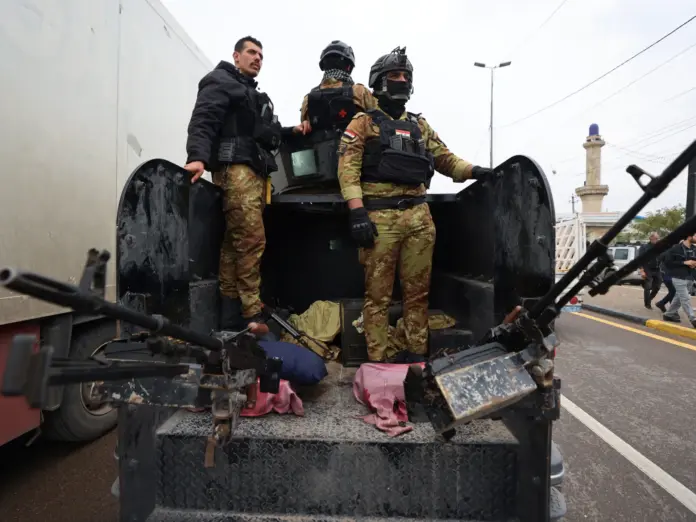
The assault targeted positions belonging to the Popular Mobilisation Forces (PMF), a paramilitary umbrella organisation that includes brigades aligned with Iran. Crucially, the PMF shares the Habbaniyah base with members of Iraq’s conventional military — making Wednesday’s strike what analysts described as the first time the paramilitary group appears to have been hit alongside the broader Iraqi armed forces, a significant and dangerous threshold.
Multiple waves of strikes were carried out on the same position, with follow-on attacks hitting the base after the initial salvo. Iraqi Prime Minister Mohammed Shia al-Sudani ordered the Ministry of Foreign Affairs to summon the US charge d’affaires in Baghdad, and the government announced it would file a formal complaint with the United Nations Security Council.

Wednesday’s bloodshed came just 24 hours after an even deadlier strike at the same base. That Tuesday attack killed 15 fighters, including a commander, making it the deadliest single incident in Iraq since the broader war on Iran began on February 28. The PMF attributed that strike directly to the United States.
The back-to-back attacks have pushed Baghdad to the edge of a diplomatic rupture with Washington. Al-Sudani’s office had already announced plans to summon both the US charge d’affaires and the Iranian ambassador following Tuesday’s strike. The government also formally granted the PMF a ‘right to respond’ to any aggression — a position Baghdad reaffirmed on Wednesday, with the Defence Ministry stating it would ‘take all necessary measures to respond to this aggression within the established legal frameworks.’
The US Department of Defense has acknowledged that combat helicopters are conducting strikes against pro-Iran armed groups operating inside Iraq. Washington had announced a brief five-day pause on such strikes earlier in the week, a ceasefire that evidently did not hold. Pro-Iran factions within the PMF have claimed responsibility for a series of attacks on American interests across Iraq and the wider region since the conflict erupted in late February.

The strikes represent a sharp escalation in the scope of US military action inside Iraqi territory. While previous operations targeted PMF positions, hitting a facility shared with Iraq’s regular army crosses a line that Baghdad has made clear it will not ignore. Iraq warned explicitly that the continued campaign risks undermining the foundations of US-Iraqi relations — a partnership that has underpinned regional security architecture for two decades.
Analysts observing the situation noted that warnings from senior American officials about the dangers of expanding ground and air operations inside Iraq have gone unheeded as strikes continue to multiply. The targeting of a military healthcare clinic drew particular condemnation, with Iraq’s government arguing the attack violated core principles of international humanitarian law.
The Habbaniyah base sits in Anbar province, a vast western region that has long been a flashpoint in Iraq’s complex security landscape. The PMF’s presence there alongside conventional Iraqi forces reflects the degree to which the paramilitary network has been formally integrated — at least structurally — into the Iraqi state’s security apparatus, complicating any US argument that strikes can be cleanly confined to non-state actors.
With Baghdad now pursuing both diplomatic and legal avenues, and having granted the PMF authority to retaliate, the risk of a broader confrontation between American forces and Iraqi-based factions is rising sharply. The coming days will test whether Washington recalibrates its approach or presses forward with a campaign that is rapidly eroding one of its most strategically important partnerships in the Middle East.