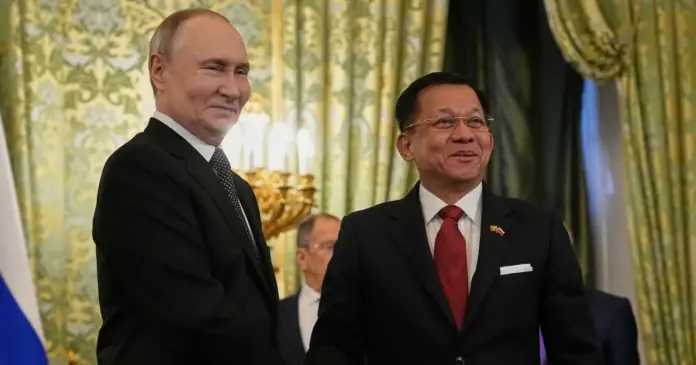
Myanmar’s military junta has become one of Russia’s most consequential strategic partners, receiving a steady flow of advanced weaponry, battlefield doctrine, and technical expertise drawn from Moscow’s ongoing war in Ukraine — transforming a six-year civil conflict into a proving ground for Russian military exports.
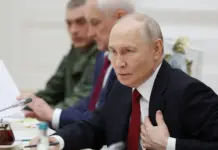
The depth of the relationship was underscored in early February when Sergei Shoigu, Vladimir Putin’s close confidant and former defence minister, travelled to the capital Naypyidaw — the first senior foreign official to visit Myanmar following military-organised elections. The trip produced a four-year military cooperation agreement, cementing ties that have grown steadily since Senior General Min Aung Hlaing seized power in a February 2021 coup.
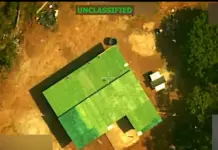
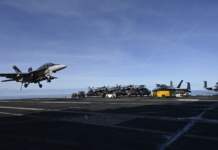
At the core of the partnership is airpower. Russia has delivered six Sukhoi Su-30 multirole jets to Myanmar’s military, with the final aircraft arriving in December 2024. Russian personnel have been observed on the ground servicing the aircraft, and Russian trainers are conducting maintenance and instruction on the full range of supplied equipment. Myanmar also became the first foreign buyer of Russia’s new Mi-38T assault-transport helicopter, and Moscow has supplied a suite of surveillance and strike drones — including the Albatross-M5, Orlan-10E, and VT-40 models. The Orlan-10E, equipped with optical and thermal imaging, can remain airborne for 16 hours, giving the junta persistent surveillance capability over contested territory.
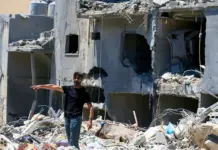
To coordinate this expanding aerial arsenal, Myanmar’s military established a dedicated Drone Warfare Directorate in 2024. The consequences for civilians have been severe. Between February 2021 and March 2026, the Armed Conflict Location and Event Data Project (ACLED) recorded 5,912 air strikes resulting in at least 4,865 reported deaths, alongside 931 drone attacks that killed at least 366 people. The United Nations identified air attacks as the leading cause of civilian casualties in Myanmar, with deaths from aerial raids climbing 52 percent in 2025 compared with the previous year.
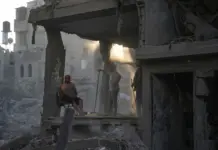
Individual incidents illustrate the scale of the violence. A bombing in Myanmar’s Sagaing region in April 2023 killed more than 160 people. In the Bago region, ethnic Karen armed groups reported that government forces killed at least 30 villagers, including women and children, with all but five dying in aerial attacks. The Arakan Army reported that air strikes killed at least 116 prisoners of war and wounded 32 others at a detention camp in Rakhine state. Since the 2021 coup, at least 96,000 people have been killed in the conflict.
Beyond hardware, Russia has exported the tactical philosophy shaping its Ukraine campaign. Myanmar’s military has adopted so-called ‘meat assault’ tactics — massed infantry waves pressed forward with little regard for casualties. The approach coincides with the introduction of nationwide conscription in 2024, which reportedly swelled the army by nearly 100,000 soldiers. In one recent operation, the junta deployed more than 1,000 troops in an attempt to retake Falam, the former capital of Chin state; an initial column of roughly 450 soldiers was ambushed and halted before reinforcements were committed.
The exchange is not one-directional. Myanmar has emerged as the only Southeast Asian nation to fully endorse Russia’s war on Ukraine and provide material assistance in return. In early 2023, Ukraine’s military intelligence chief, Lieutenant-General Kyrylo Budanov, revealed that Moscow had requested military supplies from countries operating Russian-made weaponry — and Myanmar answered. Russian tank manufacturer Uralvagonzavod reportedly imported optical targeting systems from Myanmar to upgrade T-72 tanks deployed in Ukraine. Mortar shells are also reported to have flowed from Naypyidaw to Moscow.
The partnership extends well beyond the battlefield. Direct flights between Russia and Myanmar resumed after a 30-year hiatus. Russia established a satellite imagery centre in Naypyidaw and has proposed building a nuclear power plant in the country. Last month, Moscow announced it would assist in selecting and training Myanmar’s first astronaut. Approximately 600 Myanmar officers were enrolled in Russian military institutions by 2018, a pipeline that has only deepened since the coup.
Opposition forces are not standing still. Resistance groups have tested fibre-optic first-person-view drone technology since late 2025. Security analyst Anthony Davis notes that such systems can strike targets from standoff ranges of up to 20 kilometres, potentially shifting the tactical balance in contested areas.
The trajectory of the Russia-Myanmar axis points toward further integration. With a new cooperation framework signed, advanced weapons flowing, and Russian advisers embedded on the ground, Myanmar’s junta has positioned itself as Moscow’s most reliable partner in Southeast Asia — while its own population bears the mounting cost of a war fought increasingly from the air.