Lebanon’s government has taken its most confrontational stance toward Iran in decades, with Prime Minister Nawaf Salam publicly accusing the Islamic Revolutionary Guard Corps (IRGC) of directing Hezbollah‘s military operations — including a drone strike on a British Air Force base in Cyprus — while Beirut moved to expel Tehran’s top diplomat from the country.
Speaking to Saudi Arabian television station al-Hadath on Sunday, Salam charged that IRGC officials had entered Lebanon using false passports and were managing military operations on Lebanese soil. He also accused the IRGC of orchestrating the drone attack on the British base in Cyprus earlier this month, a significant escalation that extended the conflict’s reach beyond Lebanon’s borders.
The Lebanese government’s break with Tehran deepened further on Tuesday, when Foreign Minister Youssef Rajji declared the Iranian ambassador to Lebanon persona non grata, giving him until Sunday to leave the country. Beirut has also formally banned Hezbollah’s military activities and requested that Iranians believed to have ties to the IRGC depart Lebanese territory.
The diplomatic rupture follows a March 2 rocket attack in which Hezbollah fired six projectiles across the border into Israel, collapsing a ceasefire that had held since November 2024. Hezbollah described the strike as retaliation for the assassination of Iranian Supreme Leader Ali Khamenei on February 28, as well as for more than a year of Israeli military operations in Lebanon that had killed hundreds of people.
Nicholas Blanford, a nonresident senior fellow at the Atlantic Council, said sources indicated the March 2 attack may have been conducted in direct coordination with the Quds Force, the IRGC’s foreign operations unit. Notably, Blanford added that Hezbollah’s own senior leadership may not have been aware of the plans in advance — a detail that underscores the degree to which Iranian operatives may have been acting independently within the group’s restructured command.
That restructuring is itself a significant development. After the November 2024 ceasefire, IRGC officers deployed to Lebanon to conduct a post-war audit and reorganise Hezbollah’s military architecture. The group’s chain of command was transformed from a traditional hierarchy into a network of smaller, semi-autonomous cells operating under what analysts describe as a ‘mosaic’ defence model — designed to preserve operational capacity even as individual nodes are degraded or destroyed.
Hezbollah was founded in 1982, three years after Iran’s Islamic Revolution, and was created in direct coordination with the IRGC. The corps answers exclusively to Iran’s supreme leader, making the Lebanese government’s accusations a direct indictment of Tehran’s highest levels of authority.
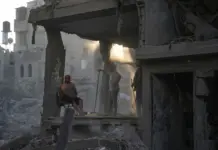
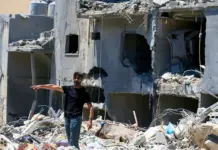
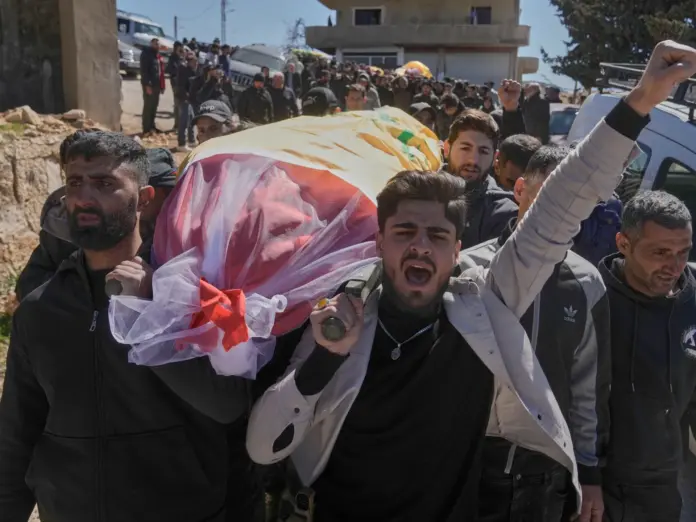
The human cost of the renewed fighting is staggering. Israeli military operations that resumed in early March have killed more than 1,000 people in Lebanon and displaced at least 1.2 million — more than 20 percent of the country’s entire population. Researchers at Human Rights Watch have warned that the scale of mass displacement could constitute a war crime under international law.
Israeli Defence Minister Israel Katz announced that the military intends to establish a permanent ‘security zone’ in southern Lebanon extending to the Litani River, approximately 30 kilometres north of the Israeli border. UN peacekeepers operating in Lebanon documented more than 10,000 Israeli ceasefire violations during the period between November 2024 and the ceasefire’s collapse earlier this month.
Hezbollah has responded to the Lebanese government’s moves with barely veiled hostility. Mahmoud Qamati, deputy head of Hezbollah’s political council, compared the Salam government to France’s wartime Vichy regime — a collaborationist administration that served occupying Nazi forces. Wafiq Safa, until recently the head of Hezbollah’s Liaison and Coordination Unit, went further, stating the group would force the government to reverse its decision to ban the party’s military activities once the war concluded.
The crisis has also exposed fractures within Lebanon’s political establishment. Hezbollah had reportedly given assurances to key government allies — including Parliament Speaker Nabih Berri — that it would not enter the war in support of Iran. The March 2 attack, apparently launched without the knowledge of Hezbollah’s own senior leadership, suggests those assurances may have been undermined by IRGC operatives acting through the group’s newly decentralised structure.
On the diplomatic front, US President Donald Trump said his envoys Steve Witkoff and Jared Kushner held talks with Iran on Monday aimed at exploring a possible end to the conflict. Iran subsequently denied that any such discussions took place, leaving the prospects for a negotiated resolution deeply uncertain as Lebanon braces for further violence.