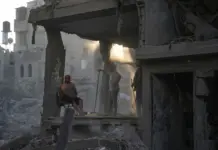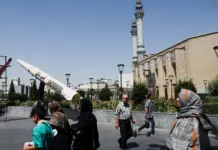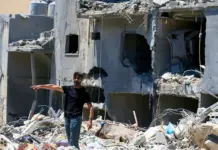
A pharmacist going about her workday. A 26-year-old blogger who had just returned home because she missed her family. A three-year-old girl who never recovered from her injuries. These are among the faces of a civilian catastrophe unfolding across Iran as US and Israeli airstrikes enter their fourth week, striking Tehran and cities far beyond the capital.
Parastesh Dahaghin was killed at her pharmacy in Tehran’s Apadana neighbourhood when a missile struck an adjacent building housing an IT company that reportedly played a role in Iran’s internet shutdown infrastructure. The blast destroyed her workplace and her life simultaneously — a collision of the war’s military logic and its human cost.
Across the city, in the affluent Zafaraniyeh neighbourhood, Berivan Molani died in her bed on March 17th. The 26-year-old lifestyle blogger and online clothes shop owner had travelled back to Tehran from northern Iran just the day before, homesick and eager to return. She was killed when a missile struck the residence of Iran’s minister of intelligence, Esmail Khatib, who lived directly opposite her family’s home on Makouyipour Street. Molani never knew how close she lived to a high-value military target.

In the western town of Sardasht, a child named Eilmah Bilki, just three years old, died a day after sustaining injuries in an airstrike. She did not survive long enough to understand what had happened to her.
The scale of civilian death is now being documented in stark statistical terms. The Human Rights Activists News Agency (HRANA) has recorded more than 1,400 civilian deaths since the conflict began, with children accounting for approximately 15 percent of that total. At least 1,167 military personnel have also been killed. The Kurdish human rights organisation Hengaw documented one of the single deadliest incidents: a missile strike on a primary school in the southern town of Minab at the outset of the war, which killed 48 children and 10 adults. The US military has not publicly acknowledged responsibility for the Minab school strike but has stated it is investigating the incident.
Healthcare infrastructure has been systematically degraded. The World Health Organisation has verified more than 20 attacks on medical facilities, with at least nine health workers killed. Tehran’s Gandhi hospital, a 17-storey private medical centre, sustained damage during strikes near the state broadcaster’s headquarters. A Red Crescent hospital in the western city of Mahabad was also hit, as was a hospital in the southern port of Bushehr, where staff were forced to evacuate babies from incubators on March 3rd. A Red Crescent worker, Hamidreza Jahanbakhsh, was among those killed in the conflict.
The International Committee of the Red Cross has described the price being paid by civilians as ‘alarming,’ a characterisation that carries particular weight given the organisation’s typically measured public language.
Iranian surgeon Dr Hashim Moazenzadeh, now practising in France, has warned that the munitions being deployed are exceptionally large, producing casualty figures far higher than conventional strikes would generate. His assessment aligns with the pattern of destruction visible across multiple cities.
Tehran itself presents a particular vulnerability: despite being one of the region’s largest metropolitan areas, the city has no civilian bomb shelters. Residents have no designated refuge when strikes occur, leaving millions exposed in their homes, workplaces, and streets.
The conflict has also generated secondary crises. Iranian border guards have reportedly received orders to shoot at civilians attempting to access Iraqi telephone and internet networks near the border — a measure apparently aimed at preventing communication outside state-controlled channels during the ongoing hostilities.
The deaths of Dahaghin, Molani, and Bilki are not anomalies. They represent a pattern documented by human rights monitors, international health bodies, and humanitarian organisations: a war in which the distance between military objectives and civilian life has, repeatedly and fatally, collapsed.