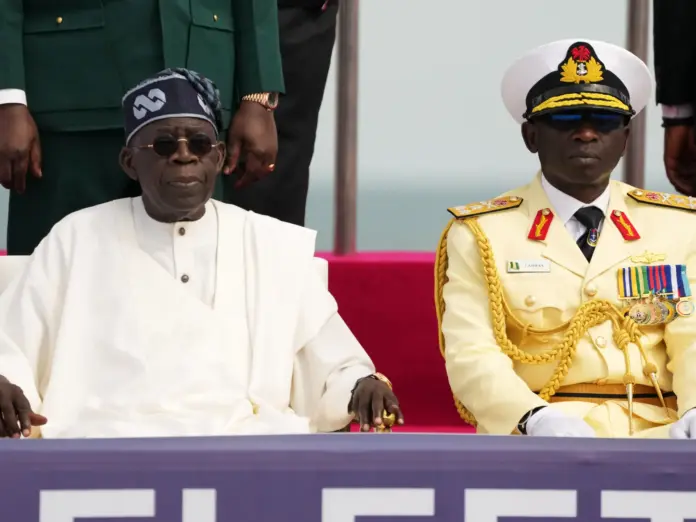
ABUJA — Nigeria’s President Bola Ahmed Tinubu declared significant progress in his government’s campaign against armed militancy on Friday, telling the nation in a televised address that deaths linked to armed conflict have fallen by 81 percent since he assumed power in 2023 — even as kidnapping gangs continue to terrorise communities and expand their reach into previously untouched parts of the country.
Nigeria Armed Groups — Speaking in commemoration of Democracy Day — the annual holiday marking Nigeria’s return to civilian rule in 1999 after decades of military government — Tinubu said the military had neutralised more than 13,000 terrorists over the past year. He also credited Operation Safe Corridor, a government rehabilitation initiative, with drawing 124,000 fighters and their dependants away from armed groups through voluntary disarmament since 2023.
The address offered a rare moment of optimism for Africa’s second-largest economy, which has long struggled with overlapping security crises. Armed factions with ties to ISIL and al-Qaeda, as well as criminal kidnapping gangs, have terrorised communities across the country — targeting schools, churches, and mosques, particularly in remote rural areas where state protection is limited.
Recommended Reading
Yet the scale of the ongoing threat remains stark. Scores of people have been abducted since January alone, among them teachers and children as young as four years old. In May, 46 people were seized from a school in Oyo State in the country’s southwest — a region that had previously been largely insulated from the violence concentrated in the north. Security analysts have warned that armed groups are deliberately shifting their operations through forest corridors to strike new targets as military pressure intensifies on their traditional strongholds.
That pressure appeared to yield a significant result earlier this week. On Monday, the Nigerian military announced it had rescued 360 people kidnapped by Boko Haram-linked militants from a remote mountain hideout in northern Borno State — a dramatic operation that underscored both the military’s growing capability and the continued human cost of the insurgency.
Nigeria has also secured direct military assistance from the United States. 100 American soldiers were deployed to Nigeria in February to support precision strikes on armed group positions, a significant deepening of bilateral security cooperation. The deployment came months after US President Donald Trump made unfounded allegations of a Christian genocide taking place in Nigeria — claims that drew sharp rebukes from Nigerian officials and independent observers.
The geographic spread of militant activity is among the most troubling developments for security planners. Armed groups that once confined themselves to Nigeria’s north have been steadily pushing southward, exploiting dense forest terrain to establish new operational corridors. The attack in Oyo State in May was a vivid illustration of that shift, bringing the violence to communities that had little experience of it and straining security resources already stretched across a vast country.
Nigeria Armed Groups: The Broader African Context
Operation Safe Corridor represents the government’s attempt to address the insurgency not only through force but through structured disengagement. The programme offers rehabilitation and reintegration pathways for fighters who voluntarily surrender, and officials say the 124,000 figure — encompassing both combatants and their dependants — reflects its growing reach. Critics, however, have questioned whether the programme has sufficient resources and oversight to prevent relapses into militancy.
Tinubu’s Democracy Day address was carefully framed as a moment of national stocktaking. The holiday carries particular symbolic weight in Nigeria, commemorating the end of a prolonged era of military rule and the inauguration of the Fourth Republic on May 29, 1999. For a president who has staked much of his political credibility on restoring security and economic stability, the security statistics offered a platform to demonstrate tangible results ahead of future electoral cycles.
Whether those results translate into lasting stability will depend heavily on whether the military can consolidate its gains in the north while simultaneously containing the southward spread of armed groups — a dual challenge that has so far resisted easy solutions. With kidnappings continuing at pace and militants adapting their tactics in response to military operations, the gap between the government’s declared achievements and the daily reality facing ordinary Nigerians remains wide.