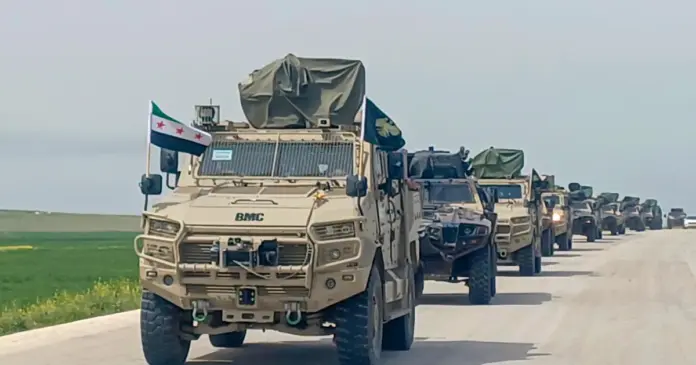
Syria has assumed full control of every military installation previously occupied by American forces, closing a chapter on a decade-long US presence that reshaped the country’s northeast and helped dismantle the territorial caliphate of the Islamic State.
The last convoy of US soldiers and equipment rolled out of Qasrak air base in the northeastern Hasakah governorate, completing what US Central Command described as a deliberate and conditions-based transition. Rather than withdrawing through Iraq, the convoy was routed overland via Jordan — a decision driven by the need to reduce exposure to potential attacks by Iranian-backed armed groups operating along the Iraqi corridor.
Syria’s Ministry of Foreign Affairs and Expatriates confirmed the handover was carried out in full coordination with Washington, framing the transfer as a concrete step toward consolidating single-state authority across Syrian territory. The ministry’s statement underscored that the transition was not a unilateral seizure but a negotiated process reflecting the new government’s diplomatic outreach.
The withdrawal marks the end of a military footprint that began in 2014, when US forces entered Syria to fight alongside Kurdish fighters against ISIL. Those Kurdish-led forces eventually coalesced into the Syrian Democratic Forces (SDF), which — with tacit American backing — came to govern large swaths of northern and eastern Syria for nearly a decade.
The political landscape shifted dramatically after Syrian President Ahmed al-Sharaa came to power. Government forces fought a brief but decisive conflict with the SDF, seizing much of the territory the group had controlled. A preliminary deal between Damascus and the SDF was struck in January, followed by a more comprehensive agreement in March that laid out the terms of integration.
Under the March agreement, Kurdish fighters are being absorbed into the Syrian national army, while control of border crossings and civilian institutions has transferred to Damascus. Syrian security forces have already deployed to the city centres of Hasakah and Qamishli, the two largest urban centres in the country’s northeast.
The diplomatic momentum behind the transition was on display Thursday when President al-Sharaa received SDF military commander Mazloum Abdi and political wing head Ilham Ahmad in Damascus. Foreign Minister Asaad Hassan al-Shaibani and a presidential envoy overseeing the integration process were both present at the meeting, signalling the weight Damascus attaches to the normalisation of relations with the Kurdish-led administration.
The meeting in Damascus followed al-Sharaa’s visit to the White House, where he met US President Donald Trump in November — a session that helped lay the groundwork for the coordinated military handover. Syria also formally joined the international coalition against ISIL in November, a symbolic alignment that reinforced the new government’s positioning as a partner rather than an adversary of Western interests.
The base handovers carry significant strategic implications. For Damascus, reclaiming the northeast consolidates territorial sovereignty that had been fragmented since the early years of the civil war. For Washington, the withdrawal reflects a recalibration of its Syria posture at a moment when the threat landscape has shifted — ISIL no longer holds territory, and the government in Damascus has demonstrated a willingness to engage diplomatically.
The integration of SDF forces into the national army remains the most complex element of the transition. Kurdish political identity and the question of administrative autonomy in the northeast have not been fully resolved, and the pace of institutional consolidation will test the durability of the March agreement. Syrian security deployments to Hasakah and Qamishli represent a visible assertion of central authority, but the longer-term accommodation of Kurdish political aspirations within a unified Syrian state remains an open question.
US forces first entered Syria more than a decade ago with a narrow counter-terrorism mandate. What followed was an extended, low-profile military presence that helped sustain the SDF through years of grinding combat against ISIL and, later, served as a counterweight to Iranian and Russian influence in the region. The final departure from Qasrak closes that chapter — and opens a new, uncertain one for Syria’s fragile reconstruction.