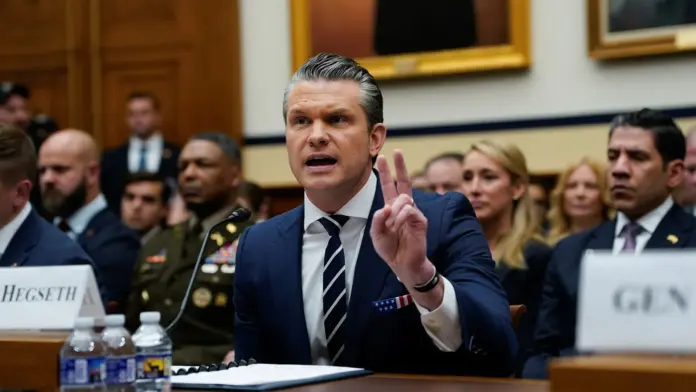
WASHINGTON — Secretary of Defense Pete Hegseth and Joint Chiefs Chairman General Dan Caine appeared before Congress on Friday to defend a war that has cost the United States $25 billion, killed 14 American service members, and triggered a fierce debate over whether the Trump administration is legally obligated to seek congressional authorisation to continue fighting.
Friday marked exactly 60 days since President Donald Trump formally notified Congress of the joint US-Israeli strikes on Iran that began on February 28 — a threshold that carries significant legal weight under the 1973 War Powers Act, which theoretically compels a president to begin withdrawing forces or obtain legislative approval once that deadline passes.
The Pentagon’s acting comptroller, Jules Hurst III, publicly disclosed the $25 billion price tag for the first time during the hearing, attributing the bulk of the expenditure to munitions, the rapid deployment of military assets to the Middle East, and equipment lost in combat. The administration is separately considering asking Congress for an additional $200 billion to sustain the war effort — a request that would dwarf even the White House’s already extraordinary $1.5 trillion defence budget proposal.
Active fighting has been largely paused since April 8, following what officials have described as a 12-day intensive campaign. The US imposed a naval blockade on the Strait of Hormuz as part of the operation, a move with sweeping implications for global energy markets. Trump has warned he will resume strikes if ceasefire negotiations, currently stalled, fail to produce progress.
Democratic lawmakers used the hearing to press Hegseth on a range of troubling aspects of the conflict. Representative Adam Smith challenged the secretary on what he described as contradictions in Hegseth’s public statements regarding Iran’s nuclear programme, pressing for clarity on the administration’s ultimate strategic objective. Representative John Garamendi was more blunt, calling the war a "quagmire" and a "political and economic disaster at every level."
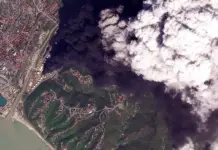
Among the most contentious moments came when lawmakers raised a US strike on a school in Minab, Iran, that killed at least 120 children. The strike has drawn international condemnation and complicated diplomatic efforts to broker a ceasefire. Hegseth did not offer a detailed public accounting of the incident during the hearing.
General Caine acknowledged that 14 US military personnel have died during the conflict — the only casualties the Pentagon has officially confirmed to date. The figure, while relatively low compared to previous American wars, drew sombre reflection from members of both parties.
The War Powers Act question loomed over the entire proceeding. With Republicans controlling both chambers of Congress, the administration faces little immediate legislative threat. Senior Republicans have largely signalled they intend to avoid holding a formal vote to authorise the war, effectively shielding the White House from a politically uncomfortable debate. Representative Nancy Mace, who had previously expressed scepticism about the conflict, praised Hegseth’s testimony and appeared to soften her earlier reservations.
The hearing exposed a striking tension at the heart of Hegseth’s tenure. The secretary, a former Army National Guard officer who served in Iraq, built much of his public profile on sharp criticism of American involvement in "endless wars" and what he called misguided "nation building" abroad. Critics noted the irony of Hegseth now defending an open-ended military campaign with no clearly defined exit strategy and a potential nine-figure supplemental funding request on the horizon.
The administration’s war posture is also reverberating through global markets. The US naval blockade of the Strait of Hormuz — through which a significant share of the world’s oil supply passes — has contributed to an oil shock with far-reaching economic consequences, including inflationary pressure felt as far away as Australia.
With ceasefire talks stalled, the 60-day War Powers deadline now passed, and a massive supplemental spending request potentially heading to Capitol Hill, the political and financial stakes of the Iran conflict are escalating rapidly. Whether Congress chooses to assert its constitutional authority — or continue to defer to the executive — may define the trajectory of the war as much as any battlefield development.