KYIV, Ukraine — Russia issued an extraordinary warning Monday urging all foreign nationals, diplomatic staff, and international organisation personnel to leave Kyiv immediately, threatening a new wave of strikes on the Ukrainian capital in what European governments swiftly condemned as an unacceptable escalation of the three-year war.
Russia Warns Diplomats Kyiv — The Russian Ministry of Foreign Affairs announced that its armed forces were preparing systematic strikes against Ukrainian military-industrial facilities, decision-making centres, and drone manufacturing sites in Kyiv. In an unusual direct communication, Foreign Minister Sergey Lavrov personally notified US Secretary of State Marco Rubio of the planned operations and urged Washington to evacuate its embassy staff from the city.
It marked the first time Moscow had issued such a direct, public warning to foreign nationals inside Ukraine since the war began in February 2022.
Recommended Reading
![A fire engulfs a building following a Russian air strike on a residential area in Kramatorsk, Donetsk region, eastern Ukraine, May 25, 2026 [Maria Senovilla/EPA]](https://world-tension.s3.us-east-2.amazonaws.com/articles/1145/7aca8fd4c3c243a68056953a40f4e86f.webp)
Moscow framed the threatened strikes as retaliation for a Ukrainian drone attack on a student dormitory in Starobilsk, in the Russian-occupied Luhansk region, which Russia said killed 21 people. Earlier figures had placed the death toll at 18. President Vladimir Putin ordered his military on Friday to prepare retaliatory options following the attack. Ukraine’s military denied striking a dormitory, insisting its forces had targeted an elite drone command unit in the area.
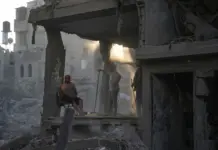
The warning came days after Russian drones and missiles struck Kyiv over the weekend, killing at least four people and injuring roughly 100 others. Overnight strikes Tuesday into Wednesday killed at least four more people and wounded more than 60 across Kyiv and surrounding areas. Separately, Ukrainian officials confirmed additional casualties in the eastern Kharkiv and Donetsk regions on Monday.
Ukraine has significantly expanded its own drone warfare capabilities in recent months, deploying largely homegrown interceptors designed to pursue and neutralise enemy unmanned aerial vehicles before they reach their targets. On May 17, a large Ukrainian drone barrage struck Moscow and several surrounding regions, killing at least five people. One Indian worker was killed and three others injured in the Moscow region, the Indian embassy in Russia confirmed. A woman also died after a drone struck a house in Khimki, north of Moscow, according to regional Governor Andrei Vorobyov.
Russia has deployed its Oreshnik hypersonic missile in recent attacks — a weapon capable of travelling at ten times the speed of sound — underscoring the increasingly sophisticated and destructive character of the conflict.
European governments reacted with alarm. Germany, the Netherlands, Norway, and the European Union all summoned Russian envoys on Tuesday, one day after Moscow’s warning was issued. The EU’s charge d’affaires was also called in by Russia. EU spokesperson Anitta Hipper described Russia’s threat to diplomats and foreign citizens as an ‘unacceptable escalation.’ Germany’s Federal Foreign Office accused Moscow of resorting to ‘threats, terror and escalation,’ pledging to continue supporting Ukraine with full force. Norway and the Netherlands each summoned their respective Russian ambassadors over the threats.
Russia Warns Diplomats Kyiv: The Wider European Impact
On the ground in Kyiv, life continued with a degree of defiant normalcy. French Ambassador Gael Veyssiere noted Monday that residents were going about their daily lives despite the weekend’s violence. Ukrainian Foreign Minister Andrii Sybiha urged allied nations not to capitulate to what he characterised as Russian blackmail.
The escalation arrives at a particularly fraught moment for diplomacy. US President Donald Trump, who returned to office in January 2025 having pledged to end the war, has met separately with both Putin and Ukrainian President Volodymyr Zelenskyy in pursuit of a negotiated settlement. Those efforts have so far yielded little. On May 22, Rubio acknowledged that the latest round of trilateral talks had been unsuccessful, though he reaffirmed Washington’s readiness to organise a new round of negotiations.
A brief three-day ceasefire agreed at the start of May — timed to coincide with Russia’s Victory Day commemorations marking the defeat of Nazi Germany — collapsed almost immediately, with both sides accusing the other of violations. Russia’s insistence on retaining the Ukrainian territories it has seized remains the central obstacle to any durable truce.
The war, now in its fourth year, shows no sign of abating. With European allies hardening their stance, peace talks stalled, and Moscow threatening fresh strikes on the Ukrainian capital, the prospect of a negotiated end to the conflict appears as distant as ever.