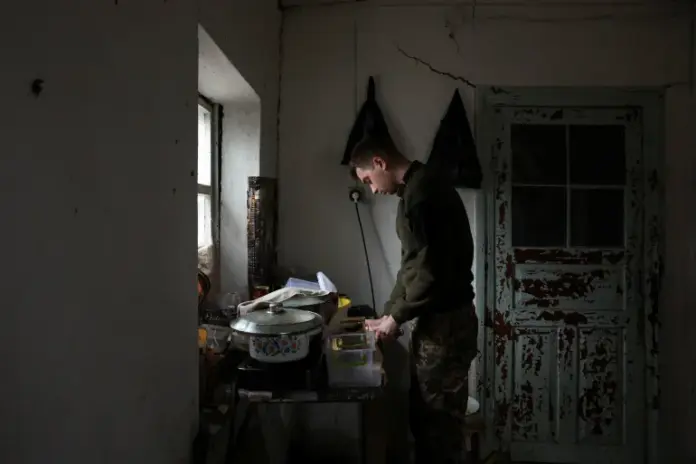
Ukraine Front-Line Starvation — Photographs of four skeletal Ukrainian soldiers, their faces hollowed by weeks of near-starvation, circulated widely in late April, igniting a national reckoning over how the country feeds its fighters in an era when drones have turned supply runs into suicide missions.
The soldiers belonged to units positioned on the eastern bank of the Oskil River in the southeastern Donetsk region, cut off from their brigade after Russian strikes destroyed the bridges connecting them to resupply lines. For up to 17 days, food deliveries simply did not arrive.
Anastasia Silchuk, whose husband serves in the 14th Mechanised Brigade, described the situation on social media on April 22, writing that fighters were fainting from hunger and drinking rainwater to survive. A 31-year-old soldier named Oleksandr said his daily rations had been reduced to chocolate bars, a packet of oatmeal, and a single bottle of water — a diet sustained not for days but for weeks.
Recommended Reading
The Ukrainian Defence Ministry ordered a formal investigation on April 28 into the failure to supply the brigade and two adjacent military units. The brigade’s commanding officer was dismissed in the aftermath of the images going viral.
The root cause, military analysts and soldiers alike agree, is the drone. Military drones now patrol kill zones extending up to 25 kilometres on both sides of the front line, around the clock. Suicide drones have rendered tanks and armoured vehicles largely ineffective, and even a four-wheel drive vehicle must travel at 120 kilometres per hour with constant evasive manoeuvres to have any chance of escaping an aerial attack. Oleksandr reported losing four pickup trucks in a single day to drone strikes. Ihor, a drone unit commander operating in eastern Ukraine, said soldiers can no longer safely leave their bunkers even for something as mundane as a cigarette.
The technological response has been the deployment of robotised carts equipped with video cameras, capable of ferrying ammunition and food to isolated outposts and evacuating the wounded without exposing human drivers. Heavier cargo drones capable of releasing several kilograms of supplies have become a primary lifeline for the most exposed positions. Andriy Pronin, one of Ukraine’s pioneering drone warfare specialists, said front-line logistics has been managed predominantly through drones and robotic carts for at least a year.
Yet the coverage remains far from universal. Nikolay Mitrokhin, a researcher at Bremen University in Germany, estimated that no more than ten percent of the entire Ukrainian army currently receives food delivered by drone. A disruption to that fragile aerial supply network, he warned, could produce starvation cases across a far wider stretch of the front.
Russian forces appear to be suffering comparable deprivation. In March 2025, soldiers from Ukraine’s Third Stormtrooper Brigade encountered a starving Russian fighter in the northeastern Kharkiv region who surrendered after being offered a chocolate bar tucked inside a note with instructions. A Tajik labour migrant named Mohammad, who had been conscripted into Russian service, described receiving only a small bottle of water and two or three small chocolate bars before being sent on a high-risk mission in the eastern Luhansk region. By the time he reached a Ukrainian prisoner-of-war detention facility — where he received three meals a day — he had dropped from 76 kilograms to 60.
Ukraine Front-Line Starvation: The Wider European Impact
The isolation of Russian units has reached extreme proportions in some sectors. Ukrainian intelligence reported in October 2025 that hundreds, possibly thousands, of Russian soldiers had been abandoned on islands in the Dnipro River in the southern Kherson region, facing acute shortages of both food and ammunition. Russian soldiers in active combat zones are reportedly ordered to move only in pairs or groups of three to avoid detection by Ukrainian forces.
The most disturbing account of Russian deprivation came from an intercepted conversation between two Russian officers, in which one described a soldier who killed a fellow serviceman and severed a leg for food. The exchange was reported in late April and has not been independently verified by Ukrainian authorities, though it aligns with a broader pattern of documented supply failures on the Russian side.
Together, the evidence from both sides of the front line paints a portrait of a conflict in which the ancient problem of feeding soldiers has collided with 21st-century aerial surveillance technology — producing a battlefield where hunger has become as lethal a threat as artillery. The Ukrainian government’s investigation may result in systemic reforms to drone logistics, but for soldiers already isolated in bunkers along the Oskil, the question of the next meal remains immediate and unresolved.