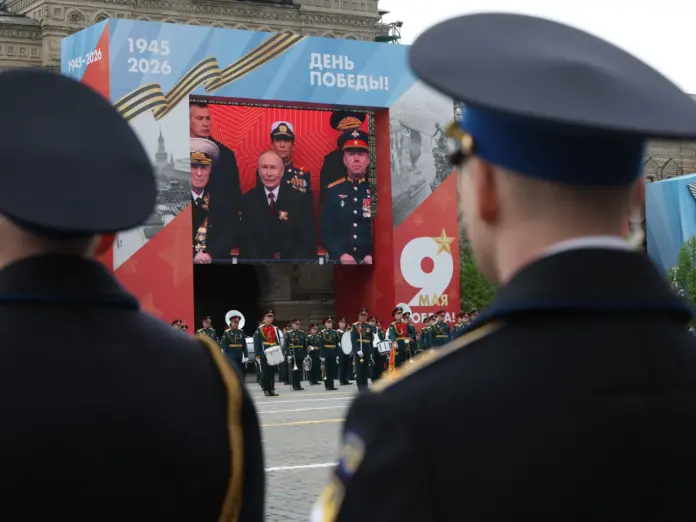
Russia Victory Day — Moscow staged its annual Victory Day Parade on May 9, but the spectacle carried unmistakable signs of strain. For the first time in recent memory, no heavy military equipment rolled across Red Square — tanks, missile launchers, and armoured vehicles conspicuously absent from a ceremony that has long served as a showcase of Russian military power. The reason was blunt: fear of Ukrainian drone strikes, which have penetrated deep into Russian territory and rendered even the symbolic heart of the Russian state vulnerable to aerial attack.
The contrast with last year’s parade was stark. The 80th anniversary of the Soviet triumph over Nazi Germany drew a constellation of world leaders to Putin’s side, including Chinese President Xi Jinping, Brazilian President Luiz Inácio Lula da Silva, Slovak Prime Minister Robert Fico, Serbian President Aleksandar Vucic, Venezuelan President Nicolás Maduro, Egyptian President Abdel Fattah el-Sisi, and Palestinian Authority head Mahmoud Abbas. This year’s guest list was considerably thinner — leaders from Belarus, Kazakhstan, Laos, Malaysia, and Uzbekistan attended, along with representatives from the breakaway territories of Republika Srpska, Abkhazia, and South Ossetia. The diplomatic retreat reflects Russia’s deepening isolation among major global powers.
President Vladimir Putin declared on Saturday that ‘the matter’ — his reference to the war in Ukraine — is coming to an end, even as the Russian military offensive remains stalled along multiple front lines. The claim sits uneasily alongside the economic data. Russian growth, which reached 4 percent in 2024 on the back of wartime spending, is projected to fall to just over 1 percent this year. Sanctions pressure, military expenditure, and demographic losses are compounding into a structural drag that wartime stimulus can no longer mask.
Recommended Reading
Donald Trump claimed credit for brokering a three-day ceasefire between Moscow and Kyiv, a development that generated headlines but little durable progress. The US president has also removed sanctions on some Russian oil exports in a bid to increase global supply — a move that has paradoxically pushed oil prices higher, filling Russian state coffers and improving Moscow’s fiscal balance even as Washington presents the policy as leverage.
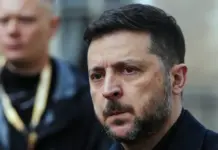
While Russia’s parade projected diminished confidence, a very different set of signals was emerging further south. Armenia hosted the annual summit of the European Political Community in the past week, with Ukrainian President Volodymyr Zelenskyy among the attendees. The gathering was followed immediately by the first-ever EU-Armenia summit, at which Brussels discussed up to 2.5 billion euros — approximately $2.95 billion — in investment in the country.
The diplomatic momentum around Yerevan is accelerating. In February, JD Vance became the first sitting US vice president to visit the Armenian capital. In August, Armenian Prime Minister Nikol Pashinyan and Azerbaijani President Ilham Aliyev signed a joint declaration at the White House pledging to pursue peace, and negotiations over the opening of the Zangezur corridor — a transit route connecting Azerbaijan proper to its exclave of Nakhchivan through Armenian territory — are ongoing. The project has been branded the "Trump Route for International Peace and Prosperity."
The pivot carries significant geopolitical weight. Armenia remains formally embedded in Russia’s orbit as a member of both the Collective Security Treaty Organisation and the Eurasian Economic Union. Yet Pashinyan’s government has been steadily reorienting toward the West, a trajectory that will face a direct electoral test in a June general election. His Civil Contract party will compete against the Armenia Alliance of former President Robert Kocharyan and the Strong Armenia party — both of which maintain strong connections to Moscow. The outcome will shape whether Armenia’s westward drift deepens or reverses.
Russia Victory Day: The Wider European Impact
Broader post-Soviet realignments are visible elsewhere. Pro-EU forces prevailed in Moldova’s 2025 parliamentary elections, consolidating that country’s European trajectory. Georgia, despite being governed by the Russia-friendly Georgian Dream party, maintains no diplomatic relations with Moscow — a reminder that even nominally sympathetic governments operate within constraints imposed by public opinion and economic reality.
Taken together, the images from Moscow and Yerevan this week tell a coherent story. A parade stripped of its armour, a shrinking guest list, a stalling economy, and drone strikes reaching the Russian heartland on one side; investment summits, vice-presidential visits, and peace declarations on the other. The post-Soviet order that Russia has long sought to anchor is shifting, and the pace of that shift appears to be quickening.