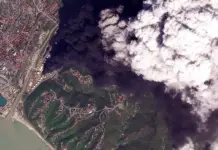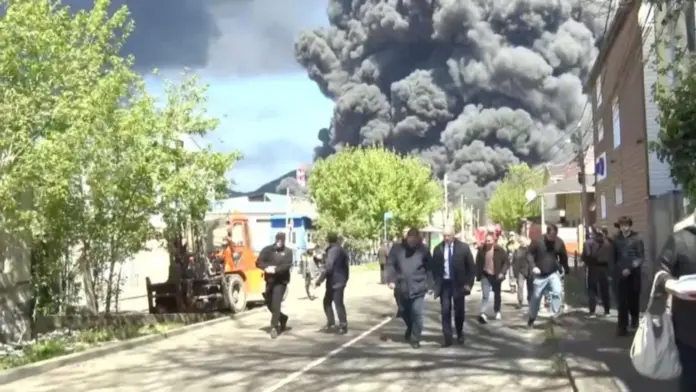
Ukrainian drones struck the Tuapse oil refinery on Russia’s Black Sea coast for the third time in a single month on Sunday, triggering a massive fire that forced the evacuation of nearby residents and prompted Vladimir Putin to order his emergencies minister to fly to the site immediately.
More than 160 firefighters were deployed to battle the blaze at the strategically significant facility in the Krasnodar region, one of Russia’s most important petroleum processing installations. No casualties were reported from the strike itself, though a temporary evacuation centre was established at a local school to shelter displaced residents.
The regional crisis centre issued a public health warning, alerting residents that combustion products were being released into the atmosphere and advising them to wear masks and rinse their nose, eyes and throat. The scale of the environmental impact was already visible before Sunday’s attack — earlier strikes at the refinery over the preceding two weeks had caused a significant oil spill into the Black Sea. Residents of Tuapse reported a disturbing phenomenon: black rain falling on the city, leaving an oily residue across the urban area.
Krasnodar regional governor Veniamin Kondratyev confirmed the evacuation orders, while Sergei Boyko, head of the local municipal district, coordinated emergency response on the ground. Local environmental correspondent Anastasia Troyanova of the outlet Kedr documented the environmental fallout from the repeated strikes.
Ukraine’s military confirmed responsibility for the attack, framing it explicitly within a broader strategic objective. Kyiv has argued consistently that Russian energy facilities constitute legitimate military targets because the revenue and fuel they generate directly sustain Moscow’s war machine. The Tuapse strike is part of a markedly intensified Ukrainian campaign against key energy infrastructure across Russian territory in recent months — a campaign designed, in Kyiv’s own words, to degrade Russia’s military-economic potential.
The Kremlin pushed back sharply. Spokesman Dmitry Peskov accused Ukraine of deliberately engineering oil shortages in global energy markets through its targeting of refinery infrastructure — a charge Kyiv dismisses as deflection from Russia’s own conduct in the war.
The exchange of strikes underscored the widening geographic scope of the conflict. In Kyiv, Russian drone attacks on the same day left one person injured and sparked several fires across the city, including one at a cemetery. Mayor Vitaliy Klitschko confirmed the incidents as emergency services responded across multiple districts.
The Tuapse refinery has now become one of the most frequently targeted single facilities in Ukraine’s long-range strike campaign. Its location on the Black Sea coast makes it both a logistical hub for Russian fuel distribution and a symbolically significant target. The cumulative damage from three strikes within a month raises serious questions about the facility’s operational capacity and Russia’s ability to protect critical industrial infrastructure deep within its own territory.
Putin’s decision to personally direct his emergencies minister to travel to Tuapse signals the political weight the Kremlin attaches to the attack — both as an operational crisis requiring urgent management and as a domestic communications challenge, given the visible environmental damage now affecting a Russian civilian population.
Russia launched its full-scale invasion of Ukraine in February 2022. Since then, the conflict has evolved from conventional ground warfare into a multi-domain struggle encompassing long-range missile exchanges, drone warfare, and deliberate targeting of economic infrastructure on both sides. Ukraine’s systematic pressure on Russian oil refining capacity represents one of the most consequential strategic shifts of the war’s third year, with potential implications not only for Russia’s battlefield logistics but for global energy supply chains.
The fires at Tuapse were still being brought under control as of Sunday evening, with authorities providing no immediate timeline for when the refinery might resume operations.