The world’s leading shipping industry body has issued a sharp condemnation of both the United States and Iran for seizing commercial vessels in the Gulf, warning that the escalating maritime standoff is devastating global trade and leaving tens of thousands of sailors trapped in one of the world’s most strategically vital waterways.
The International Chamber of Shipping, which represents approximately 80 percent of the world’s merchant fleet, declared that the capture of commercial ships by either side violates the freedom of navigation enshrined in international law. Marine director John Stawpert also dismissed Iran’s stated ambition to charge tolls in the Strait of Hormuz as having no legal foundation whatsoever under international maritime law.
The crisis has unfolded rapidly since the United States and Israel launched military operations against Iran on February 28, prompting President Donald Trump to impose a naval blockade of Iranian ports. Iran responded by effectively shutting down the Strait of Hormuz, a chokepoint that ordinarily carries roughly one-fifth of the world’s oil and natural gas supplies.
The consequences for global shipping have been severe. Where the strait once recorded a daily average of 129 transits — a figure documented by the United Nations Trade and Development agency before February 28 — just five ships passed through in the most recent 24-hour period. An estimated 20,000 seafarers remain stranded in the Gulf, unable to transit safely in either direction.
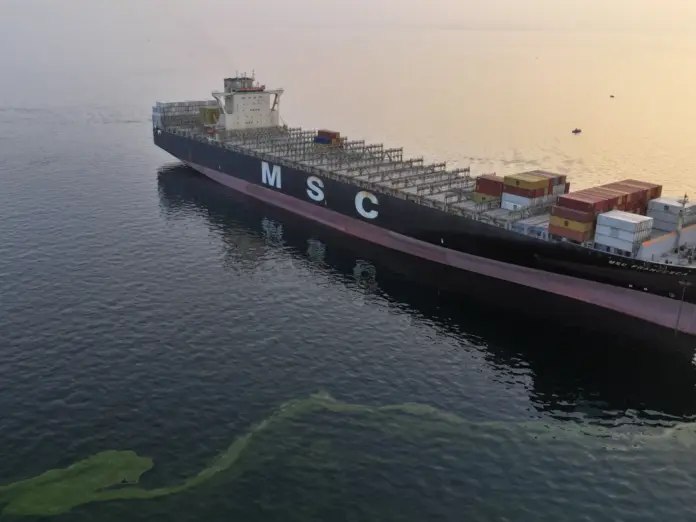
Iran’s Islamic Revolutionary Guard Corps has seized at least two commercial vessels in recent days. The Panamanian-flagged MSC Francesca and the Greek-owned Epaminondas were both detained, with Iranian authorities claiming the ships were operating without the necessary permits and had been tampering with their navigation systems. Fifteen Filipino seafarers were confirmed aboard the two vessels, along with four Montenegrin crew members on the MSC Francesca.
Diplomatic assurances have been offered regarding the welfare of those detained. The Philippines’ Department of Migrant Workers confirmed that Iranian authorities had given assurances the Filipino crew members were unharmed and safe. Montenegro’s maritime minister, Filip Radulovic, separately confirmed that the four Montenegrin nationals aboard the MSC Francesca were in good condition.
On the American side, the US Navy captured the Iran-linked vessel Majestic X in the Indian Ocean while it was transporting sanctioned oil, along with a second ship named the Tifani. The International Chamber of Shipping made clear its condemnation extends to both parties, framing the seizures as a mutual assault on the foundational principles of international maritime commerce.
The economic fallout from the strait’s near-closure is already being felt far beyond the Gulf region. Fuel prices have risen sharply worldwide, and multiple governments have begun implementing emergency energy-saving measures in response to the supply disruption. The Strait of Hormuz’s role as the primary export corridor for Gulf oil producers means that even a partial, sustained blockage sends immediate shockwaves through global energy markets.
The situation represents one of the most serious disruptions to international shipping in decades. The collapse in transit numbers — from 129 daily crossings to just five — illustrates the near-total paralysis of a waterway that underpins the energy security of nations across Asia, Europe, and beyond. Industry leaders are pressing both Washington and Tehran to allow safe passage for commercial vessels and their crews, arguing that civilian seafarers and the global economy must not be treated as instruments of geopolitical leverage.
With no immediate diplomatic resolution in sight and traffic through the strait remaining a fraction of pre-war levels, the humanitarian and economic pressure on all parties continues to mount.