KYIV — Ukraine’s intensifying campaign of deep-strike warfare is carving a widening hole in Russia’s energy economy, with Kyiv claiming billions of dollars in lost oil revenue, a sharp drop in export volumes, and forced production cuts that are straining the Kremlin’s war finances.
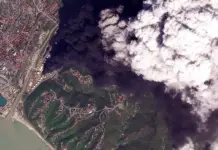
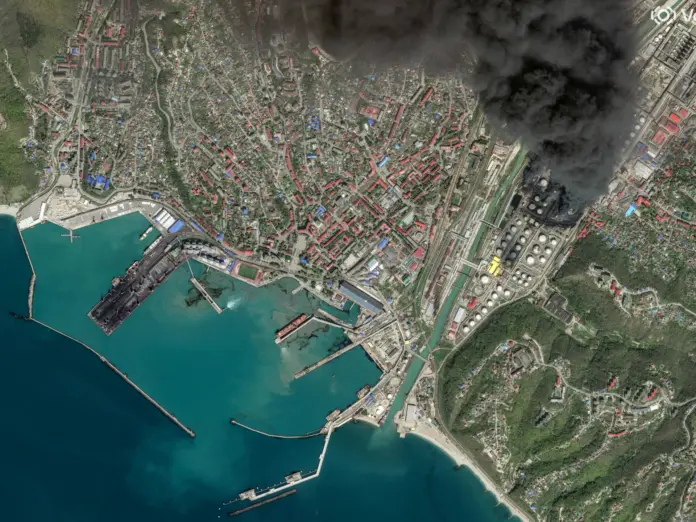
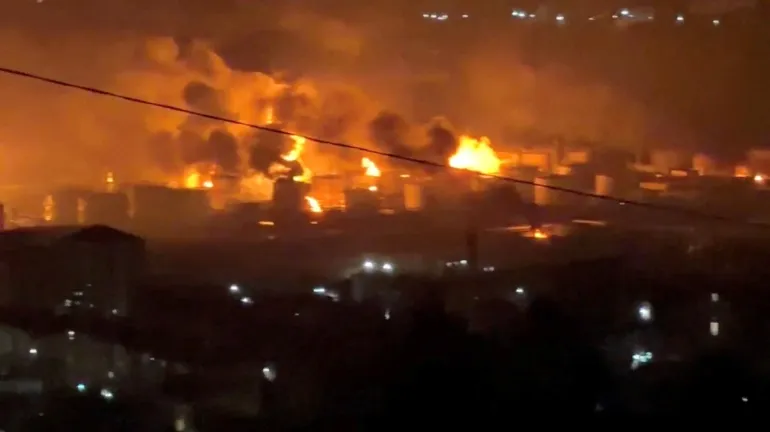
On April 16, Ukrainian forces struck oil loading berths and a refinery at Tuapse on the Black Sea coast. The following days brought further blows: refineries at Sizran and Novokuibyshevsk — roughly 1,000 kilometres from the Ukrainian border — were hit on Saturday, while the Samara refinery and the Gorky refinery in Nizhny Novgorod, 500 kilometres from Ukraine, were struck on Friday. The strikes represent a dramatic expansion of Ukraine’s operational reach, targeting industrial nodes deep inside Russian territory that Moscow had long considered beyond effective range.
The cumulative toll is significant. President Volodymyr Zelenskyy estimated that Russia’s oil revenue losses from Ukrainian long-range strikes in March alone reached no less than $2.3 billion. Ukraine’s foreign intelligence service, citing data from S&P Global Platts, reported that Russian oil transhipments fell by 300,000 barrels a day in March, with refined product transhipments declining by a further 200,000 barrels a day. Russia has been compelled to cut crude production by between 300,000 and 400,000 barrels a day, a figure corroborated by multiple industry sources. Russian business newspaper Kommersant reported that oil exports had fallen to their lowest levels since the summer of 2024.
The financial pressure on Moscow is acute. Sweden’s military intelligence chief, Thomas Nilsson, warned that Russia would need oil prices to remain above $100 a barrel for the remainder of the year simply to cover its budget deficit — a threshold that current market conditions make difficult to sustain.
The strikes have not been limited to energy infrastructure. Ukraine also targeted the Atlant Aero company, a manufacturer of Molniya drones and components for Orion reconnaissance and strike unmanned aerial vehicles, striking directly at Russia’s drone production capacity.
On the diplomatic front, Ukraine is broadening its security partnerships well beyond Europe. Zelenskyy announced that Kyiv has signed 10-year defence cooperation agreements with Saudi Arabia, Qatar, and the United Arab Emirates, and that 11 countries — primarily from the Middle East and Gulf region — have submitted requests for defence cooperation. The European Union also released a 90-billion-euro loan to Ukraine, with two-thirds of the funds earmarked to support the country’s military effort.
Ukraine’s domestic defence industry is simultaneously expanding. Defence Minister Mykhailo Fedorov disclosed on April 17 that private air defence groups are being established at 19 Ukrainian enterprises. One such system successfully downed a jet-powered Shahed drone travelling at 400 kilometres per hour. Separately, Ukraine’s Unmanned Systems Forces announced that a Sting interceptor drone shot down a Shahed launched from an unmanned surface vehicle — a first-of-its-kind engagement that signals the evolving complexity of the aerial battlefield.
Meanwhile, the geopolitical backdrop has shifted in ways that complicate Russia’s position. The United States waived sanctions on Russian oil in early March after Iran closed the Strait of Hormuz to shipping, and renewed that waiver on April 13 through May 16. The move has provided Moscow with a narrow economic lifeline, though one that Ukraine’s strike campaign is actively working to neutralise.
On the ground, competing claims over territorial control have drawn scrutiny. Russian Chief of General Staff Valery Gerasimov asserted that Russia seized 1,700 square kilometres in 2024. The Institute for the Study of War, using open-source geolocated data, calculated the actual figure at 381.5 square kilometres — and noted that Russia has suffered a net loss of 60 square kilometres since March.
The strain of prolonged conflict is registering inside Russia. The Leningrad regional Governor Alexandr Drozdenko declared on April 15 that St Petersburg had effectively become a front-line region. More strikingly, President Vladimir Putin’s approval rating fell from 72.9 percent to 66.7 percent over six consecutive weeks, according to the Russian Public Opinion Research Center’s April 17 data — a sustained erosion that analysts are watching closely as the war enters its fourth year.
In a further diplomatic development, Hungary’s Prime Minister Viktor Orban — long the most vocal opponent of EU support for Ukraine within the bloc — suffered a landslide defeat in parliamentary elections, potentially removing a key obstacle to unified European backing for Kyiv. Ukraine’s Deputy Chief of Staff Ihor Zhovkva noted that Ukraine has fulfilled 75 percent of its Association Agreement with the EU, underscoring Kyiv’s continued push toward deeper integration with the bloc even as the war grinds on.