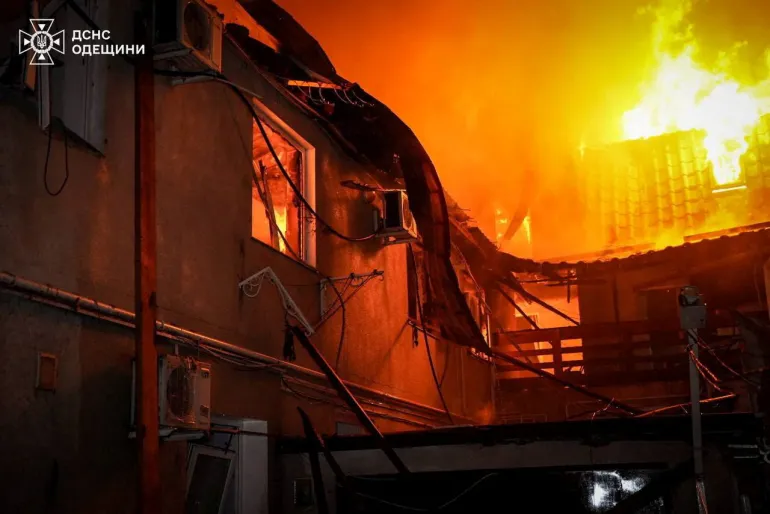
Russian forces launched a large-scale overnight assault on Odesa, Ukraine’s strategically vital southern port city, killing a married couple both aged 75 and wounding at least 14 others in a series of drone and missile strikes that also struck a foreign merchant ship operating in a nearby maritime corridor.
The elderly couple died when a separate attack struck their residential area, with one additional person wounded in the same strike. Across Odesa more broadly, overnight strikes injured at least 13 people and destroyed residential buildings throughout the city. Serhiy Lysak, head of the local military administration, confirmed the casualties and the scale of the destruction.
Two Russian drones struck a bulk carrier flagged to Saint Kitts and Nevis while it was navigating a Ukrainian maritime corridor near Odesa. The impact triggered a fire aboard the vessel, which the crew successfully extinguished. Preliminary information indicated no personnel were injured in the maritime strike.
The assault was part of a broader overnight campaign in which Russia launched 107 drones and two ballistic missiles at Ukrainian territory. Ukraine’s Air Force reported that air defences destroyed or electronically jammed 96 of the incoming drones, with 10 drones and both ballistic missiles recorded as having struck their targets. Russian authorities separately claimed their own air defences shot down 10 Ukrainian drones overnight.
The strikes arrived against a backdrop of intensifying Western economic pressure on Moscow. The European Union formally approved a landmark 90 billion-euro loan — equivalent to approximately $106 billion — for Ukraine, a package expected to cover roughly two-thirds of the country’s funding requirements for 2026 and 2027. The approval signals a sustained European commitment to underwriting Ukraine’s wartime economy as the conflict enters its fifth year.
Simultaneously, the EU imposed a fresh round of sanctions targeting Russia’s energy, banking, and trade sectors. The measures include tightened restrictions on Moscow’s so-called shadow fleet — a network of ageing tankers used to circumvent existing oil export controls. Russia’s mission to the EU swiftly rejected the measures, arguing they lacked legitimacy under international law and infringed upon the rights of third-party nations not party to the conflict.
The Odesa strikes underscore the continued vulnerability of Ukraine’s Black Sea coastline and its commercial shipping lanes, which Kyiv has worked to reopen as a lifeline for grain and commodity exports. Attacks on merchant vessels in the corridor risk renewed disruption to global food supply chains and heighten pressure on international insurers and shipping operators already wary of the region.
Beyond the battlefield, the geopolitical environment surrounding the war remains fluid. Turkish President Recep Tayyip Erdogan warned that the ongoing conflict is beginning to weaken Europe, adding a regional voice to growing concerns about the war’s long-term economic and security consequences for the continent.
Meanwhile, US President Donald Trump signalled continued American engagement across multiple global flashpoints. He announced a three-week extension of the Israel-Lebanon ceasefire — now in its 56th day — while stating he would not rush negotiations over a potential deal with Iran. Trump also ordered the US Navy to intercept and engage minelayers operating in the Strait of Hormuz, with American forces boarding an oil tanker as part of those operations, raising tensions in one of the world’s most critical maritime chokepoints.
For Ukraine, the immediate priority remains defending its cities and coastline. The destruction of residential buildings in Odesa and the deaths of two elderly civilians illustrate the human cost of a war that shows no signs of abating, even as diplomatic and financial frameworks designed to sustain Kyiv’s resistance continue to take shape in Brussels and beyond.