A fragile diplomatic pause between Washington and Tehran is fraying dangerously on its 55th day, with Iranian naval forces seizing foreign vessels in the Strait of Hormuz and both sides trading accusations of bad faith that threaten to unravel one of the region’s most consequential ceasefires.
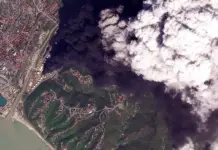
The Islamic Revolutionary Guard Corps captured two foreign ships operating in the strait and opened fire on a third vessel it accused of violating Iranian restrictions. The incidents mark a sharp escalation in what has become a battle of blockades: the United States has imposed a naval cordon on Iran’s ports, a measure Tehran’s parliament speaker condemned as a ‘blatant violation’ of the ceasefire agreement. He added that Iran would not reopen the Strait of Hormuz — a chokepoint through which roughly a fifth of the world’s oil supply passes — for as long as the American blockade remained in force.
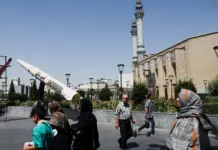
Iranian President Masoud Pezeshkian struck a more conciliatory tone publicly, insisting that Tehran still seeks ‘dialogue and agreement.’ Yet his government simultaneously cited what it described as a pattern of ‘breach of commitments, blockade and threats’ as the primary reasons negotiations have stalled. The dual messaging reflects the internal tensions within Iran’s leadership as economic pressure mounts.
The White House has shown no sign of blinking. Press Secretary Karoline Leavitt confirmed that President Donald Trump has set no deadline for Iran to submit a peace proposal, and that the ceasefire extension carries no firm expiration date. Trump’s calculation, according to administration thinking, is that the naval blockade is squeezing Iran’s economy hard enough to eventually force it back to the negotiating table on American terms.
The diplomatic paralysis in the Gulf is mirrored by renewed violence on two other fronts. In southern Lebanon, Israeli air strikes killed at least five people on Wednesday, including Amal Khalil, a correspondent for the Lebanese newspaper Al Akhbar. Freelance journalist Zeinab Faraj was wounded in the same wave of attacks. Follow-up Israeli strikes in the village of al-Tayri targeted a group that included the two reporters, and a Lebanese Red Cross ambulance attempting to evacuate one of the journalists came under stun grenades and gunfire — an incident that drew immediate condemnation from press freedom advocates.
The strikes occurred despite an active ceasefire between Israel and Lebanon, deepening questions about the durability of that agreement. Israeli Foreign Minister Gideon Saar insisted his country has no ‘serious disagreements’ with Lebanon itself, pointing instead to Hezbollah as ‘the obstacle to peace and normalisation.’ That framing was echoed by Mark Kimmitt, a retired US Army brigadier general and former assistant secretary of state, who argued that Washington’s diplomatic efforts on the Israel-Lebanon file are fundamentally undermined by Hezbollah’s absence from the talks.
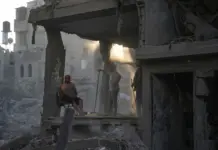
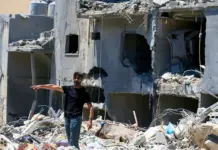
In Gaza, Israeli forces struck a group of civilians near the Al-Qassam Mosque in Beit Lahiya on Wednesday, killing five Palestinians. Three of the dead were children. The attack added to a mounting civilian toll that has drawn sustained international criticism even as Israeli military operations continue across the territory.
The overlapping crises — a naval standoff in the Strait of Hormuz, journalist casualties in Lebanon, and child deaths in Gaza — illustrate the degree to which the region’s multiple conflict threads remain dangerously intertwined. A miscalculation in any one theatre carries the potential to ignite the others.
The Strait of Hormuz confrontation is particularly volatile. Iran’s parliament speaker has effectively issued an ultimatum: the blockade must end before the waterway returns to normal operations. With Trump showing no inclination to ease economic pressure and Iran’s IRGC taking increasingly assertive action against foreign shipping, the risk of an unintended military clash in one of the world’s most strategically sensitive waterways is rising by the day.
Diplomats and analysts watching the situation note that the absence of a firm deadline from Washington, while intended to project patience and strength, also removes a structural incentive for either side to accelerate compromise. Fifty-five days in, the ceasefire that was meant to create space for a broader deal is instead becoming the arena for a new confrontation.