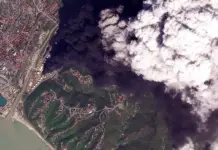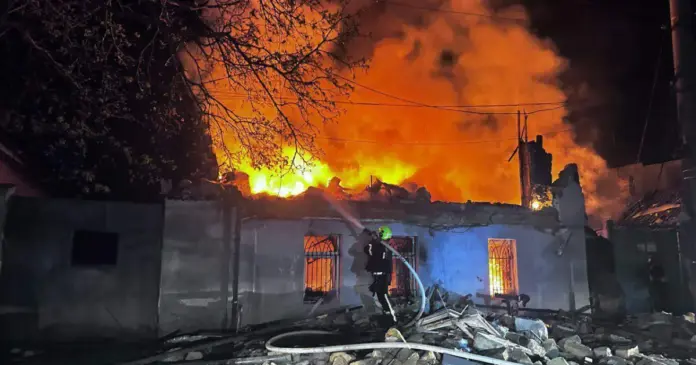
Russian drones struck Ukraine’s principal Black Sea port in Odesa and a railway sorting yard in the Zaporizhia region overnight, killing a railway worker and injuring another in one of the most expansive aerial assaults in recent weeks. The attacks, confirmed Wednesday by Ukraine’s Deputy Prime Minister Oleksii Kuleba, targeted critical logistics and export infrastructure as the war enters its fourth year.
At the Zaporizhia-Live station sorting yard, an assistant train driver was killed when Russian drones struck the facility. The main train driver sustained injuries and is receiving hospital treatment. The simultaneous assault on Odesa’s port caused extensive damage to berths, warehouses, railway infrastructure, and facilities used by port operators — a deliberate blow to Ukraine’s capacity to move grain and other exports through its most strategically vital maritime gateway.
The scale of the overnight campaign was significant. Ukraine’s army intercepted 189 of 215 Russian drones launched during the assault, but 24 drones still reached their targets, striking 13 separate locations across the country. The Russian Ministry of Defence, for its part, claimed its forces destroyed 155 Ukrainian drones overnight.
Among the most alarming aspects of the attack was the flight path of Russian Kinzhal hypersonic missiles. Prosecutor General Ruslan Kravchenko reported that 35 Kinzhals were detected flying within approximately 20 kilometres of either the decommissioned Chornobyl nuclear plant or the active Khmelnytskyi nuclear facility. Eighteen of those missiles passed within 20 kilometres of both sites on the same flight path. The proximity to nuclear infrastructure drew immediate concern, particularly as Ukraine prepares to mark the 40th anniversary of the 1986 Chornobyl disaster this Sunday.
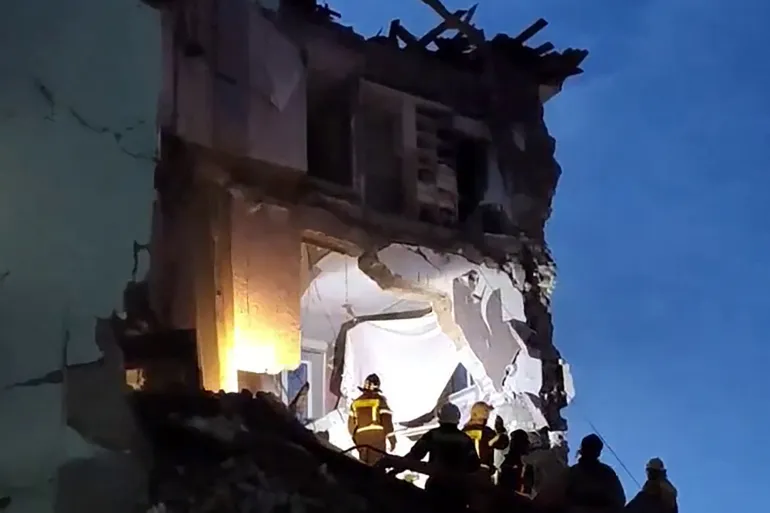
Ukraine also struck back. A Ukrainian drone attack on Syzran, a city in central Russia that is home to one of the country’s premier air force academies, killed two civilians — an adult woman and a child. The strike partially collapsed a four-storey apartment building, marking one of the deadlier Ukrainian strikes on Russian civilian infrastructure in recent memory.
The intensifying aerial exchanges unfold against a backdrop of stalled diplomacy. Several rounds of United States-brokered peace negotiations have collapsed in recent months without producing a ceasefire framework. Ukraine has proposed freezing the conflict along current front lines, but Russia has rejected the offer outright, instead demanding full control of the entire Donetsk region — territory it does not fully occupy.
Efforts to arrange a direct meeting between President Volodymyr Zelenskyy and President Vladimir Putin have similarly stalled. Foreign Minister Andrii Sybiha confirmed that Kyiv formally asked Turkiye to host a summit between the two leaders. Ukraine has stated it would accept any neutral venue for such talks, explicitly excluding Russia and Belarus — the latter having allowed Russian forces to use its territory as a launchpad for the full-scale invasion that began in February 2022. The Kremlin has previously indicated a willingness to receive Zelenskyy in Moscow, an offer he has flatly rejected.
The dual reality of relentless bombardment and diplomatic paralysis underscores the war’s grinding trajectory. Russia’s targeting of port infrastructure in Odesa is part of a sustained campaign to strangle Ukraine’s export economy, while strikes on railway networks disrupt both military logistics and civilian supply chains. Ukraine’s ability to intercept the vast majority of incoming drones reflects significant investment in air defence, but the sheer volume of attacks means critical infrastructure continues to absorb damage.
With no ceasefire in sight and missile trajectories skirting nuclear facilities, the conflict shows no signs of de-escalation — even as both sides absorb mounting losses on the ground and in the air.