Russian security forces have detained a German woman in the southern city of Pyatigorsk after discovering a homemade explosive device in her backpack, with the Federal Security Service (FSB) alleging she was part of a Ukrainian-directed plot to bomb a law enforcement facility in the Stavropol region.
The woman, born in 1969, was arrested on Monday. The FSB stated she had been recruited by a citizen of an unspecified Central Asian country, who was himself acting on orders from Kyiv. That recruiter was subsequently located and arrested near the intended target site.
The explosive device found in the woman’s backpack contained a charge equivalent to 1.5 kilograms of TNT and was designed to be detonated remotely. The FSB claimed the blast was prevented through electronic jamming, which disrupted the detonation signal before the device could be triggered.
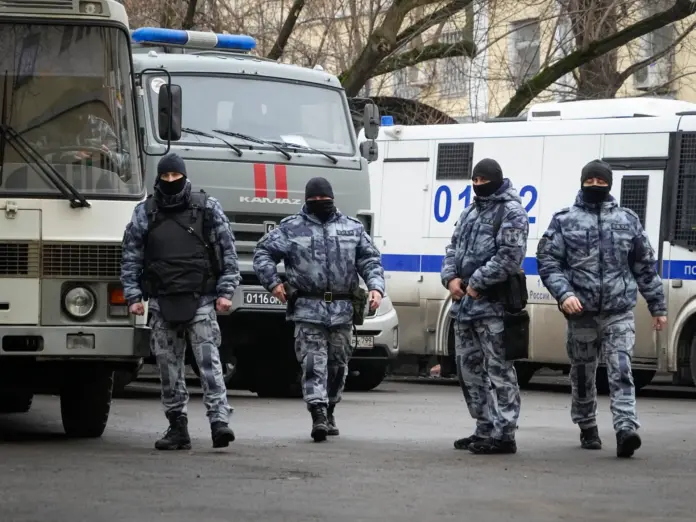
Footage of the operation, released by Russian state media, showed armed security agents in tactical gear approaching the woman in a car park. A second video depicted masked plainclothes officers detaining a man and pulling him into a station. A controlled explosion of the backpack was also captured on camera.
The Kremlin has offered no independent verification of the alleged Ukrainian connection, and Ukraine has not commented on this specific incident. Kyiv has consistently denied involvement in attacks carried out on Russian territory throughout the conflict, which entered its fourth year following Russia’s full-scale invasion in February 2022.
The arrest fits a well-established pattern. Russian authorities have detained dozens of individuals since the war began, accusing them of acting as agents or saboteurs on behalf of Ukraine. The allegations frequently involve intermediaries from Central Asian nations, a recruitment pathway Moscow has highlighted in multiple prior cases.
The most prominent and contested example came in March 2024, when gunmen stormed the Crocus City Hall concert venue on the outskirts of Moscow, killing 150 people in one of the deadliest attacks on Russian soil in decades. Russian officials initially alleged that the perpetrators — identified as members of Islamic State (ISIL) — had acted in coordination with Ukraine. ISIL claimed full responsibility for the massacre and made no reference to any Ukrainian involvement. Moscow produced no evidence linking Kyiv to the attack, and Ukraine categorically denied any role.
The recurrence of such accusations has drawn scrutiny from international observers, who note that Russia has used alleged Ukrainian-sponsored terrorism as a domestic political narrative to justify the continuation of the war and to frame Kyiv as a sponsor of indiscriminate violence against civilians.
Russia has also previously alleged that Ukraine has sought to exploit Islamic fundamentalist networks to carry out attacks inside Russian borders — a charge Ukraine rejects and one that independent analysts have found no credible evidence to support.
The Stavropol region, where the alleged attack was planned, sits in Russia’s volatile North Caucasus, a strategically sensitive area that has historically experienced instability and has been the site of previous security incidents. Pyatigorsk, where the German woman was detained, is a major city in the region.
The German woman’s identity has not been disclosed by Russian authorities. Berlin has not publicly responded to the FSB’s announcement. Germany, a NATO member and one of Ukraine’s key military and financial supporters, has been a frequent target of Russian accusations of hostile interference throughout the war.
The FSB’s announcement comes amid a broader escalation in Russian domestic security operations, with authorities framing the conflict not merely as a conventional military engagement but as an existential struggle against what they describe as Western-backed subversion. Critics argue these narratives serve to suppress dissent and justify expanded surveillance and detention powers at home.
As the war grinds on with no diplomatic resolution in sight, incidents like the Pyatigorsk arrest are likely to continue fuelling Moscow’s information campaign — regardless of whether the underlying allegations withstand independent scrutiny.