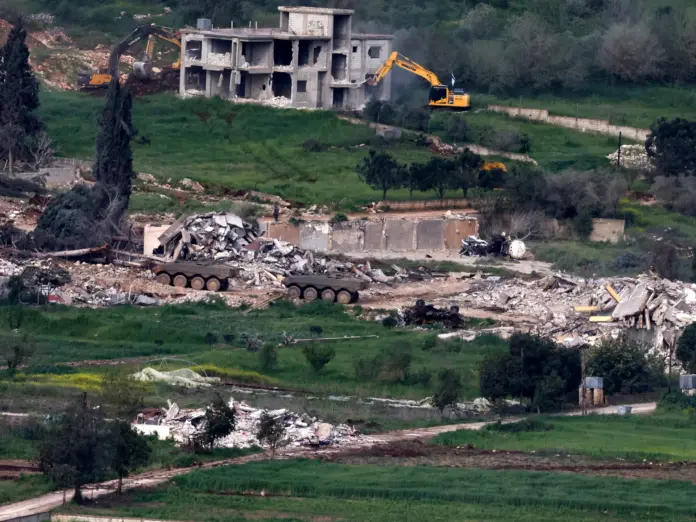
A fragile ceasefire between Israel and Lebanon collapsed into controversy within hours of taking effect Thursday night, as Israeli forces conducted demolitions, artillery strikes, and land-clearing operations across multiple border communities — even as the ink dried on an agreement meant to halt 46 days of bombardment and ground invasion in southern Lebanon.
Prime Minister Benjamin Netanyahu confirmed that Israeli troops are not withdrawing. Instead, he announced the establishment of a reinforced security buffer zone extending roughly 10 kilometres north of the Israeli border into Lebanese territory — a corridor Israeli military officials have designated the ‘Yellow Line.’ Residents of 55 Lebanese towns and villages within that zone will not be permitted to return, the military stated.
Israeli Defence Minister Israel Katz declared Friday that the military would continue to hold and control every position it has cleared and secured inside Lebanon. Military officials were explicit that the Yellow Line model mirrors the approach already applied in Gaza, where Israeli forces now control an eastern strip comprising roughly 60 percent of the enclave. Since a US-brokered ceasefire was agreed in Gaza in October, Israeli attacks there have killed more than 700 people and wounded approximately 2,000.
The ceasefire text itself contains language that critics say renders it structurally ambiguous. While it commits both Israel and Lebanon to a cessation of hostilities, it simultaneously affirms that Israel ‘shall preserve its right to take all necessary measures in self-defence.’ Israeli forces invoked that clause almost immediately, announcing air strikes after the ceasefire began — the first targeting fighters the military claimed were approaching Israeli troops near the Yellow Line.
On Saturday, Israeli forces blew up homes in the town of Haneen, while artillery shells were fired toward Beit Lif, al-Qantara, and Toul — all during the ceasefire period. The operations drew sharp condemnation from Lebanese officials and deepened alarm among international observers already watching the agreement unravel.
The situation grew more volatile Saturday when a French soldier serving with UN peacekeepers was killed and three others wounded in an ambush in southern Lebanon. French President Emmanuel Macron blamed Hezbollah for the attack. Hezbollah denied responsibility, but the incident underscored the precariousness of the security environment on the ground.
Hezbollah has made no secret of its hostility toward the agreement. The group condemned the ceasefire as ‘an insult to our country’ and ‘a slippery slope with no end in sight,’ insisting that any cessation of hostilities must be mutual rather than unilateral. The group also denounced parallel talks between the Lebanese government and Israel as a ‘humiliation’ and a ‘shameful spectacle.’
Hezbollah has further linked the Lebanon ceasefire to broader regional diplomacy, tying its posture to expected talks between the United States and Iran in Islamabad. Iranian officials have stated that a ceasefire in Lebanon is a prerequisite for any meaningful progress in negotiations with Washington — a linkage that embeds the Lebanese conflict within a wider geopolitical contest over Iran’s regional influence.
Both Israeli and Lebanese officials have called for Hezbollah to disarm. Hezbollah has refused, insisting disarmament cannot occur without agreement on a national defence strategy — a position that leaves the core political dispute entirely unresolved even as the guns nominally fall silent.
The current crisis carries the weight of unfinished history. Israel occupied southern Lebanon for years before withdrawing in 2000, though it retained control of the disputed Shebaa Farms area. Following a November 2024 ceasefire, Israeli forces never fully departed southern Lebanon, continuing to carry out operations inside the country. Israel also continues to occupy the Syrian Golan Heights and Palestinian land in the occupied West Bank — a pattern of territorial control that shapes how regional actors interpret Israeli intentions in Lebanon.
The Yellow Line, as conceived, would effectively institutionalise a new Israeli military presence on Lebanese soil — one that echoes the logic of the Gaza corridor and signals that the ceasefire, whatever its formal terms, may represent not an end to the conflict but a reconfiguration of it.