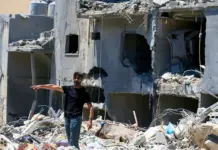
![A boy sits under a broken UNICEF sign as Palestinians inspect the site of an Israeli strike on a school sheltering displaced people [File: Mahmoud Issa/Reuters]](https://www.world-tension.com/app/uploads/2026/04/wt-image-115-696x522.webp "wt-image-115")
GAZA CITY — Israeli forces killed two water truck drivers working under contract for UNICEF on Friday morning, striking them at the Mansoura water filling point in northern Gaza — a critical facility that supplies drinking water to Gaza City. Two additional people were wounded in the attack. UNICEF immediately suspended all activities at the site and issued a sharp condemnation, calling on Israeli authorities to investigate and ensure full accountability.
"Humanitarian workers, essential service providers, and civilian infrastructure must never be targeted," UNICEF stated, invoking international humanitarian law as the binding legal framework requiring the protection of civilians and those delivering life-saving assistance. The agency described itself as "outraged" by the killings.
The suspension of operations at Mansoura compounds an already catastrophic humanitarian situation in Gaza, where access to clean water has been severely constrained throughout more than 18 months of conflict. The filling point serves as a primary water source for one of the territory’s most densely populated urban areas, and its closure — even temporarily — threatens to deepen the crisis for hundreds of thousands of civilians.
The deaths of the two drivers bring renewed international scrutiny to the conduct of Israeli military operations in Gaza. More than 72,000 Palestinians have been killed since Israel launched its military campaign on October 7, 2023, following a Hamas-led attack on southern Israel. Even after a US- and Qatar-brokered ceasefire took effect in October, more than 750 Palestinians have been killed by Israeli forces — a figure that underscores the fragility and contested nature of the truce.
Humanitarian organisations have repeatedly warned that aid workers and civilian infrastructure are being struck at an alarming rate, and Friday’s incident is likely to intensify pressure on Israel to demonstrate compliance with the laws of armed conflict. UNICEF’s call for a formal investigation reflects a broader pattern of demands from UN agencies that have gone largely unmet throughout the conflict.
Violence also continued in the occupied West Bank, where Israeli forces shot and killed a Palestinian man in the village of Khirbet Salama. The victim, Muhammad Ahmad Suwaiti, 25, was pronounced dead at the scene. The Palestinian news agency WAFA reported the killing.
Israel’s military offered a markedly different account of the West Bank incident, stating that forces had neutralised "a terrorist who infiltrated the community of Negohot" — an Israeli settlement in the area — and that the individual had been carrying a knife. The military referred to the West Bank using the biblical designation "Judea and Samaria," consistent with Israeli government terminology for the occupied territory.
The competing narratives reflect the deep divisions over accountability that have defined the conflict since its escalation in late 2023. According to the Palestinian Ministry of Health, Israeli forces and settlers have killed more than 1,060 Palestinians in the occupied West Bank since October 2023 — a toll that human rights groups say represents a dramatic surge in lethal violence against Palestinian civilians and combatants alike.
Friday’s killings in both Gaza and the West Bank arrive at a moment of intense international debate over the humanitarian consequences of Israel’s military campaign. The targeting — whether deliberate or incidental — of personnel contracted to deliver water in an active conflict zone strikes at the core of protections enshrined in the Geneva Conventions. UNICEF’s decision to halt operations at Mansoura signals that the agency is no longer willing to expose its contracted workers to what it regards as unacceptable risk without guarantees of safety.
With diplomatic efforts to broker a durable ceasefire stalled and civilian casualties continuing to mount, the deaths of the two water truck drivers are expected to feature prominently in upcoming sessions of the United Nations Security Council and in ongoing discussions between international mediators and the parties to the conflict.