BEIRUT/SANAA — Yemen’s Houthi rebels, Iran, and Hezbollah executed a coordinated assault on Israel Monday, launching a barrage of cruise missiles and drones aimed at Israeli military installations and vital infrastructure in one of the most expansive joint operations mounted by the Iran-aligned alliance since the Gaza war began.
Houthi military spokesman Yahya Saree announced the attack in a formal statement, confirming the three allies had acted in concert. The Houthis, who control most of northern Yemen, formally entered the conflict on March 28 in declared support of Iran, and have since conducted repeated strikes against Israel while also targeting commercial shipping across the Red Sea and Gulf of Aden.
Monday’s coordinated operation marked a significant escalation in the breadth and synchronisation of attacks against Israel, drawing together three of Tehran’s most capable regional proxies in a single, simultaneous offensive.
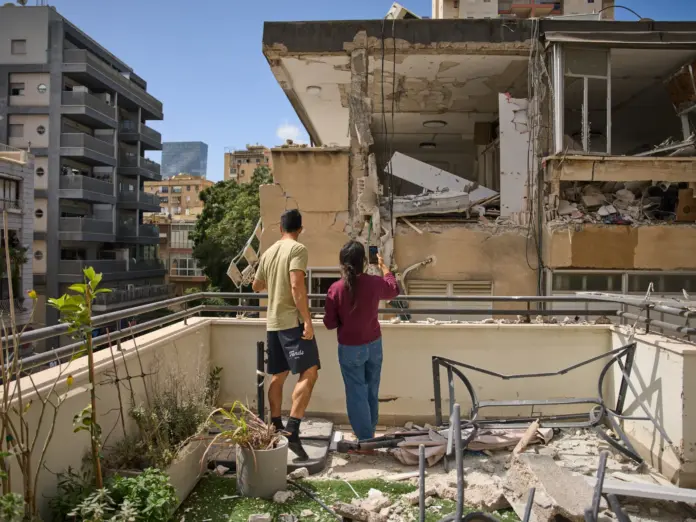
The assault came just one day after an Iranian strike on a residential building in Haifa killed four people, underscoring the intensifying pace of direct and proxy attacks on Israeli territory.
Israel responded with force across Lebanon, striking Hezbollah targets in Beirut‘s southern suburbs on Monday. The Israeli military also struck two Amana petrol stations on Sunday, which it said were controlled by Hezbollah and functioned as financial infrastructure for the militant group.
The violence across Lebanon’s south and east continued to mount. Four people were killed in an Israeli raid on a vehicle in Kfar Rumman, near Nabatieh. Strikes were also reported in the Tyre district village of Burj Rahal. A paramedic affiliated with the Hezbollah-allied Risala Scout Association was killed in an Israeli attack Monday, adding to two paramedics from the Islamic Health Committee who died in a strike the previous day.
The toll on civilians in Beirut itself has been severe. An Israeli strike Sunday on the Jnah neighbourhood killed five people, among them a 15-year-old girl and two Sudanese nationals. A separate strike the same day on Ain Saadeh, east of Beirut, killed three people, including two women.
Among the dead in Ain Saadeh was Pierre Mouawad, a local official with the Lebanese Forces party, who was killed alongside his wife. The Lebanese Forces is a Christian political party that has long been a vocal opponent of Hezbollah — a detail that underscored the indiscriminate reach of the strikes, which have claimed lives across Lebanon’s sectarian and political spectrum.
Lebanon’s government says 1,497 people have been killed since the conflict erupted, with 57 health workers among the dead. The World Health Organization has verified 92 attacks on health facilities, medical vehicles, personnel, and warehouses during the same period.
WHO Director-General Tedros Adhanom Ghebreyesus issued a stark warning in response to the mounting toll on medical infrastructure. "Attacks on health facilities cannot become the new norm," he stated, calling for the protection of medical personnel and services under international humanitarian law.
The coordinated Monday strike by the Houthi-Iran-Hezbollah axis reflects a deepening entrenchment of the regional conflict that erupted in the wake of the Gaza war. What began as cross-border skirmishing has evolved into a multi-front campaign stretching from the Yemeni coastline to the suburbs of Beirut, with Iran’s network of allies operating with increasing coordination and ambition.
Israel has maintained that its strikes target Hezbollah’s military and financial networks, which it says are embedded within civilian infrastructure. Critics and international bodies, however, continue to raise alarm over the civilian death toll and the systematic degradation of Lebanon’s health system at a time of acute humanitarian need.