Waves of US and Israeli airstrikes hammered Tehran, Isfahan, Karaj, and several other Iranian cities overnight and into Tuesday, triggering massive secondary explosions, widespread power outages, and mounting civilian casualties in what has become the most intense sustained bombardment of Iran since the joint military campaign began on February 28.
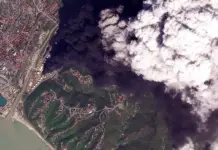
Heavy bunker-buster bombs struck a mountainous area adjacent to Isfahan, igniting secondary explosions that local observers described as among the largest recorded since the war began. Isfahan, a critical hub for Iran’s defence industry, hosts major nuclear facilities including Natanz, as well as Badr Airbase, the 8th Shekari Airbase, and the 4th Air Force Base. The scale of the blasts suggested the strikes were aimed at hardened underground military installations.
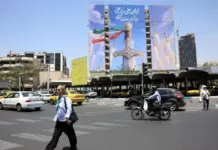
In Tehran, air raids struck repeatedly before and after midnight and continued periodically throughout Tuesday. The Ministry of Energy confirmed that shrapnel and shock waves from the attacks damaged a main power transfer line, causing electricity outages across multiple districts of the capital. Industrial zones in Karaj and surrounding towns were also hit.
![Members of the Iranian Red Crescent Society work at the site of a US-Israeli strike near a mosque in Zanjan, Iran [Iranian Red Crescent Society/Handout via Reuters]](https://world-tension.s3.us-east-2.amazonaws.com/articles/299/6dfe5b35ad7f44218788ce1dd784595a.webp)
The Israeli army released an aerial map warning residents to evacuate Vardavard, a town west of Tehran that serves as a base for multiple pharmaceutical companies. The warning preceded strikes that caused extensive damage to Tofigh Darou, one of Iran’s largest pharmaceutical manufacturers, which was struck by multiple projectiles. The company — owned by the state-run Social Security Investment Company — is a leading producer of anaesthetics, cancer medications, and immunomodulator drugs used in the treatment of multiple sclerosis. The targeting of the facility carries acute humanitarian implications: Iran produces more than 90 percent of its medicines domestically, a direct consequence of longstanding US sanctions.
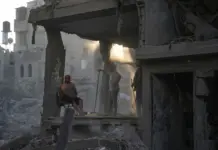
In the northwestern city of Zanjan, a strike hit a building identified as the administrative department of Husseiniya Azam, a major Shia religious centre. Local authorities confirmed at least four people were killed and two survivors were pulled from the rubble. Separately, one person was killed and eight wounded in Kermanshah province after strikes targeted a civilian contracting company in Qasr-e Shirin, a border town adjacent to Iraq.
The strikes also hit the Iran University of Science and Technology in Tehran, which had been developing an imaging satellite. Last week, a professor at the institution who had contributed to Iran’s missile programme was assassinated at his home in northern Tehran, along with his two children.
Iranian authorities place the total death toll from US-Israeli strikes since February 28 at more than 2,000 people. A separate tally cited 1,937 confirmed fatalities. In Israel, 20 people have been killed since the conflict began, with impact sites reported Tuesday in Tel Aviv, Bnei Brak, and Petah Tikva.
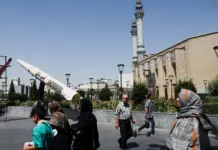
The Islamic Revolutionary Guard Corps struck back on multiple fronts. The IRGC released footage of ballistic missiles fired toward Israel and other regional targets, claimed to have shot down two US military MQ-9 Reaper drones, and confirmed an Iranian drone attack ignited a fire aboard a Kuwaiti tanker docked at Dubai Port. The corps also threatened retaliatory strikes against technology companies linked to the United States and Israel operating across the region.
Senior IRGC figures delivered defiant public statements. Ebrahim Zolfaghari, spokesman for the Khatam al-Anbiya Central Headquarters, declared that Iran’s enemies are "humiliated and on the path of destruction," adding that any US ambition to dominate the Strait of Hormuz through military force is "a wish they will take to the grave." Commander Ali Fadavi told state television that American naval vessels represent the enemy’s most vulnerable point.
Ali Akbar Velayati, a former foreign minister and longtime foreign policy adviser to the late Supreme Leader Ayatollah Ali Khamenei, warned that any ground invasion would transform the conflict into what he called a "historical and civilisational defence."
US President Donald Trump has threatened to expand the campaign further, including potential strikes on oil and gas installations, power generation plants, and Iran’s water desalination infrastructure.
Inside Iran, the government of President Masoud Pezeshkian held its first cabinet meeting since the war’s outbreak late Monday, convening at an undisclosed location in a makeshift setting. Israeli media alleged that Pezeshkian has sought authority to open negotiations with Washington, but that IRGC chief Ahmad Vahidi rejected the request, refusing to offer concessions to the US or Israel.
The judiciary has issued new indictments against 200 individuals accused of assisting US and Israeli operations, with spokesman Alireza Jahangir announcing that punishments for national security offences will include full asset confiscation and execution. Two individuals identified as members of the Mojahedin-e-Khalq were executed Tuesday morning. Additional executions carried out Monday and in recent weeks were linked in part to Iran’s nationwide protests in January, during which thousands were killed on the streets of Tehran and other cities.