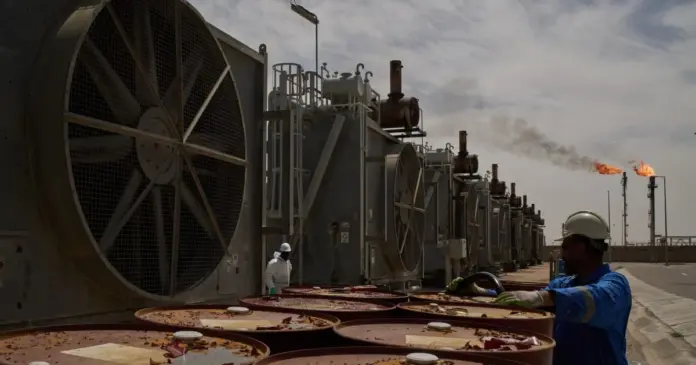
STRAIT OF HORMUZ — Global energy markets lurched deeper into crisis Monday as Brent crude surged more than 3 percent to top $116 a barrel during Asian trading hours, its highest point since March 19, when prices briefly touched $119. US crude climbed to $103 after gaining around 3.5 percent, extending a rally that has now pushed oil prices nearly 60 percent higher since the war began — a trajectory analysts describe as the largest oil disruption in recorded history.
The immediate trigger was a weekend of sharp escalation. Iran-backed Houthi rebels in Yemen launched missile strikes against Israel for the first time in the conflict on Saturday, opening a new front in a war already stretching across Lebanon, the Persian Gulf, and the broader Middle East. Simultaneously, Israel expanded its ground invasion of southern Lebanon, while an additional 3,500 US troops arrived in the region over the weekend.
Iran’s rhetoric intensified in parallel. The speaker of Iran’s parliament declared Sunday that the country’s forces were ‘waiting for American soldiers’ and vowed to ‘set them on fire’ upon arrival, while also threatening to punish Washington’s regional allies. Tehran separately warned it would expand retaliatory strikes to target universities and the homes of US and Israeli officials, and threatened to attack any ships attempting to cross the Strait of Hormuz.

That waterway — through which approximately 20 percent of the world’s oil flows — has largely come to a standstill. Iran’s effective closure of the strait has disrupted roughly one-fifth of global oil and liquefied natural gas supplies, and analysts warn the situation could deteriorate further if Houthi rebels move to close the Bab al-Mandab Strait, a critical chokepoint connecting the Red Sea to international shipping lanes.
Greg Newman, chief executive of Onyx Capital Group, a firm with deep roots in oil derivatives trading, said physical premiums have reached their highest ever recorded levels. Newman noted that Europe has taken roughly three weeks to begin feeling the full weight of the supply shock, and predicted a steady climb in Brent crude toward $120 and beyond unless maritime traffic through the strait resumes. ‘The world is facing its biggest energy crisis in decades,’ Newman said, a view echoed across trading floors from London to Singapore.
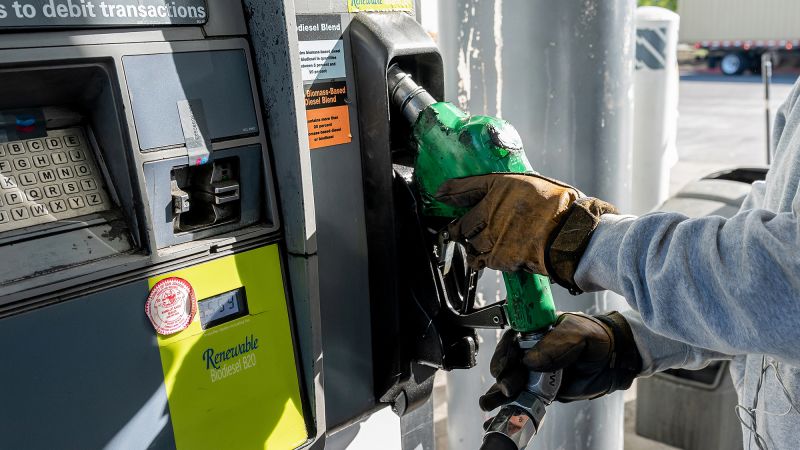
The human cost of surging prices is already spreading globally. Fuel costs have risen in countries across every continent, and numerous governments have enacted emergency energy conservation measures. In the United States, the average price of a gallon of gasoline reached $3.98 on Sunday. Brent is on course for its largest monthly gain on record.
Financial markets reflected the deepening anxiety. Dow futures fell 241 points, or 0.53 percent, on Sunday, while S&P 500 and Nasdaq futures declined 0.46 percent and 0.48 percent respectively. In Asia on Monday morning, Japan’s Nikkei 225 dropped more than 4.5 percent and South Korea’s Kospi fell 3.5 percent, underscoring how the energy shock is reverberating through global equity markets.
Bob McNally, president of Rapidan Energy, warned that smaller nations across Asia face the most severe exposure to the price surge, given their heavy dependence on imported energy and limited capacity to absorb the shock. In a worst-case scenario, McNally cautioned, the only force capable of ending the oil price spiral could be a global recession — a grim prospect that is beginning to surface in mainstream economic forecasts.
Iran’s strike on Ras Laffan in mid-March — the world’s largest gas production facility, located in Qatar — demonstrated Tehran’s willingness to target critical energy infrastructure far beyond its own borders, a move that sent an immediate shockwave through liquefied natural gas markets. Experts caution that even once the conflict ends, gas prices will take considerable time to fall, given the structural damage to supply chains and the lasting uncertainty premium now embedded in energy contracts.
Diplomatic channels remain active despite the battlefield escalation. President Donald Trump said Friday that talks aimed at ending the war are ongoing, and extended the deadline on his ultimatum demanding Iran reopen the Strait of Hormuz. Foreign ministers from Pakistan, Saudi Arabia, Egypt, and Turkey convened Sunday in what Pakistan’s Foreign Minister Ishaq Dar described as a ‘very productive’ meeting. Dar confirmed that Islamabad will facilitate direct talks between Washington and Tehran in the coming days — a development that offered markets a rare, if fragile, note of cautious optimism amid an otherwise darkening outlook.