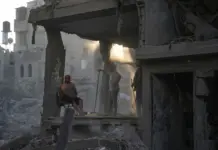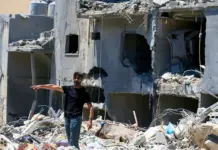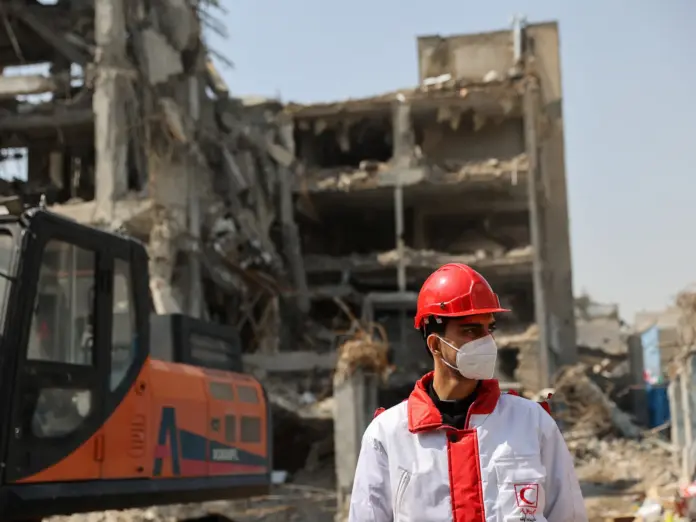
Rescue teams from Iran’s Red Crescent combed through rubble in multiple cities on Friday as US-Israeli strikes continued to devastate residential neighbourhoods, deepening a conflict that has now claimed at least 1,937 Iranian lives and left nearly 25,000 people wounded since fighting erupted on February 28.
Air raids struck three residential houses in Qom on Friday, killing six people. The city’s deputy governor confirmed the strikes to state media, adding that the full toll of the injured remained unclear. In Urmia, a direct missile strike overnight obliterated four residential buildings, according to Hamed Saffari, director-general of crisis management for West Azerbaijan province. Explosions also rocked Tehran as the Israeli military targeted what it described as Iranian leadership infrastructure, while further raids were reported at an industrial complex in Isfahan and in the city of Karaj.
Iran’s Deputy Health Minister Ali Jafarian provided the most comprehensive casualty accounting to date, confirming that among the dead are 240 women and 212 children — figures that humanitarian organisations say underscore the war’s devastating toll on civilian populations. Jan Egeland, head of the Norwegian Refugee Council, warned that millions of Iranians have fled their homes in search of safety, describing the population as exhausted and traumatised. Egeland placed the broader regional death toll at 2,700, with more than half of those fatalities inside Iran, the result of strikes carried out by US, Israeli, and Iranian forces across the Middle East.
The Israel Defense Forces confirmed overnight strikes on 50 targets inside Iran, including ballistic missile storage facilities and launch sites. Iranian missiles, meanwhile, struck central Tel Aviv, destroying property and wounding several people. Israel is simultaneously pressing a ground invasion into Lebanon, issuing a warning Friday to residents of the village of Sajd in the south to evacuate immediately, threatening to act with force.
The conflict has spread well beyond Iran’s borders. Bahrain, home to US Naval Forces Central Command, saw emergency workers battle a blaze ignited by Iranian attacks on Tuesday morning. A civilian contractor serving with the UAE Armed Forces was killed during a strike on Bahrain while on a routine mission. Amazon’s data centres in Bahrain suffered disruptions as a result of the fighting. The United Arab Emirates intercepted 17 drones and five ballistic missiles on Tuesday, with Sharjah’s air defence systems activated against a separate missile threat. Military forces in Kuwait and Saudi Arabia also reported intercepting drones and missiles, and Kuwait’s National Guard shot down two drones in defence of vital sites.
US forces have not been spared. A total of 13 American service members have died since the war began, with US Central Command reporting 290 troops wounded as of Tuesday — 255 of whom have returned to duty, while 10 remain seriously injured. Washington has signalled it is prepared to deploy thousands of additional troops and at least three warships to the region to bolster Operation Epic Fury.
President Donald Trump announced a temporary pause on US strikes against Iranian power plants and energy infrastructure, pledging to hold off until the end of the week. Despite that announcement, missiles and drones continued to fly across the region. Trump simultaneously threatened to resume attacks on Iran’s energy sector if Tehran does not restore free navigation through the Strait of Hormuz, the chokepoint through which nearly 20% of the world’s fuel supply passes. Iran has asserted what it calls its natural and legal right over the strait, a claim that has drawn sharp international condemnation.
A coalition of 22 nations, including numerous NATO members and partners, signed a joint statement over the weekend condemning Iranian attacks on commercial vessels and civilian infrastructure. The signatories declared themselves ready to contribute to efforts ensuring safe passage through the Strait of Hormuz. Saudi Arabia’s foreign minister, Prince Faisal bin Farhan, added that Riyadh’s patience with Iranian attacks was not unlimited, while reports indicate that Crown Prince Mohammed bin Salman has privately urged Trump to press forward with the military campaign.
Diplomatic channels remain strained. Tehran has flatly denied claims that US negotiators are engaged in productive talks to end the war. Iran did, however, lay out formal ceasefire conditions on Thursday, demanding a halt to assassination operations and compensation for war reparations. The United Nations Security Council, with the United States holding the rotating presidency, scheduled a closed consultation on the Iran crisis for 10am New York time on Friday, as international pressure mounts for a negotiated off-ramp to a conflict that shows no immediate sign of abating.