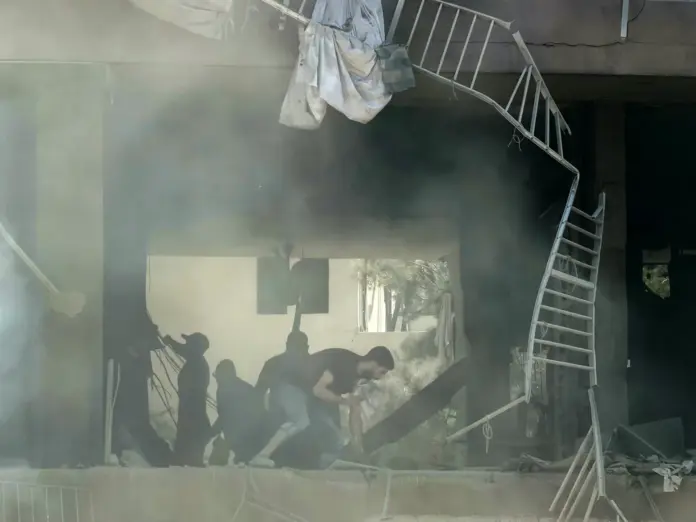
BEIRUT — Israeli warplanes struck the Dahiyeh district of southern Beirut on Sunday, killing at least two people and wounding four others, in a move that threatens to collapse fragile diplomatic efforts to reach a US-Iran nuclear agreement and deepen a crisis already engulfing Lebanon.
Israel Strikes Beirut — The Israeli military said the strikes were a direct response to Hezbollah launching three projectiles toward northern Israel, which it characterised as a blatant violation of an existing ceasefire. Prime Minister Benjamin Netanyahu posted a stark warning on social media: if Hezbollah does not halt its fire on Israeli cities and citizens, Israel will continue striking terrorist targets in Beirut.
Lebanon’s National News Agency confirmed the casualties in Dahiyeh, a densely populated southern suburb long associated with Hezbollah’s political and military infrastructure. The attack came just one week after a previous Israeli strike on the same area — an assault that had already triggered a retaliatory Iranian missile barrage against Israel and prompted an angry phone call from President Donald Trump to Netanyahu demanding restraint.
Recommended Reading
The timing is diplomatically explosive. Trump declared Sunday that a deal between Washington and Tehran would be finalised the same day, a claim echoed by Pakistani Prime Minister Shehbaz Sharif, who said the agreement would be completed within 24 hours and signed electronically. Pakistan has been serving as a key intermediary in the negotiations, a role that has elevated Islamabad’s profile in one of the most consequential diplomatic processes of the year.
Iranian officials, however, pushed back sharply. Foreign Ministry spokesman Esmaeil Baghaei acknowledged that a deal was close but flatly rejected the notion it would be signed on Sunday. Foreign Minister Abbas Araghchi went further, stating that Iran would not accept any agreement that permits Israel to continue conducting military strikes. Tehran has consistently maintained that the situation in Lebanon cannot be separated from any broader peace framework — a position Iranian officials have reiterated throughout the negotiating process.
A Qatari delegation was in Tehran over the weekend working to bridge remaining gaps in the talks, underscoring the multilateral nature of the diplomatic effort. The involvement of both Qatar and Pakistan as facilitators reflects the complexity of building trust between Washington and a Tehran that has long viewed direct engagement with deep suspicion.
The stakes in Lebanon itself are severe. On Sunday, the Israeli military issued forced displacement orders covering 29 locations in southern Lebanon — 25 in Nabatieh district and four in Sidon district. Residents of towns including Jbaa, Houmin al-Tahta, Ansar and Kfar Sir were ordered to flee immediately to areas north of the Zahrani River. The orders raise acute humanitarian concerns: Nabatieh is home to one of the only hospitals still functioning in southern Lebanon, and mass displacement could sever access to the region’s last major medical facility.
Israel Strikes Beirut: Regional Implications
The pattern of escalation has alarmed diplomats tracking the Lebanon file. A broader ceasefire linked to the Lebanese situation was announced on April 8th, yet within hours of that announcement Israel struck more than 100 locations across Lebanon in the span of just ten minutes — Lebanon’s deadliest single day of the conflict, with more than 350 people killed. The episode illustrated how quickly diplomatic progress can unravel on the ground.
Iran’s red-line declaration over attacks on southern Beirut now places the nuclear negotiations in direct tension with Israeli military operations. Each Israeli strike risks triggering an Iranian response that could, in turn, collapse the diplomatic architecture that Washington, Doha, and Islamabad have spent months constructing. Netanyahu’s government has shown no indication it intends to pause military pressure on Hezbollah, even as Trump’s team races to lock in what would be a landmark foreign policy achievement.
The convergence of these crises — an active military campaign in Lebanon, a nuclear negotiation at its most sensitive juncture, and a regional power dynamic in flux — leaves little margin for miscalculation. Whether Sunday’s strikes prove to be a contained exchange or the opening of a broader escalation may depend as much on decisions made in Tehran and Washington as on the battlefield in Beirut.