Brent crude oil surged to $106.80 per barrel at 01:00 GMT on Friday, a gain of nearly 5 percent from Wednesday’s closing price, as an escalating military and maritime standoff in the Strait of Hormuz sent shockwaves through global energy markets. The benchmark had already broken the $100 threshold for the first time in two weeks on Wednesday, but the pace of the rally accelerated sharply as the scale of the disruption to one of the world’s most critical shipping corridors became clear.
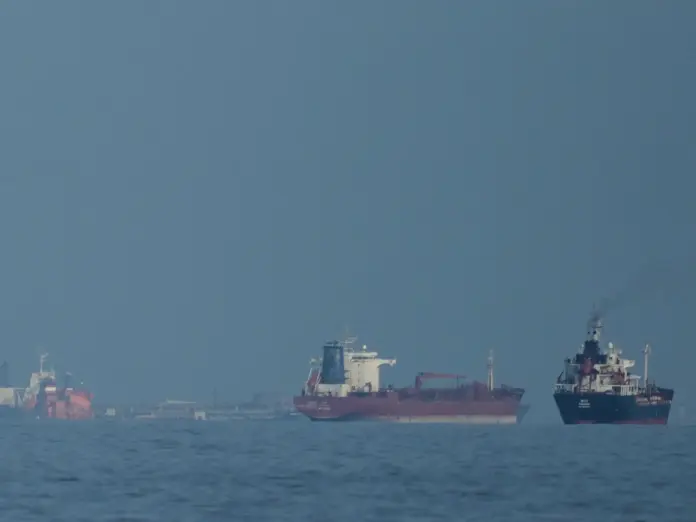
The strait, which under normal conditions handles roughly one-fifth of the planet’s oil and natural gas supply, has been reduced to a trickle of activity. Where an average of 129 commercial vessels transited the waterway each day before February 28 — the date the United States and Israel launched military operations against Iran — that figure collapsed to 15 on Monday, fell further to seven on Tuesday, and dropped again to nine on Wednesday. Shipping through the strait is now effectively at a standstill.
President Donald Trump escalated the confrontation dramatically, announcing on Truth Social that no vessel may enter or leave the strait without explicit approval from the US Navy. He also ordered naval forces to destroy any Iranian boats caught laying mines in the waterway. The declarations came as the Pentagon confirmed it had seized a tanker carrying sanctioned Iranian oil — the second such seizure in less than a week — underscoring Washington’s determination to enforce a blockade on Iranian maritime trade.
Tehran responded in kind. Iran’s Islamic Revolutionary Guard Corps announced the capture of two foreign cargo ships operating in the strait. The IRGC named the vessels as the Panamanian-flagged MSC Francesca and the Greek-owned Epaminondas, claiming both had endangered maritime security by operating without the required permits and tampering with navigation systems. Iran has insisted on its right to determine which ships may pass through the strait — a demand Washington has flatly rejected.
The seizure of the Epaminondas drew an immediate denial from Athens. The Greek Maritime Affairs and Insular Policy Ministry stated the vessel had not been captured, leaving the fate of the ship and its crew unresolved amid conflicting official accounts. The incident illustrated the fog of confrontation now enveloping one of the world’s most strategically sensitive maritime chokepoints.
Financial markets reflected the anxiety. The S&P 500 index slipped 0.41 percent overnight, while the Nasdaq Composite fell 0.89 percent, as investors weighed the prospect of a prolonged energy supply disruption against an already uncertain global economic backdrop. Analysts warned that any further deterioration in Hormuz transit numbers could push crude prices significantly higher, with knock-on effects for inflation across import-dependent economies.
The confrontation has its roots in the broader military campaign launched by the US and Israel against Iran on February 28. Since then, the two sides have engaged in an escalating series of moves and countermoves centred on the strait, with each action narrowing the space for de-escalation. Iran’s insistence on controlling vessel passage directly contradicts the US position that the waterway must remain open under international maritime law, and Washington’s naval blockade of Iranian trade has given Tehran little incentive to stand down.
The crisis has also drawn attention to alternative shipping routes. Indonesia briefly floated the idea of imposing transit fees on the Malacca Strait, a key artery for Australian and Asian trade, before ruling out the proposal. The episode highlighted how the Hormuz standoff is prompting regional powers to reassess the leverage they hold over global shipping infrastructure.
With commercial traffic through the strait at a fraction of its normal volume and both Washington and Tehran showing no sign of retreat, energy traders and shipping companies are bracing for the disruption to deepen. The question now is whether diplomatic channels — largely silent since the conflict began — can be reopened before the economic consequences of a prolonged Hormuz closure become irreversible.