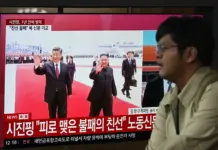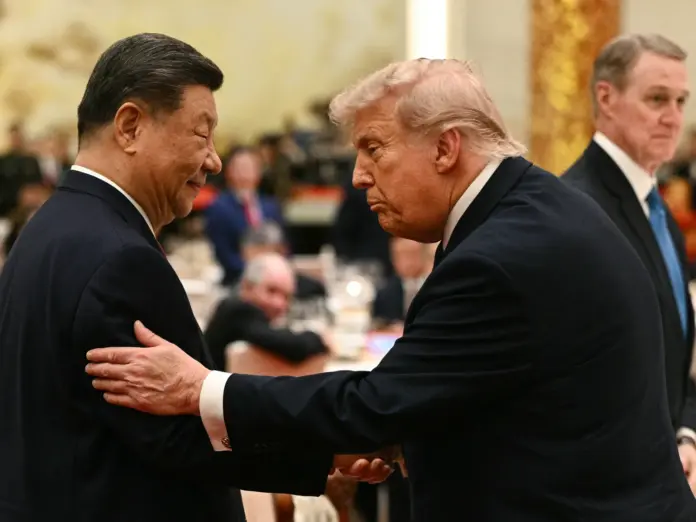
BEIJING — Chinese President Xi Jinping delivered an unambiguous warning to Donald Trump on Wednesday: mishandle Taiwan, and the world’s two most powerful nations risk collision. The caution came at the opening of a high-stakes summit at Beijing’s Great Hall of the People, the first time a sitting US president has set foot on Chinese soil in nearly a decade.
Xi Warns Trump Taiwan — The two leaders met for two hours and fifteen minutes in a session that ranged across trade disputes, technology competition, and the simmering conflict in Iran. Yet it was Taiwan that Xi placed at the centre of the diplomatic encounter. ‘The Taiwan question is the most important issue in China-US relations,’ Xi told Trump directly, adding that if the matter were mishandled, the two countries could ‘collide or come into conflict.’
Despite the gravity of the warning, the atmosphere was notably warm on the surface. Trump arrived to an elaborate welcome ceremony featuring an honour guard and children waving flowers and flags. He called Xi a ‘great leader’ and a ‘friend,’ and declared during opening remarks, ‘There are those who say this may be the biggest summit ever.’ He also extended a formal invitation for Xi to visit the White House in September.
Recommended Reading
Xi, for his part, framed the relationship in cooperative terms. ‘The two sides should be partners and not rivals,’ he said — language that signals Beijing’s preference for managed competition over open confrontation, provided Washington respects its core interests.
Those core interests, however, are non-negotiable. Analysts and officials familiar with the talks note that while China has shown a willingness to be flexible on a range of contentious issues — including Iran, trade terms, and technology transfer — it has drawn an absolute line on Taiwan. Beijing continues to claim the self-governing island as its own territory and has made broader cooperation conditional on Washington accepting the principle that there is only one China.
The summit was preceded by preparatory negotiations between US and Chinese economic and trade teams held in South Korea earlier in the week. Xi told Trump those talks had reached ‘balanced and positive outcomes,’ a characterisation that suggests both sides arrived in Beijing with at least a partial framework for progress on economic issues.
The meeting carries particular weight given the domestic pressures bearing down on Trump. His approval ratings have been eroded by an ongoing war with Iran that shows no signs of resolution, lending the Beijing visit an added urgency as his administration seeks diplomatic wins on the world stage.
The Taiwan issue remains the most structurally dangerous fault line in US-China relations. Washington has long maintained a policy of strategic ambiguity — neither formally recognising Beijing’s sovereignty claim nor explicitly committing to defend Taiwan militarily. That ambiguity has historically provided diplomatic room to manoeuvre, but Xi’s direct warning suggests Beijing’s patience with uncertainty is wearing thin.
Xi Warns Trump Taiwan: Cross-Strait Relations in Focus
China’s military posture around Taiwan has grown increasingly assertive in recent years, with regular incursions into the island’s air defence identification zone and large-scale naval exercises. Any shift in US policy — whether through arms sales, diplomatic recognition, or official contact with Taipei — risks triggering a response that neither side may be able to contain.
Xi’s framing of the summit as an opportunity for partnership rather than rivalry reflects a calculated Chinese strategy: offer the prospect of cooperation on issues where Beijing has flexibility, while making unmistakably clear that Taiwan is the one domain where no compromise is possible. For Trump, navigating that distinction — and managing expectations at home — will define whether the Beijing summit produces lasting results or merely a temporary thaw.
The White House has not yet confirmed whether Xi has accepted the September invitation.