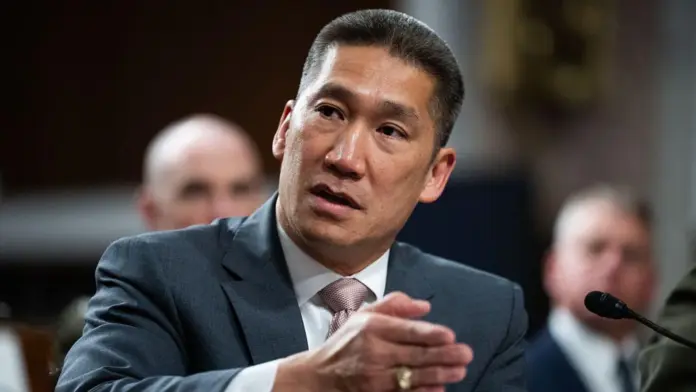
Taiwan Arms Sale — The United States has placed on hold a $14 billion arms sale to Taiwan, with Acting Navy Secretary Hung Cao confirming at a Senate hearing that the pause stems from the need to preserve sufficient munitions for the joint US-Israel military operation against Iran, codenamed ‘Epic Fury’. The disclosure has sent shockwaves through the already fraught triangular relationship between Washington, Taipei, and Beijing.
The arms package — which has been awaiting President Donald Trump‘s approval for months — includes advanced air defence systems such as Lockheed Martin‘s PAC-3 interceptor missiles and surface-to-air missile platforms. Despite the gravity of the decision, Cao acknowledged he had not informed Taiwanese officials of the pause. Taiwan’s presidential office confirmed as much on Friday, with a spokesperson stating that Taipei had received no information about any US adjustments to the sale.
Cao sought to reassure lawmakers that the delay was logistical rather than strategic, insisting the US military has ‘plenty’ of munitions to sustain the Iran campaign. Critics, however, are not convinced the distinction holds, particularly given the diplomatic context surrounding the pause.
Recommended Reading
Trump has been unusually candid about the geopolitical calculus at play. Speaking to Fox News, the president described the Taiwan arms sale as ‘a very good negotiating chip’ with China, adding that he would ‘make a determination over the next fairly short period’ on whether to proceed. The remarks came shortly after Trump held a presidential summit in Beijing with Chinese leader Xi Jinping, during which Xi stated that Taiwan was the single most important issue between the two countries. Trump told reporters he discussed US arms sales to Taiwan ‘in great detail’ with Xi during those talks.
The optics have alarmed analysts and Taiwanese officials alike. Under a 1982 US assurance to Taiwan, Washington pledged it would not consult Beijing on arms sales to the island — a commitment that Trump’s public framing appears to strain, if not directly contradict. China claims Taiwan as its sovereign territory and has never renounced the use of force to achieve unification.
Trump further signalled an unusual diplomatic overture, stating he intended to speak directly with Taiwanese leader Lai Ching-te about the arms sale. Such direct communication between US and Taiwanese leaders has not occurred in decades. The last known instance was Trump’s own call with Lai’s predecessor, Tsai Ing-wen, when Trump was president-elect during his first term.
Beijing’s reaction to US arms transfers to Taiwan has historically been fierce. When Washington approved a separate $11 billion arms sale to Taiwan in December, China’s foreign ministry warned it would ‘accelerate the push towards a dangerous and violent situation across the Taiwan Strait.’ That sale drew vehement opposition from Beijing, underscoring how sensitive the issue remains.
Taiwan Arms Sale: Cross-Strait Relations in Focus
For its part, Taiwan under Lai has significantly increased defence spending in response to mounting military pressure from China. Lai has consistently framed US arms sales as ‘a key factor in maintaining regional peace and stability’ — language that takes on sharper urgency as Washington’s reliability as a security partner comes under renewed scrutiny.
The pause arrives at a moment when the United States is simultaneously managing a major military operation in the Middle East, recalibrating its relationship with China, and navigating the complex legal and diplomatic architecture that governs its unofficial ties with Taiwan. Whether the hold on the arms package is a temporary logistical measure or the opening move in a broader strategic realignment remains, for now, an open question — one that Taipei, Beijing, and Washington’s allies around the world are watching closely.