The United States has placed a hold on a proposed $14 billion arms sale to Taiwan, with Acting Navy Secretary Hung Cao telling lawmakers the pause is necessary to preserve munitions stockpiles for ongoing military operations against Iran.
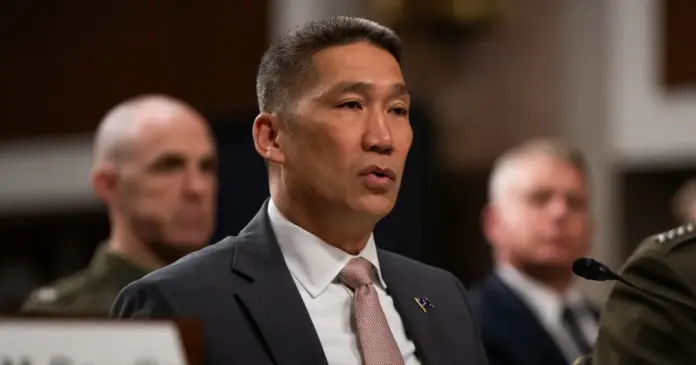
Cao delivered the disclosure Thursday before the Senate Appropriations Subcommittee on Defense, stating the administration needed to ensure sufficient weapons were available for an operation referred to as ‘Epic Fury’ — the US military campaign against Iran. The US and Iran had agreed to a ceasefire on April 8, though hostilities have continued to shape American defence priorities.
The proposed package, which Congress approved in January, would represent the largest single weapons transfer to Taiwan in history if finalised. President Donald Trump approved an $11 billion arms package for the island as recently as December, making the current pause a notable reversal in trajectory. Any decision to proceed now rests with Secretary of Defense Pete Hegseth and Secretary of State Marco Rubio, though the sale ultimately requires Trump’s personal sign-off.
Trump confirmed he raised the arms sale during talks with Chinese President Xi Jinping in Beijing, and in a subsequent Fox News interview said he ‘may’ or ‘may not’ approve the package. He suggested the deal could serve as a ‘negotiating chip’ in broader diplomatic exchanges with Beijing — a framing that has drawn sharp concern from security analysts and Taiwan’s government alike.
Trump also indicated he would consider speaking directly with Taiwanese President William Lai Ching-te about the arms deal, a move that would break with more than four decades of diplomatic protocol. Washington severed formal ties with Taipei in 1979 and does not officially recognise Taiwan as a sovereign state, though it remains legally committed under the 1979 Taiwan Relations Act to supporting the island’s capacity to defend itself. Trump previously broke with convention after his 2016 election win by accepting a phone call from then-President Tsai Ing-wen, before taking office.
Taiwanese Premier Cho Jung-tai addressed the situation Friday, telling reporters that Taiwan would press ahead with efforts to acquire arms regardless of the current pause. The statement reflects Taipei’s determination to maintain its defence posture even as uncertainty grows over the reliability of American commitments.
William Yang, senior analyst for northeast Asia at the Crisis Group, warned the pause would intensify anxiety in Taiwan about the depth of US support. China, which claims self-governing Taiwan as part of its territory, has long sought to limit American arms transfers to the island, and Beijing’s influence over the current deliberations is being closely watched across the region.
The timing of the pause is particularly sensitive. Taiwan sits at the centre of one of the world’s most volatile geopolitical fault lines, and any perception that Washington is willing to trade its security commitments for diplomatic leverage with Beijing risks undermining the deterrence framework that has kept the Taiwan Strait stable for decades. The 1979 Taiwan Relations Act has historically served as the legal and political bedrock of that framework, but its practical weight depends heavily on presidential will.
The decision to link the Taiwan sale to munitions requirements for the Iran campaign adds another layer of complexity, suggesting that American military resources are under strain across multiple theatres simultaneously. Whether the pause proves temporary or signals a deeper recalibration of US policy toward Taiwan remains the central question for governments across the Indo-Pacific.