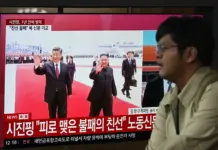
BEIJING — Donald Trump is preparing to confront one of the most volatile fault lines in US-China relations when he sits down with President Xi Jinping this week, confirming he will raise American weapons sales to Taiwan during two days of high-level talks in the Chinese capital.
Taiwan Arms Sales — Trump, who told reporters at the White House ahead of his departure that he expects to arrive in Beijing on Wednesday, is scheduled to hold substantive discussions with Xi on Thursday and Friday. The visit marks his first trip to China in nine years and comes at a moment of acute tension over Taiwan’s status.
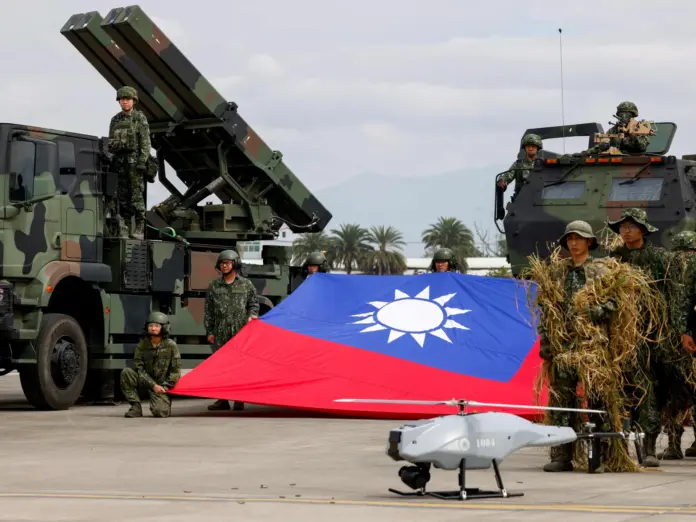
The arms sales issue sits at the heart of that tension. In December, Trump approved what he described as the largest weapons package in history for Taiwan — a deal valued at more than $11 billion. Beijing responded swiftly and forcefully, launching a series of military drills designed to simulate a blockade of Taiwanese ports. China condemned the sale in the strongest terms, and Xi has made clear he would prefer Washington to halt such transfers entirely.
Recommended Reading
The United States maintains no official position on Taiwanese sovereignty, but has long served as the island’s most important international backer, supplying it with weapons capable of countering a potential Chinese military assault. Washington has consistently called on both Taipei and Beijing to resolve questions about Taiwan’s future through peaceful means.
Taiwan, for its part, has firmly rejected any suggestion that military force could determine its fate. The self-governed island has insisted that its people alone must be free to decide their political future — a position that places it in direct opposition to Beijing’s claim that Taiwan is an inalienable part of Chinese territory.
Despite the structural tensions, Trump projected cautious optimism ahead of the summit. He said he does not believe a military conflict between the United States and China over Taiwan’s status is likely in the near term, and pointed to what he described as a strong personal rapport with Xi as a stabilising factor. "I have a very good relationship with President Xi," Trump said.
The Taiwan question is expected to dominate the agenda, though the broader arc of US-China relations — encompassing trade, technology, and regional security — will also feature prominently. Trump’s willingness to openly signal that arms sales will be on the table is itself a notable diplomatic move, one that could either open space for negotiation or harden positions on both sides before talks have formally begun.
Xi’s government has long regarded US military support for Taiwan as a direct challenge to Chinese sovereignty and a violation of the foundational understandings that underpin diplomatic relations between Washington and Beijing. Each successive arms package has drawn sharp protests from Chinese officials, and the December deal — the largest of its kind — provoked an unusually muscular military response.
Taiwan Arms Sales: Cross-Strait Relations in Focus
The timing of Trump’s visit adds further weight to the encounter. His return to the presidency has injected fresh uncertainty into cross-strait dynamics, with both Taipei and Beijing watching closely for signals about how his administration intends to balance its security commitments to Taiwan against its broader strategic interests in managing competition with China.
Trump also touched on the situation in Iran before departing, describing a potential ceasefire there as being on what he called "massive life support" — a remark that underscored the crowded and volatile international landscape he is navigating as he heads into one of the most consequential diplomatic encounters of his presidency.
Whether the Beijing summit produces any concrete movement on Taiwan arms sales — or simply reaffirms the deep disagreements that have long defined this dimension of the relationship — the talks are set to be among the most closely watched diplomatic exchanges of the year.