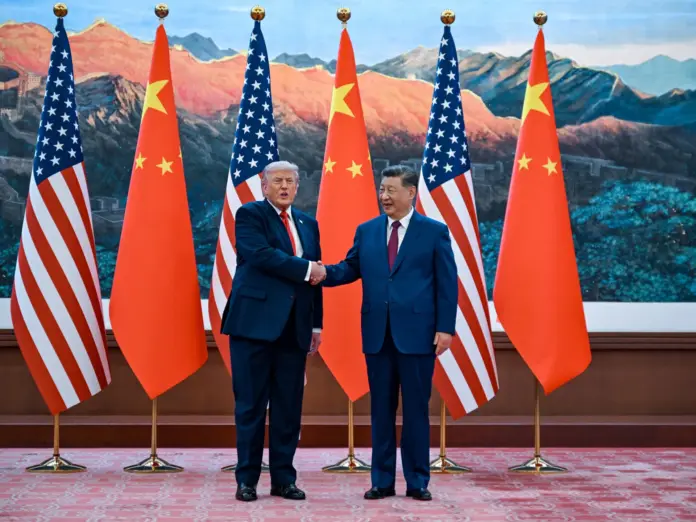
BEIJING — Donald Trump and Xi Jinping sat down for high-stakes bilateral talks at the Great Hall of the People on Wednesday, with the two leaders navigating a dense agenda spanning trade imbalances, Taiwan’s future, and the widening fallout from the US-Israeli military campaign against Iran.
Trump Xi Beijing Summit — The summit, preceded by a pomp-filled welcome ceremony at which Vice President Han Zheng received Trump at Beijing airport, carries the weight of a relationship that came perilously close to economic rupture. Tariffs on Chinese imports escalated to 145 percent before both governments stepped back from the brink, and the two sides are now seeking to translate a fragile truce into durable agreements.
Xi opened the talks by invoking the Thucydides Trap — a concept developed by Harvard scholar Graham Allison in 2015 to describe the dangerous friction that arises when a rising power challenges an established hegemon. Allison’s study of 16 such rivalries over six centuries found that war resulted in 12 of them. Xi’s reference signalled both a warning and an appeal: that the two largest economies on earth must find a way to coexist. "China’s and the United States’ common interests outweigh their differences," Xi told Trump.
Recommended Reading
Trump, who holds the informal Chinese nickname that translates roughly as "Nation Builder," reciprocated with praise for Xi’s leadership, calling it "great." The flattery, however, sits alongside a firm American commercial agenda. Trump is pressing Beijing to open its markets more widely to US companies and to significantly increase purchases of American goods. China is expected to announce orders for Boeing aircraft and commitments to buy American soybeans as tangible deliverables from the summit. A proposed joint board of trade is also under active discussion.
Xi, for his part, is seeking concessions on two fronts that Beijing regards as existential. On tariffs, China wants a sustained rollback of the punishing duties that have disrupted bilateral trade flows. On Taiwan, Xi delivered his most pointed language of the summit, declaring that "the Taiwan question is the most important issue in China-US relations" and that Taiwan independence and peace in the Taiwan Strait are as "irreconcilable as fire and water."
The Iran dimension adds a further layer of complexity. The US and Israel’s military campaign against Tehran has placed Beijing in an uncomfortable position: China is Iran’s largest oil and gas customer, and between 30 and 40 percent of China’s total energy supplies transit the Strait of Hormuz. Washington has already sanctioned at least five Chinese oil refineries and a number of Chinese technology companies over alleged support for the Iranian war effort, and the issue is expected to feature prominently in the closed-door sessions.
Trump also signalled he would raise the case of Jimmy Lai, the 78-year-old founder of the now-defunct Apple Daily newspaper, who was sentenced to 20 years in prison in February in a high-profile national security prosecution. Trump drew a comparison between Lai’s case and that of former FBI director James Comey — a framing that underscored the political charge he attaches to the imprisonment.
The diplomatic choreography surrounding the summit has itself been revealing. Secretary of State Marco Rubio, who has been sanctioned by China on two separate occasions, is attending the talks at the Great Hall of the People. Chinese officials used an alternative spelling of Rubio’s name in official documents for the visit — a subtle but deliberate signal of Beijing’s residual displeasure. Meanwhile, Foreign Minister Wang Yi remained in Beijing to manage the Trump visit rather than travelling to New Delhi, where BRICS foreign ministers are convening simultaneously. China’s ambassador to India is representing Beijing at those talks, a scheduling choice that illustrates the priority Xi’s government has placed on the Washington relationship.
Trump Xi Beijing Summit: Cross-Strait Relations in Focus
BRICS — whose membership now includes Russia, China, India, Brazil, South Africa, Indonesia, Ethiopia, Egypt, Iran, and the UAE — has increasingly positioned itself as a counterweight to Western-led institutions, making the optics of the Beijing summit all the more significant for the bloc’s internal dynamics.
Trump was accorded "state visit-plus" status during his first visit to China in 2017, a designation that signalled exceptional hospitality. Wednesday’s reception, with Han Zheng — who holds a largely ceremonial role and previously attended the coronation of King Charles — leading the airport welcome, suggests Beijing is again investing heavily in the atmospherics of the relationship even as the substantive disputes remain formidable.
Whether the summit produces a durable framework or merely a temporary easing of tensions will depend on whether both sides can convert the goodwill on display into binding commitments — on tariffs, on technology, and on the volatile question of Taiwan’s status, which Xi has now placed unambiguously at the centre of the bilateral agenda.