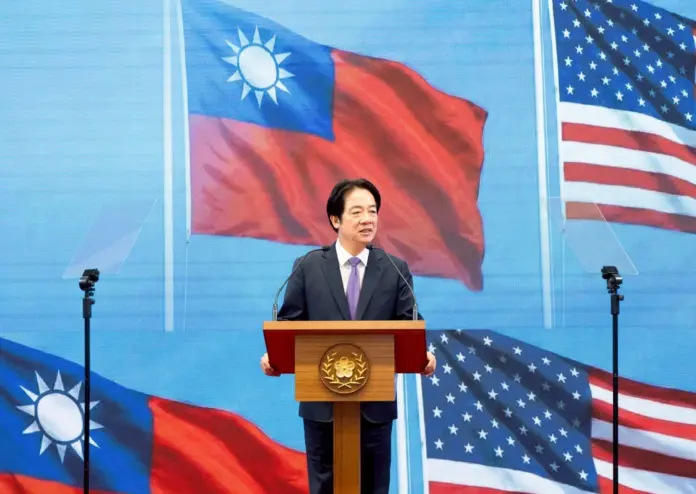
Taipei/Washington — Taiwan’s President William Lai Ching-te issued a firm public declaration Sunday, pledging that his government would neither provoke conflict with China nor surrender its national sovereignty, dignity, or democratic freedoms under any form of external pressure. The statement, posted on social media, came in the immediate aftermath of a high-stakes summit between US President Donald Trump and Chinese leader Xi Jinping that placed the future of cross-strait relations under renewed international scrutiny.
Taiwan Strait Tensions — Lai was unequivocal in framing Taiwan’s position. His government, he said, has consistently acted as a stabilising force in the Taiwan Strait, and he placed the blame for regional instability squarely on Beijing. At the same time, he emphasised that US security cooperation and arms sales to Taiwan represent the most important deterrent against any threat to regional peace — a pointed message directed as much at Washington as at Beijing.
The timing of Lai’s remarks was deliberate. Trump, speaking to Fox News on Friday, said he was not seeking Taiwanese independence and acknowledged that Xi Jinping holds an intense personal opposition to the prospect. Trump added that he made no commitment in either direction on the Taiwan question during the summit — a formulation that offered little reassurance to Taipei.
Recommended Reading
Chinese state media reported that Xi told Trump the Taiwan question was the single most important issue in the relationship between the two powers, warning that mishandling it risked a direct collision between the United States and China. Beijing’s position has remained consistent for decades: it regards Taiwan as an inalienable part of its territory and has pledged to achieve reunification by force if it deems that necessary.
A particularly sensitive flashpoint is an $11 billion arms package to Taiwan already approved by the US Congress. Trump told Fox News he has not yet signed off on the package and indicated he may or may not do so. The ambiguity alarmed observers in Taipei, where Lai’s administration has consistently argued that arms transfers from Washington are a cornerstone of the island’s defence posture and a critical signal of American commitment.
The United States does not officially recognise Taiwan’s claims to independence and has long maintained a policy of deliberate ambiguity over whether it would intervene militarily in a cross-strait conflict. Nevertheless, successive administrations — Republican and Democrat alike — have sustained the relationship through arms sales and political statements of support. Whether the Trump administration will continue that pattern or recalibrate toward Beijing remains an open question.
The roots of the dispute stretch back to the Chinese civil war of the 1940s, when the defeated Nationalist government retreated to Taiwan and established a separate administration. Decades of diplomatic maneuvering, military posturing, and economic interdependence have failed to resolve the fundamental disagreement over the island’s status. What has changed in recent years is the pace and scale of Chinese military activity near Taiwan, which has intensified pressure on both Taipei and its partners.
Taiwan Strait Tensions: Cross-Strait Relations in Focus
Lai’s insistence that Taiwan will not relinquish its democratic way of life reflects a domestic political reality as much as a foreign policy stance. Public support for formal independence has grown steadily in Taiwan over the past two decades, even as the government has carefully avoided provocative unilateral moves. The president’s framing — defending the status quo while resisting coercion — is designed to hold that domestic coalition together while avoiding giving Beijing a pretext for escalation.
The coming weeks are likely to test that balance. With the congressional arms package in limbo and the Trump administration’s strategic priorities still taking shape, both Beijing and Taipei are watching Washington closely for signals of where American policy is heading. For Lai, the message Sunday was clear: Taiwan will not be a passive observer of decisions made about its future.