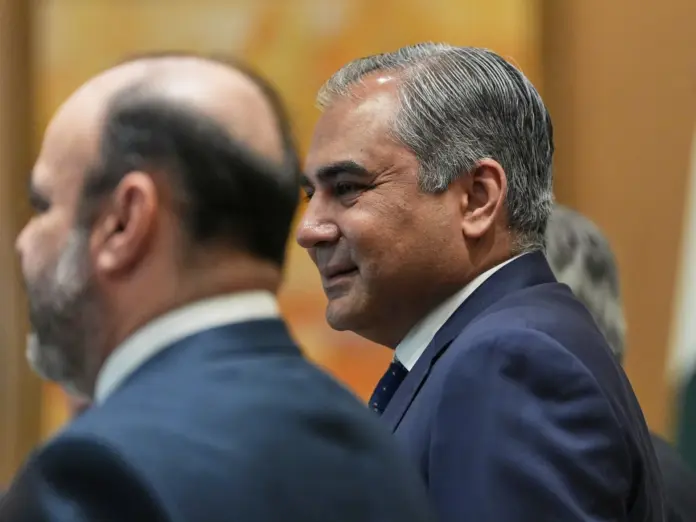
TEHRAN — Pakistan dispatched its interior minister to Iran on Saturday in a high-stakes diplomatic push, as negotiations to end the US-Israeli war on Iran stalled and military clashes continued to roil the Strait of Hormuz, the chokepoint through which roughly a fifth of the world’s traded oil normally flows.
Mohsin Naqvi arrived in Tehran late Saturday, carrying a letter jointly authored by Pakistan’s army chief and prime minister and addressed to Supreme Leader Mojtaba Khamenei. Naqvi also held talks with his Iranian counterpart, Interior Minister Eskandar Momeni, in what officials framed as an effort to revive a diplomatic process that has grown increasingly fragile.
Pakistan Iran Diplomacy — The visit underscores Pakistan’s continued role as a back-channel intermediary in a conflict now entering its 100th day. A Pakistan-mediated ceasefire took effect on April 8, but direct talks held in Islamabad collapsed just four days later, on April 12. Since then, multiple flare-ups have punctuated an uneasy and contested pause in hostilities.
Recommended Reading
The prospects for a breakthrough appeared dim on Saturday. Mohsen Rezaei, a military adviser to Iran’s supreme leader, told international media that negotiations are at a complete deadlock, directly contradicting an assertion by US President Donald Trump on Wednesday that a deal could be finalised over the weekend.
The gap between the two sides remains wide. Iran is demanding the release of approximately $24 billion in frozen assets, along with sanctions waivers on crude oil exports, an end to a US port blockade, and guarantees covering all fronts of the conflict, including Lebanon. A central and deeply contested issue is control over the Strait of Hormuz itself. Iran declared the waterway closed when the war began on February 28 and has threatened to strike any vessel transiting without its permission — a posture that has sent oil and gas prices to multi-year highs.
Complicating any settlement, US Treasury Secretary Scott Bessent was reported to be considering redirecting frozen Iranian assets toward Gulf reconstruction efforts, a move likely to harden Tehran’s position at the negotiating table.
Military exchanges in and around the strait showed no sign of abating. On Sunday, US Central Command announced its forces shot down two Iranian one-way attack drones in the Strait of Hormuz. The previous day, US forces struck Iranian coastal surveillance radar installations at Garuk and on Qeshm Island. On Friday alone, American forces intercepted seven ballistic missiles aimed at Kuwait and Bahrain and shot down four Iranian drones launched toward the strait.
The strikes drew sharp condemnation from across the region. Bahrain — which hosts the headquarters of the US Fifth Fleet — denounced the latest American attacks as "blatant aggression." Kuwait warned that the strikes "represent a dangerous escalation." Egypt, Jordan, and Qatar joined Gulf nations in formally condemning the US military actions, reflecting the deep unease among regional governments caught between Washington’s military posture and the economic devastation wrought by the closure of the strait.
Pakistan Iran Diplomacy: Regional Implications
The Strait of Hormuz has been effectively sealed since the war’s opening weeks, with Iran enforcing its declared closure through drone and missile patrols. The disruption to global energy markets has been severe, with oil and gas prices climbing to levels not seen in years as tanker traffic through the narrow passage ground to a halt.
Pakistan’s diplomatic intervention reflects Islamabad’s attempt to preserve its role as a credible intermediary at a moment when direct communication between Washington and Tehran has broken down. Whether Naqvi’s letter and the conversations in Tehran can inject new momentum into a stalled process remains uncertain, particularly as both sides continue to exchange fire across one of the world’s most strategically vital waterways.
With Trump’s self-imposed weekend deadline for a deal having passed without agreement, and Iran’s negotiators publicly declaring an impasse, the path to a ceasefire that holds — let alone a comprehensive settlement — appears narrower than at any point since the April 8 truce began.