Tene, Mali — Mali’s military killed at least 10 civilians, including children, when it launched drone strikes on a wedding procession in the central San region on Sunday, deepening a humanitarian crisis as the country’s security situation spirals toward collapse.
Mali Drone Strike — The strikes hit a convoy of motorbikes in the Tene locality during preparations for a traditional collective wedding — a significant cultural gathering in the region. A local resident confirmed that 10 children were among those killed, while a local official placed the overall death toll at approximately 10 people. The attack drew immediate condemnation and raised urgent questions about the military government’s use of airpower against civilian gatherings.
The strike is the latest in a cascade of violence engulfing Mali. On May 7, al-Qaeda-affiliated fighters killed at least 30 people in attacks on the villages of Korikori and Gomossogou in the Mopti region of central Mali — the same broad area where Sunday’s drone strike occurred. That assault followed an even more devastating coordinated offensive launched on April 25 and 26, during which the al-Qaeda-linked group JNIM (Jama’at Nusrat al-Islam wal-Muslimin) and the Tuareg separatist FLA (Azawad Liberation Front) struck military government positions across the country in a joint operation.
Recommended Reading
The April offensive proved catastrophic for Bamako’s forces. Mali’s defence minister was killed during the two-day assault — a blow that underscored the severity of the threat. The allied militant groups subsequently seized Kidal and a string of towns and villages across northern Mali, and have since imposed a blockade on Bamako, the capital. The alliance between JNIM and the FLA, formalised in April, represents a significant escalation in the coordination of armed opposition to the military government.
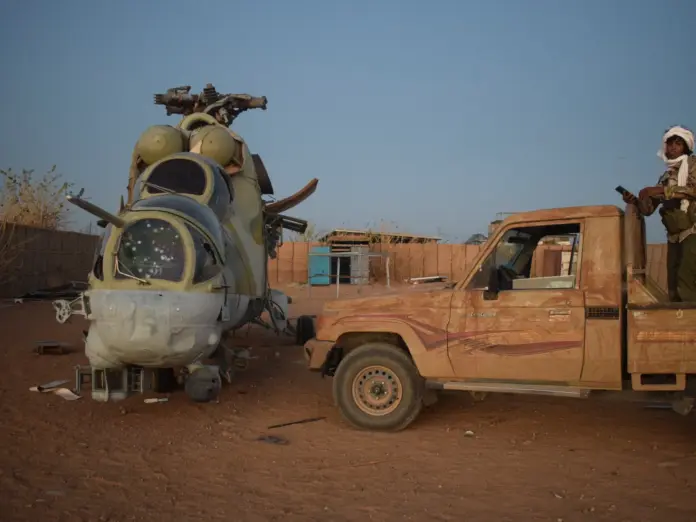
Mali has been mired in instability since 2012, when a Tuareg rebellion and jihadist insurgency first fractured the state. The security crisis has since been driven by three principal forces: JNIM, the FLA, and the Africa Corps — a Russian government-controlled paramilitary organisation that succeeded the private Wagner Group in the country. Russian fighters have been reported operating in Bamako, including around the airport, as the government leans heavily on Moscow for military support.
That reliance on Russia is itself a consequence of a dramatic geopolitical realignment. Following military coups in 2020 and 2021, Mali’s junta expelled both French forces and United Nations peacekeepers who had been deployed to contain the jihadist insurgency. In their place, Bamako invited Russian fighters, a decision that has done little to stem the deteriorating security environment. Mali is rich in gold and other valuable minerals, making it a prize for external actors with strategic and economic interests in the region.
Mali Drone Strike: What This Means for the Sahel
The drone strike on the Tene wedding procession illustrates the dangerous ambiguity now defining Mali’s conflict. With armed groups blending into civilian populations and military forces conducting strikes in areas of active insurgent activity, non-combatants are bearing an increasingly deadly toll. The Mopti and San regions, both in central Mali, have become epicentres of violence as fighting that once concentrated in the north spreads southward toward the capital.
The international community has largely been sidelined following the expulsion of French and UN forces, leaving few external mechanisms to monitor or constrain the conduct of hostilities. With Bamako under blockade, key northern towns under militant control, and civilian casualties mounting from both insurgent attacks and military operations, Mali faces one of the most acute security crises in its modern history.