BEIRUT — An Israeli airstrike on a Lebanese army vehicle travelling along the Khardali-Nabatieh road killed three military personnel on Saturday, including a senior officer, in an attack that Lebanese officials condemned as a deliberate attempt to derail fragile peace efforts.
Israel Lebanese Army Strike — The dead were identified as Brigadier General Wissam Sabra, Captain Elie Khoury, and soldier Hussein Ghozal. Funerals for the three men were scheduled for Sunday. The Israeli army said it was investigating the circumstances of the strike.
Lebanese President Joseph Aoun said the attack was ‘aimed at thwarting all efforts to reach a solution,’ while Prime Minister Nawaf Salam described it as ‘a heinous crime and an attack on Lebanon and all Lebanese people.’ The killing of uniformed soldiers from the Lebanese Armed Forces — a institution distinct from Hezbollah and broadly regarded as a neutral national institution — sharpened the political outrage in Beirut.
Recommended Reading
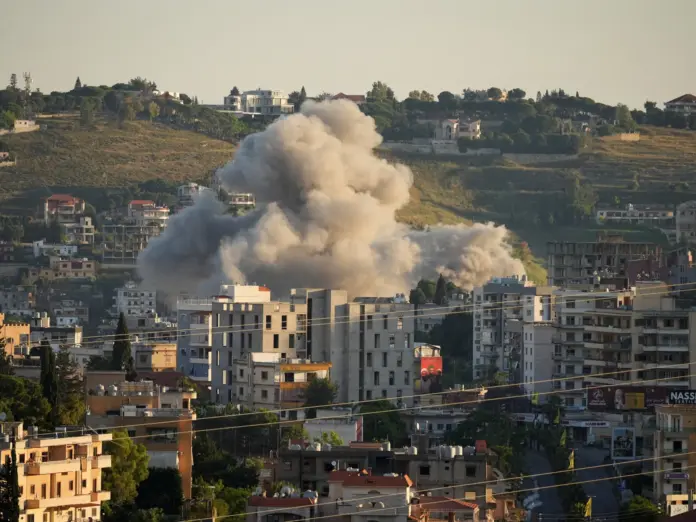
The strike was far from isolated. Israeli air attacks struck the towns of Qalawiya, al-Qatrani, Byblos, Rihan, Deir Kifa, Srifa, and Dweir in the same period. A raid on the town of Saksakiyeh killed at least two people and wounded 22 others, among them three children and a woman. Two additional people were wounded in a drone attack on Shahabiyeh. Overnight, intermittent artillery shelling struck Barashit and Chaqra in the Tyre district, as well as the towns of al-Mansouri and Bayt al-Sayyad.
Hezbollah, for its part, launched rockets, artillery fire, and drone attacks against Israeli forces, including near Beaufort Castle in Yohmor al-Shaqif, underscoring that the conflict remains active on both sides of the border.
The violence unfolds against a deeply complicated diplomatic backdrop. A ceasefire between Israel and Hezbollah was agreed on April 17, yet Israel has continued near-daily attacks since that date. A conditional truce was announced by Lebanese and Israeli envoys meeting in Washington last week, but Hezbollah swiftly rejected it, objecting that the group was excluded from the agreement and that it made no provision for an Israeli withdrawal from southern Lebanon.
The human cost of the resumed conflict has been staggering. More than 3,500 people have been killed in Lebanon since hostilities escalated again on March 2, when Iran-backed Hezbollah attacked Israel following joint US-Israeli strikes on Iran. Tehran has since made a ceasefire in Lebanon a precondition for any broader peace agreement with Washington — a linkage that has complicated negotiations on multiple fronts simultaneously.
Adding a new dimension to the diplomatic picture, Lebanon’s army chief Rodolphe Haykal departed for Pakistan on Saturday. The visit carries significance beyond bilateral military ties: Pakistan has emerged as a central mediator between the United States and Iran, positioning Islamabad as a potential back-channel at a moment when direct US-Iran communication remains fraught.
Israel Lebanese Army Strike: Regional Implications
The territorial situation on the ground continues to harden. A demarcation known as the ‘Yellow Line’ — a concept first applied in Gaza, where it now encompasses roughly 60 percent of that territory — has been extended to Lebanon, where it now covers nearly a fifth of the country. The expansion of this zone signals an Israeli intent to maintain a buffer of influence well beyond any formal ceasefire line.
Independent Lebanese parliament member Najat Aoun Saliba has been among the voices pressing for accountability over the continuing strikes on Lebanese soil, reflecting broader parliamentary frustration with the international community’s inability to enforce the terms of the April ceasefire.
With diplomatic channels strained, military casualties mounting, and no enforceable agreement in place, Lebanon faces a deepening crisis in which each day of continued strikes erodes confidence that any negotiated pause can hold. The killing of Brigadier General Sabra and his colleagues has become the latest symbol of that fragility — uniformed officers of a sovereign state’s army, struck on a public road, as their country’s leadership scrambles to find a path toward peace.