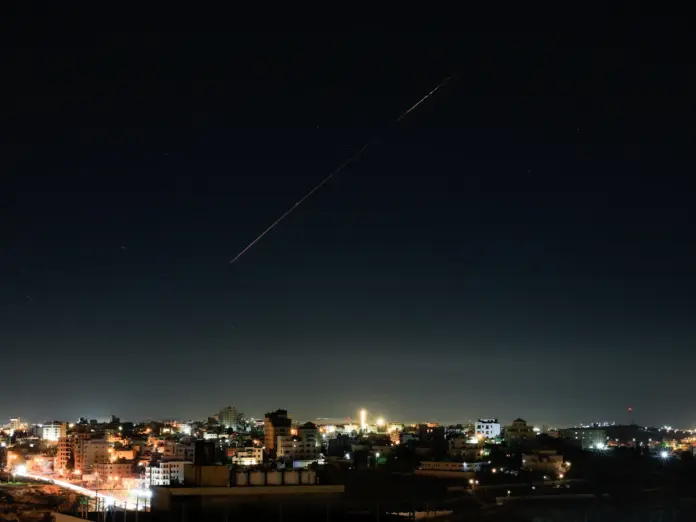
Tehran launched a significant missile offensive against Israel late Sunday, with the Islamic Revolutionary Guard Corps (IRGC) confirming it had targeted the Ramat David airbase in northern Israel using ballistic missiles. The barrage began at approximately 10pm local time — 19:00 GMT — triggering air raid sirens across wide stretches of Israeli territory. The Israeli military said it intercepted every incoming missile, and residents sheltering in protected spaces were cleared to leave roughly an hour after the attack commenced.
Iran Fires Missiles At Israel — The IRGC framed the strike as a direct response to Israeli military operations in southern Lebanon, specifically the killing and displacement of civilians in the Tyre and Nabatieh regions. The corps’ Khatam al-Anbiya headquarters declared that Israel had crossed "all red lines" by continuing to strike the southern Beirut suburb of Dahiyeh, and warned that any repetition of such aggression would draw responses targeting all American-Zionist assets across the region.
The attack came just days after Israel and Lebanon agreed to a ceasefire brokered in Washington, DC. Despite that agreement, Israeli forces struck Dahiyeh on Sunday afternoon, killing at least two people and wounding 11 others. Prime Minister Benjamin Netanyahu and Defence Minister Israel Katz said the strikes destroyed a Hezbollah command centre in the district.
Recommended Reading
Mohsen Rezaee, a military adviser to Iran’s supreme leader, said Tehran would not tolerate what he described as violations of the ceasefire or continued aggression against Lebanon. Mohammad Bagher Ghalibaf, Iran’s parliament speaker and top nuclear negotiator, went further, warning that Iran would enter direct confrontation with Israel if the violations persisted. The IRGC characterised Sunday’s missile salvo explicitly as "a warning" rather than a full military response — a framing that underscored both the gravity of the moment and Tehran’s apparent desire to calibrate escalation.
Israeli officials, however, were not inclined toward restraint. Senior figures in Jerusalem indicated on Sunday that a forceful response to the Iranian strikes was being planned, setting the stage for a potential new cycle of cross-border exchanges that could destabilise the fragile Lebanese ceasefire and the broader region.
US President Donald Trump moved quickly to apply pressure on both sides. He said he intended to call Netanyahu directly to urge him against retaliating, noting that the Iranian missiles had caused no casualties. Trump also disclosed that Washington was "very close" to finalising a comprehensive deal with Iran — a statement that suggested American diplomatic calculations were weighing heavily against any Israeli military action that could derail those negotiations. A senior US official separately communicated to Israeli media that Washington would not back a new Israeli escalation targeting Iran.
Iran Fires Missiles At Israel: Regional Implications
The backdrop to Sunday’s events is a devastating conflict that has ravaged Lebanon for months. Israeli military operations have killed more than 3,500 people in Lebanon since the beginning of March, according to available figures, with strikes concentrated in Hezbollah strongholds in the south and in Beirut’s southern suburbs. The ceasefire reached this week had raised hopes of a pause in the bloodshed, but Israel’s continued strikes on Dahiyeh — and now Iran’s missile response — cast serious doubt on whether any durable halt to hostilities is achievable in the near term.
The missile exchange marks one of the most direct confrontations between Iran and Israel in recent memory, echoing a pattern of tit-for-tat strikes that has periodically threatened to draw the two countries into open warfare. Iran has consistently positioned its military actions as defensive responses to Israeli operations against its allies, while Israel maintains it is targeting terrorist infrastructure that poses an existential threat. With Washington urging de-escalation and Tehran signalling it will not absorb further provocations passively, the coming days will test whether diplomacy can contain a conflict that has already consumed thousands of lives.