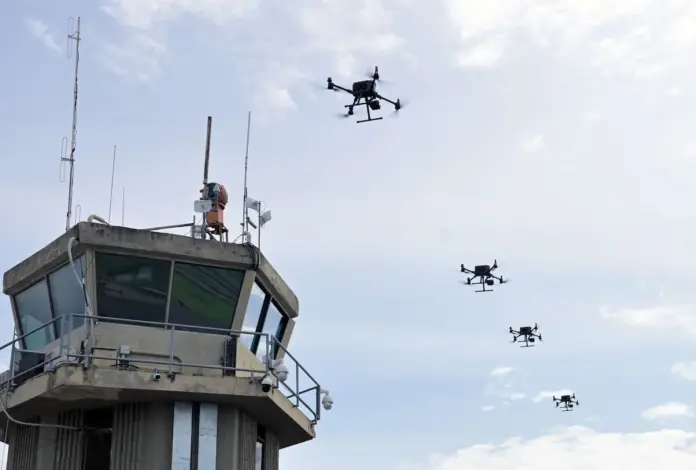
Colombia Drone War — Sandra Montoya’s daily life near Tibu, in Colombia’s volatile Catatumbo region, is punctuated by the hum of drones overhead. The aircraft are not government surveillance platforms or commercial delivery vehicles — they are weapons, and they are becoming more common by the month.
Colombia’s Ministry of Defence recorded 8,395 weaponised drone attacks in 2025, a staggering 445 percent increase from the 2024 figure. Of those, 333 strikes were classified as ‘effective’ — meaning they successfully hit their intended target — compared with just 61 effective incidents the previous year. Twenty people were killed and 297 injured across the country as armed groups embraced aerial warfare with alarming speed.
The human cost is most viscerally felt in places like Tibu. In May 2025, a 12-year-old boy and his mother were killed when an explosive device fell onto their home during active fighting in the town. The attack was not an isolated tragedy. In July 2024, Dylan Camilo Erazo Yela, aged 10, died in El Plateado in the Cauca department after a dissident FARC faction’s drone dropped a homemade explosive on him. Last month, three soldiers were killed in a drone strike in the southwestern department of Narino.
Recommended Reading
Three principal armed organisations are driving the escalation: the National Liberation Army (ELN), the Clan del Golfo, and dissident factions of the FARC — the guerrilla movement that signed a landmark 2016 peace agreement ending six decades of conflict with the Colombian state. Splinter groups that rejected that accord have since rebuilt their capacity, incorporating drone technology as a central tactic.
The procurement pipeline for these weapons is disturbingly straightforward. Armed groups source commercial drones through online platforms including Amazon and Temu, through urban intermediaries, and via cross-border smuggling networks. Chinese-manufactured DJI models are among the most commonly modified for combat use. Basic consumer drones carry an operational range of three to four kilometres, while industrial variants deployed by armed groups can carry payloads averaging 1.5 kilograms — with some capable of lifting more than three kilograms of explosives. Certain factions have adopted first-person view (FPV) drones, piloted using immersive goggles, which allow operators to guide munitions with precision. Training a new operator takes approximately one week.
The Catatumbo region, which shares a porous border with Venezuela, has become one of the most dangerous flashpoints. Fighting between the ELN and the FARC dissident faction known as Frente 33 at the start of 2025 left more than 80 people dead and forced at least 100,000 residents from their homes — more than half the territory’s population. Drones operated continuously over the region throughout the violence.
The broader displacement crisis is severe. The International Committee of the Red Cross estimates that 235,619 people were displaced across Colombia in 2025, a figure that reflects the cumulative toll of multiple simultaneous conflicts rather than any single confrontation.
Colombia Drone War: Regional Political Context
Bogota has begun responding with institutional urgency. In October 2025, Colombia launched BANOT — the Unmanned Aircraft Battalion — becoming the first country in Latin America to establish a dedicated military drone unit. Then, in January 2026, the government announced a $1.68 billion project to construct a national anti-drone shield, signalling that authorities view the aerial threat as a long-term strategic challenge rather than a temporary tactical problem.
The timing carries political weight. Colombia’s presidential elections are scheduled for the end of May, and the security situation in regions like Catatumbo is likely to feature prominently in campaign debates. Candidates will face pressure to articulate credible strategies for confronting armed groups that have demonstrated both the will and the technical capacity to wage war from the sky.
For residents like Sandra Montoya, policy announcements and election cycles are abstractions measured against a far more immediate reality: the sound of rotors above the treeline, and the knowledge that what follows could be lethal. The drone war in Colombia is no longer an emerging threat. It has arrived.