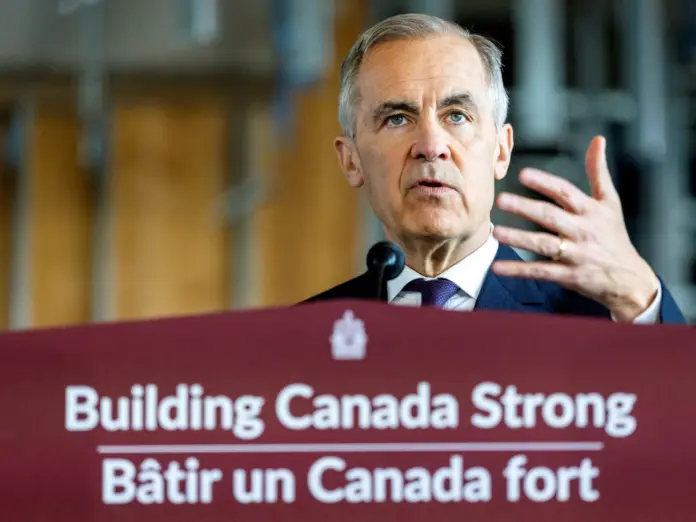
Canada Saab Globaleye — Canada has chosen Sweden’s Saab GlobalEye aircraft to form the backbone of its Arctic early warning capability, bypassing American manufacturer Boeing in a decision that carries unmistakable geopolitical weight. Prime Minister Mark Carney made the announcement Wednesday at a defence conference in Ottawa, confirming plans to acquire six of the surveillance planes as part of a sweeping expansion of Canada’s military posture.
The GlobalEye, built on Bombardier’s Global 6500 business jet platform, beat out Boeing’s E-7 Wedgetail, a competing aircraft that had been plagued by delays and cost overruns. Swedish Prime Minister Ulf Kristersson confirmed that the GlobalEye programme is already generating employment in Canada, and Saab pledged to invest further in Canadian research and development as part of any finalised deal.
The strategic rationale is stark. Canada’s Arctic territory spans more than 4.4 million square kilometres — an expanse larger than India — and for decades Ottawa relied on a partnership with Washington to monitor it. That arrangement has grown increasingly uncomfortable. In March, Carney pledged that Canada would assume full responsibility for defending its own Arctic, a declaration that coincided with his government announcing plans to ramp up defence spending. Canada met NATO’s 2 percent of GDP defence spending target last year, Carney confirmed at the time.
Recommended Reading
Sweden, a recent NATO member, has been actively cultivating closer ties with the Canadian military, and the GlobalEye selection represents a significant dividend of that effort. Saab is also competing to supply Canada with its Gripen fighter jets, potentially expanding the bilateral defence relationship further.
The Boeing snub arrives against a backdrop of sharply deteriorating relations between Ottawa and Washington. President Donald Trump imposed tariffs on Canadian imports after taking office, triggering a reassessment of defence procurement priorities. Last year, following the tariff announcement, Carney directed the military to examine whether Canada could reduce its order of 88 F-35 jets from Lockheed-Martin. A Pentagon official responded by accusing Ottawa of prioritising politics over genuine defence considerations — a charge Canada’s government has not publicly accepted.
Trump has also made repeated remarks suggesting the United States should annex Canada and absorb it as the 51st state, comments that have inflamed public sentiment in Ottawa and accelerated the search for non-American defence suppliers. Washington subsequently suspended planned biannual defence talks with Canada, leaving the bilateral security relationship in an unusual state of suspension.
The trade dimension compounds the tension. The USMCA — the trilateral trade agreement linking the United States, Canada, and Mexico — is due for formal review beginning July 1. Trump has publicly stated that Washington does not consider the agreement essential. Compounding Canadian concerns, the United States announced a structured bilateral negotiating process with Mexico while making no equivalent overture to Ottawa. Deputy US Trade Representative Jeffrey Goettman will lead talks in Mexico City on Thursday and Friday, with a second round scheduled in Washington on June 16-17 and a third set of negotiations in Mexico City the week of July 20.
Canada Saab Globaleye: The Arctic Strategic Context
By contrast, formal US-Canada trade negotiations have not been launched. Exchanges between US Trade Representative Jamieson Greer and Canadian Trade Minister Dominic LeBlanc have been sparse since early March, with no structured process in place. The asymmetry is not lost on Canadian officials, who are acutely aware that nearly 80 percent of Canada’s exports have historically flowed to the United States.
The GlobalEye announcement is therefore as much a diplomatic signal as a procurement decision. By turning to a European NATO ally for a capability once assumed to be an American domain, Canada is demonstrating that it is prepared to diversify its defence and strategic partnerships — and that the leverage Washington once held over Ottawa’s military choices is no longer absolute.
Whether the F-35 order will ultimately be reduced remains unresolved. The question hangs over the broader relationship, a symbol of how thoroughly the once-close alliance between the two neighbours has been strained by tariffs, annexation rhetoric, and the suspension of institutional dialogue that had defined North American defence cooperation for generations.