China Blocks Us Sanctions — China has moved to directly counter American economic pressure on its energy sector, issuing a formal legal order that prohibits five domestic oil refineries from recognising or complying with US Treasury Department sanctions targeting their purchases of Iranian crude.
The Ministry of Commerce published the prohibition order on Saturday, declaring that the sanctions — announced by Washington late last month — violate international law and the basic norms governing relations between sovereign states. The ministry further argued the measures unlawfully restrict commercial activity between Chinese enterprises and third-party nations.
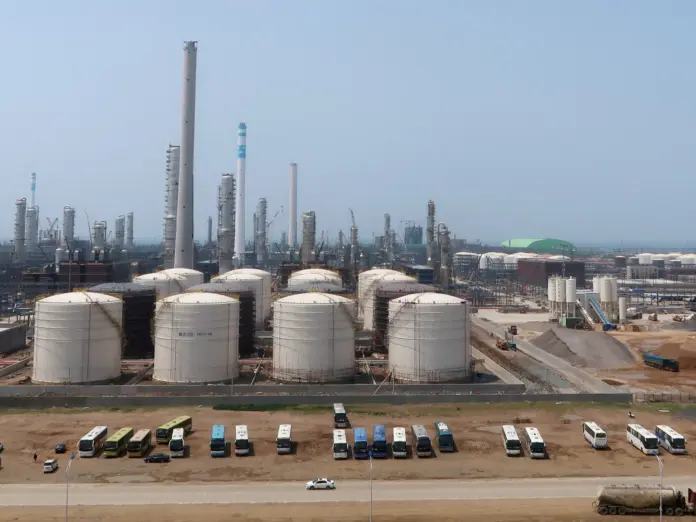
The five refineries named in the dispute are Hengli Petrochemical (Dalian) Refinery, Shandong Jincheng Petrochemical Group, Hebei Xinhai Chemical Group, Shouguang Luqing Petrochemical, and Shandong Shengxing Chemical. The Trump administration had already imposed sanctions on four of the five facilities in a prior round of measures last year, making Saturday’s Chinese response a direct escalation of an ongoing confrontation.
Recommended Reading
The US sanctions bar the named companies from accessing the American financial system and seek to penalise any third-party entity that continues doing business with them — a so-called secondary sanctions mechanism designed to extend Washington’s economic reach beyond its own borders. Beijing has consistently rejected such instruments as illegitimate when they lack authorisation from the United Nations Security Council.
At the heart of the dispute is China’s outsized role in absorbing Iranian crude that would otherwise struggle to find buyers. Data from commodity analytics firm Kpler shows that China purchased more than 80 percent of all oil Iran exported in 2025, providing Tehran with a vital economic lifeline despite years of Western pressure. China itself sources more than half of its total oil imports from the Middle East, making the region’s supply chains a matter of strategic national interest.
The refineries at the centre of the row belong to a category known colloquially as ‘teapot’ refineries — independent, privately operated facilities that are generally smaller than the plants run by state-owned giants. These operators have carved out a niche by purchasing heavily discounted crude from countries operating under international sanctions, including Iran, Russia, and Venezuela. Collectively, teapot refineries account for roughly a quarter of China’s total refining capacity.
The business model, however, is under strain. Teapot operators typically work on narrow margins that can turn negative during periods of weak demand, and the sector has faced additional headwinds from sluggish domestic fuel consumption in recent months. US sanctions have compounded these pressures by creating complications for the refiners when attempting to sell processed products under accurate country-of-origin labelling.
Beijing’s prohibition order represents one of the more assertive uses of China’s anti-sanctions legal toolkit, which the government has developed over several years in response to what it characterises as the weaponisation of the US dollar and American financial infrastructure. The ministry’s statement made clear that Chinese firms are not only permitted to ignore the Treasury Department’s designations but are legally required to do so under domestic law.
China Blocks Us Sanctions: The Energy Security Dimension
The confrontation arrives at a moment of broader tension in US-China relations, with trade, technology, and energy policy all serving as active fault lines. Washington’s campaign to cut off Iranian oil revenues — a central pillar of its maximum-pressure strategy toward Tehran — has repeatedly collided with Beijing’s refusal to subordinate its energy security interests to American foreign policy objectives.
For Iran, the Chinese counter-move offers meaningful relief. The Islamic Republic has relied on the teapot refinery network as a primary outlet for its crude exports, and any disruption to that channel would significantly tighten the financial squeeze that US and Western sanctions are designed to impose. With Beijing now formally shielding those buyers from American penalties, the effectiveness of Washington’s enforcement mechanism faces a direct legal and diplomatic challenge.
The standoff is unlikely to be resolved quickly. China has shown no indication it intends to curtail Iranian oil purchases, and the US has shown equal resolve in expanding the list of entities it holds accountable for facilitating those transactions. The five refineries now find themselves at the intersection of two competing legal orders — one issued from Washington, the other from Beijing — with global energy markets watching closely.