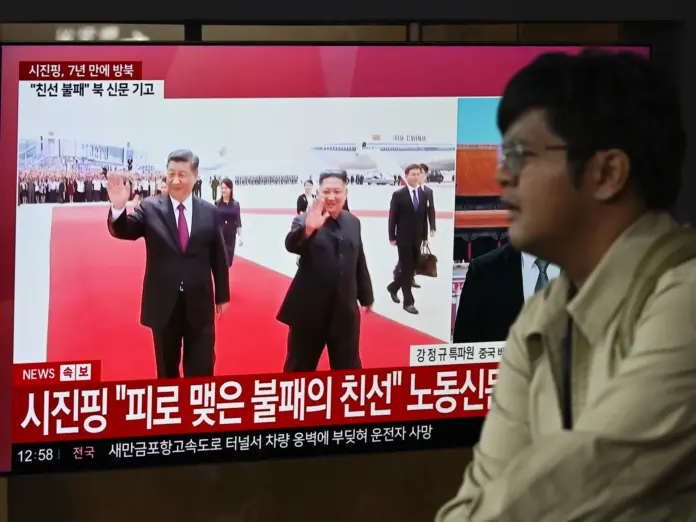
PYONGYANG — Chinese President Xi Jinping touched down in the North Korean capital on Monday for a two-day state visit, the first time he has set foot in Pyongyang in seven years, as Beijing moves to reassert its influence over an ally that has grown increasingly close to Russia.
Xi Jinping Pyongyang Visit — Xi and his wife, Peng Liyuan, were received at the international airport by North Korean leader Kim Jong Un and his wife, Ri Sol Ju, in a ceremony that included a 21-gun salute and military bands performing both nations’ national anthems. The pageantry extended across the city: buildings were draped in Chinese and North Korean flags, and crowds dressed in festive clothing — including children waving flags, clutching flowers and releasing balloons — filled Pyongyang’s main square to greet the visiting delegation.
The visit marks Xi’s first overseas trip of 2025 and carries significant diplomatic weight. In an editorial published ahead of his departure, Xi described the bilateral relationship as standing at a "new historical starting point, facing new development opportunities," and characterised the strengthening of ties with Pyongyang as an "unwavering policy" of the Chinese Communist Party.
Recommended Reading
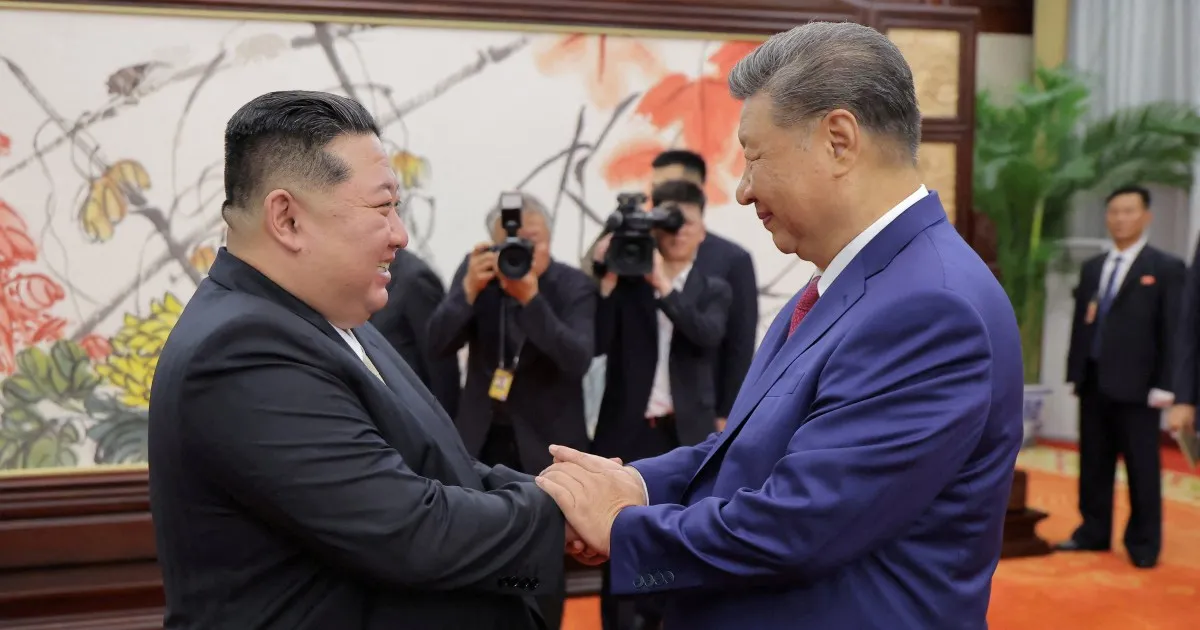
A formal summit between Xi and Kim is expected during the two-day stay. The two leaders last met in Beijing in September 2024, when Kim attended a Chinese military parade marking 80 years since Japan’s unconditional surrender in World War II.
Countering Russia’s Growing Pull
The timing of Xi’s visit is widely seen as a calculated response to the shifting dynamics on the Korean Peninsula. Since Russia’s full-scale invasion of Ukraine in 2022, North Korea has supplied Moscow with critical weapons, artillery shells and military manpower — a partnership that has drawn Pyongyang into an increasingly tight orbit around the Kremlin. Russian President Vladimir Putin visited Pyongyang in 2024, his first trip there in 24 years, and the two countries formalised their relationship with a mutual defence pact.
Analysts argue Beijing is now seeking to rebalance that equation. China remains by far North Korea’s dominant economic partner, accounting for as much as 95 percent of the country’s total trade, with bilateral commerce valued at approximately $2.74 billion. Despite that leverage, the deepening Russia-North Korea axis has raised concerns in Beijing that Pyongyang may be drifting beyond its traditional sphere of influence.
To draw Kim back into closer alignment, Xi is expected to table a range of economic incentives. These could include shipments of rice and fertilisers, a resumption of Chinese group tourism to North Korea — suspended during the COVID-19 pandemic — and the launch of new joint economic projects. China established both a shipping route and a high-speed rail link with North Korea in 2015, infrastructure that could underpin expanded commercial engagement.
Strategic Competition with Washington
Beyond the bilateral relationship, experts say Xi’s Pyongyang visit is also a message directed at Washington. With more than 28,500 American troops stationed in South Korea under the Mutual Defense Treaty, the Korean Peninsula sits at the heart of the broader strategic contest between the United States and China in Northeast Asia. By demonstrating active diplomatic leadership in the region, Beijing aims to signal that it — not Washington — holds the decisive cards in managing the peninsula’s future.
Xi Jinping Pyongyang Visit: Peninsula Security in Context
North Korea’s economy, while still dwarfed by South Korea’s approximately $1.88 trillion GDP, recorded modest growth in 2024, reaching $26.6 billion — a 3.7 percent increase from the previous year. Whether expanded Chinese economic support could accelerate that trajectory remains a key question heading into the summit.
A Relationship Forged in War
The foundation of Sino-North Korean ties stretches back to the Korean War, during which between 200,000 and 400,000 Chinese soldiers lost their lives fighting alongside Pyongyang. The two countries signed the Treaty of Friendship, Cooperation and Mutual Assistance in 1961, a pact renewed for a further 20 years in 2021. North and South Korea remain technically in a state of war, with only an armistice — signed in 1953 — halting active hostilities.
North Korea conducted its first nuclear test in 2006, triggering United Nations sanctions three years later. Diplomatic efforts to roll back Pyongyang’s nuclear programme have repeatedly stalled; talks between Kim and former US President Donald Trump in Singapore produced no lasting agreement, and the programme has continued to advance.
Xi’s previous visit to Pyongyang, in June 2019, came at a moment of intense diplomatic activity on the peninsula. The current visit arrives in a markedly different environment — one defined by war in Europe, a resurgent Russia-North Korea axis, and a sharpening contest for regional primacy between the world’s two largest economies.